



By Akani Nkuna
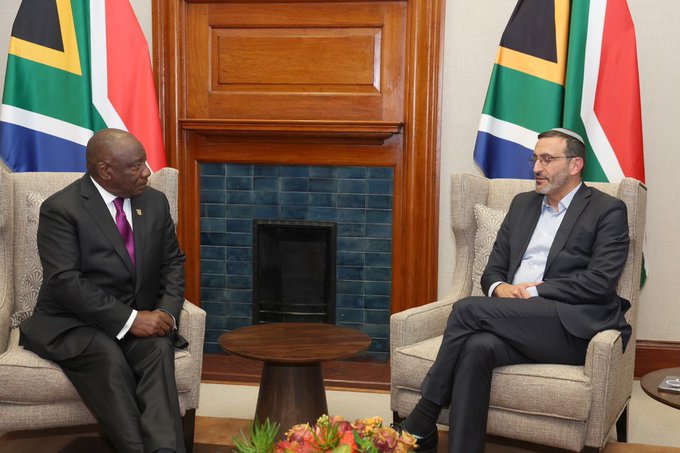
President Cyril Ramaphosa met the family of South African-born Israeli soldier Captain Daniel Perez on Monday following what the Presidency said was government’s intervention to help secure the return of his remains from Gaza.
Perez, who was born and raised in South Africa, was killed during the Hamas-led attack on southern Israel on 7 October 2023. His body was taken into Gaza and remained there until it was returned to Israel in October 2025.
The Presidency said Ramaphosa expressed his condolences to the Perez family during the meeting and reaffirmed South Africa’s support for an “all inclusive peace process” aimed at securing lasting peace for Israelis and Palestinians.
Presidential spokesperson Vincent Magwenya told Inside Politics that government’s responsibility to assist people caught in conflicts extended beyond the Perez case.
“The commitment as stated in our statement is to assist all South Africans and other foreign nationals should such assistance be required when individuals are caught up in conflict situations,” he said.
The Presidency said government remained engaged in helping South Africans “irrespective of race or religion” who become caught in conflicts abroad, as well as foreign nationals where South Africa’s assistance is requested.
It cited efforts involving South Africans trapped in the conflict in Syria, citizens caught up in mercenary activity linked to the Russia-Ukraine war and the return of Ukrainian children among cases in which government had sought to intervene.
Perez was 22 when he was killed while serving as a tank platoon commander near the Nahal Oz military base on the Gaza border.
His death came during the Hamas-led assault on southern Israel on 7 October 2023, when militants crossed the Gaza border and attacked Israeli communities, a music festival and military positions while rockets were fired into Israel.
About 1,200 people were killed in Israel during the attack, most of them civilians, while 251 people, including civilians and soldiers, were taken into Gaza as hostages.
Of the 251 people taken hostage that day, 85 were ultimately confirmed dead. That number includes people who were killed during the 7 October assault and whose bodies were taken into Gaza, as well as hostages who died or were killed after being taken captive.
The remaining hostages who survived were eventually released or rescued. The IDF announced on 26 January 2026 that all living and deceased hostages had been returned from Gaza after the remains of the final hostage, Israeli police officer Ran Gvili, were recovered.
Israeli authorities initially listed Perez among those taken hostage because his fate was unclear. The Israeli military later determined that he had been killed during the fighting on 7 October and that his body had been taken into Gaza.
Israel responded to the October 7 attacks with a large-scale military campaign in Gaza, saying its objectives included dismantling Hamas’s military capabilities and securing the release of the hostages.
The campaign has drawn extensive international criticism over civilian deaths and widespread destruction in Gaza, including damage to hospitals, schools and residential areas.
Israel has maintained that its forces target Hamas and other armed groups rather than civilians, and has repeatedly accused Hamas of operating from civilian areas and infrastructure and of using civilians as human shields.
South Africa instituted proceedings against Israel at the International Court of Justice in December 2023, accusing it of violating its obligations under the Genocide Convention through its military campaign in Gaza.
Israel has rejected the genocide allegation, maintaining that its military operations are directed against Hamas and that it has a right to defend itself following the October 7 attacks.
The case remains before the ICJ.
Spain, Brazil and a number of other states have filed declarations of intervention in the proceedings rather than becoming co-applicants in South Africa’s case.
In May 2026, the ICJ directed that a further round of written arguments be submitted, consisting of a reply from South Africa and a rejoinder from Israel.
INSIDE POLITICS






