



Staff Reporter
Gift of the Givers has put a search-and-rescue team on standby for possible deployment to Nepal after four South Africans were reported missing in catastrophic floods that have killed more than 160 people and left thousands of others unaccounted for.
The humanitarian organisation was contacted by the daughter of one of two South African couples reported missing after Wednesday’s disaster, Gift of the Givers founder Dr Imtiaz Sooliman said in a statement issued on Wednesday night.
“The daughter is known to us. We spoke to the tour operator that hosted the couple, he confirmed that a second South African couple and several international tourists are missing and that thousands of homes, shopping malls and businesses have been washed away,” Sooliman said.
The Nepal Tourism Board had earlier confirmed that four South Africans were among foreign tourists unaccounted for following the floods. Other South Africans known to Gift of the Givers to be in the region were safe, Sooliman said.
The scale of the disaster increased dramatically overnight.
By Thursday morning, Reuters reported that nearly 1,500 people were missing across Nepal and China’s Tibet region, including hundreds of foreigners, after a mass of mud, rock and water swept through Himalayan valleys and settlements along the border.
More than 160 deaths had been reported, with Nepalese police warning that the toll was expected to rise as rescue teams reached devastated areas.
Almost 600 foreigners were among 826 people reported missing in Nepal, while Chinese authorities said another 558 people, including 260 foreign nationals, were missing in Tibet’s Gyirong county.
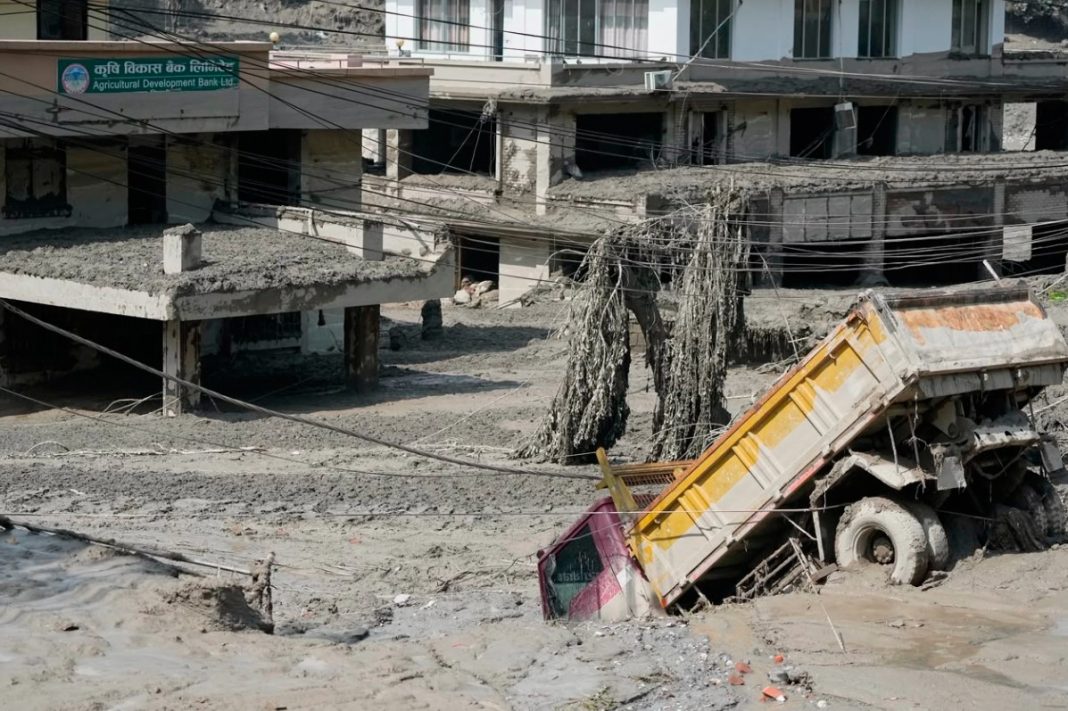
The flooding struck the Bhotekoshi river system in northern Nepal and caused widespread destruction in Rasuwa and neighbouring districts. Homes, roads, bridges and hydropower infrastructure were swept away, cutting off communities and severely restricting access to the disaster zone.
Nepal’s Department of Roads said the flooding destroyed multiple sections of the 42km road between Betrawati in Nuwakot and the Rasuwagadhi border crossing, with several concrete bridges also washed away.
Sooliman said the destruction meant helicopters were initially the only means of reaching some of the worst-affected areas.
“Helicopter surveillance is the only means of access as all roads have been totally destroyed, but landing is not currently possible as there is no solid ground given the height of the water level,” he said.
By Thursday, helicopters were being used to search for survivors and deliver tents, food and other emergency supplies to communities cut off by the disaster. More than 5,000 Nepalese army and police personnel had been mobilised for search-and-rescue operations.
Preliminary investigations indicate that the disaster was triggered when a large mass of glacial ice and rock collapsed and sent debris into the Lhende River near the Nepal-China border.
The United States Geological Survey said seismic activity initially recorded as a magnitude 4.4 earthquake was instead energy generated by the collapse of glacial rock and ice and the subsequent debris flow.
Nepalese disaster officials said satellite imagery indicated that the resulting flood travelled through the Lhende River about 20km northeast of the Rasuwagadhi border crossing.
Gift of the Givers head of search and rescue Ahmed Bham has been in contact with Nepalese disaster management authorities, with whom the organisation established a relationship during its response to Nepal’s devastating 2015 earthquake.
Sooliman said Nepalese authorities had advised the organisation on Wednesday night to keep its team on standby because Nepal had not at that stage issued a call for international search-and-rescue assistance.
“They suggest that teams should remain on standby and not travel as the government has not made a call for international assistance as yet but that may just be forthcoming once the true scale of the disaster is manifest in daylight hours,” he said.
Sooliman also warned of the possibility of a secondary disaster if a dam collapsed upstream.
On Thursday, Chinese authorities reported that a dammed lake had formed upstream from the flood-hit border area. China’s Ministry of Water Resources was monitoring the lake and assessing the risk that it could cause a further disaster and complicate rescue operations.
Gift of the Givers has 11 urban search-and-rescue and water-rescue personnel ready for deployment, along with four South African Police Service dog handlers and four search dogs, whose deployment was authorised by Deputy National Police Commissioner Lieutenant-General Tebello Mosikili.
The organisation has also been in contact with the Nepalese Embassy in South Africa, which Sooliman said was ready to process visas immediately if the team was deployed.
“The disaster site is 125km from the capital Kathmandu, all operations will be managed from here by the military,” he said.
International assistance was beginning to mobilise by Thursday.
India had sent 10 tonnes of emergency supplies, including temporary shelters, blankets, medicines and hygiene kits, while the International Federation of Red Cross and Red Crescent Societies released one million Swiss francs in emergency funding.
The United States announced $500,000 in assistance and said it was sending a disaster response adviser, while the World Health Organisation dispatched emergency medical supplies.
“DIRCO will be contacted for diplomatic support if the teams are deployed. Both DIRCO and the Nepalese Embassy will be visited in the morning,” Sooliman said.
INSIDE POLITICS






