

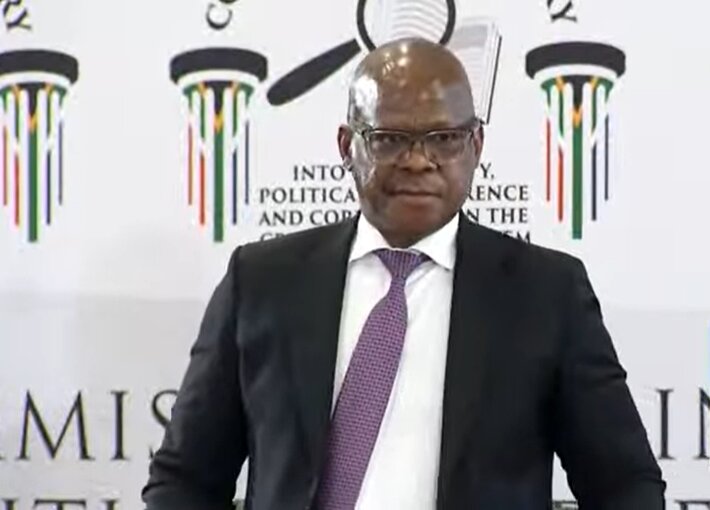


By Johnathan Paoli
Taxi boss Johannes “Joe Ferrari” Sibanyoni has rejected allegations that he discussed hiring hitmen while invoking his constitutional right against self-incrimination over the criminal case in which he faces allegations of extortion and money laundering.
Resuming his testimony before the Madlanga Commission of Inquiry on Friday afternoon, Sibanyoni said that questions concerning the alleged R2-million extortion scheme could prejudice his defence in the Delmas Magistrates’ Court, repeatedly asking for immunity before answering questions linked to the case.
The charges relate to an alleged scheme involving businessman Thomas Ntuli and the Moloto Road (R573) aggregate supply project.
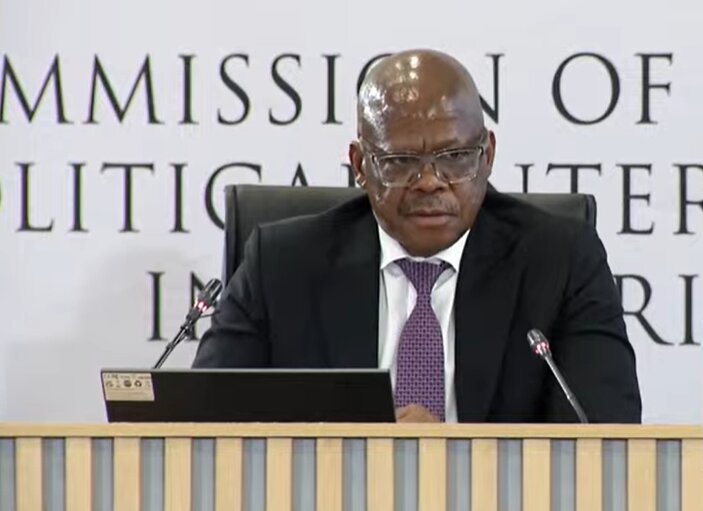
Sibanyoni said he could not answer questions about his dealings with Ntuli, Edwin Construction and Tengane Mining without potentially providing evidence that could be used against him in the criminal proceedings.
But he was unequivocal when it came to allegations that he had discussed the hiring of izinkabi (hitmen) with Bafana Sindane or anyone else.
“I have never, at any time, discussed with Mr Sindane, or with any other person, the commissioning, employment, assessment or support of any individual for the purpose of carrying out any murder, attempted murder, act of violence, or any other unlawful act against any person,” Sibanyoni said.
He said the allegation was difficult to reconcile with his own history as a target of assassination attempts and his status as a state witness against controversial businessman Vusimusi “Cat” Matlala.
“The suggestion that a person who survived assassination attempts and who is yet to be a State witness against the perpetrators was simultaneously engaging in discourse about the hiring of hitmen is not merely incorrect; it is inherently implausible,” he said.
Mkhwanazi: ‘He listened attentively and completely’
Sibanyoni also gave his account of his 2024 meeting with KwaZulu-Natal police commissioner Lieutenant-General Nhlanhla Mkhwanazi.
The meeting, he said, took place after the death of taxi boss Jotham “Mswazi” Msibi, amid renewed violence and a leadership vacuum in the taxi industry.
Sibanyoni said Mkhwanazi approached him because of his knowledge of the industry and that they discussed roughly five or six taxi violence cases where investigations had been completed but there had been frustratingly little progress at the National Prosecuting Authority.
He described Mkhwanazi’s conduct at the meeting in glowing terms.
“He listened attentively and completely. He asked questions. He took extensive and careful notes of every concern I raised. He treated every matter I brought to him as deserving of serious professional attention,” Sibanyoni said.
He claimed the engagement was followed by movement in the prosecution of some of the cases and a reduction in the intensity of taxi killings.
For Sibanyoni, the meeting also exposed what he described as a striking contradiction in his current position before the commission.
“It is a matter of deep personal significance that the very General Mkhwanazi whose public allegations on 6 July 2025 led directly to the establishment of this Commission was a person who, only one year prior, had personally reached out to me to seek my assistance in addressing taxi violence,” he said.
Sibanyoni and the ‘Presidential Cartel’
Sibanyoni rejected suggestions that his association with the so-called Presidential Cartel amounted to involvement in a criminal organisation.
He described the group as a social club made up of young businessmen from Secunda and eMalahleni in Mpumalanga and denied having business dealings with it as a collective.
“I have no business dealings with this group as a collective entity. I have no contractual relationship with any entity known as the ‘Presidential Cartel’,” he said.
He acknowledged knowing some of its members personally and said some viewed him as a mentor.
He also admitted providing guidance and, in some cases, financial assistance to young businessmen.
Some members, he said, referred to him as “Godfather”, a term he characterised as an expression of respect rather than evidence of criminal authority.
Sibanyoni acknowledged having a relationship with the cartel’s leader but claimed the group had since dwindled to only two members.
The cartel has featured in evidence before the commission in connection with an off-books investigation into Eskom commissioned by former CEO André de Ruyter, although evidence of wider alleged wrongdoing by the group has not emerged in Sibanyoni’s testimony.
Nkosi, security and the Gubis connection
Sibanyoni also sought to explain his relationship with Sergeant Fannie Nkosi, saying their interactions centred on his security and his attempts to broker peace in KwaZulu-Natal’s violent taxi industry.
He said he needed police assurances to attend meetings where his life was at risk and that Nkosi’s proximity to Mkhwanazi was relevant to arranging that protection.
But he rejected any suggestion that he paid Nkosi for police intelligence or used her as his proxy.
“I have never made any payment to any member of SAPS in consideration for any official favour, confidential information, suppression of any investigation or prosecution, procurement advantage, or any other improper purpose,” he said.
Sibanyoni confirmed that he was a client of Gubis85 Solutions, a security company whose dealings with the City of Tshwane have come under scrutiny.
He denied owning or controlling the company and described its director, Calvin Mahlangu, as his “homeboy”.
He also confirmed that Gubis had given him a Toyota Hilux as a birthday gift, insisting the vehicle was a legitimate personal gift and not an improper benefit.
‘My dignity is not negotiable’
Sibanyoni’s evidence repeatedly returned to his contention that he had spent decades trying to combat violence in the taxi industry rather than facilitate it.
He said he had written to police ministers about taxi killings, survived two assassination attempts and was prepared to testify against the man accused of ordering one of them.
“I have spent more than 42 years building a legitimate life. I wrote to the minister of police. When those killers shot me, I survived. When the National Prosecuting Authority charged the man who tried to kill me, I stood ready to testify against him,” Sibanyoni said.
He ended his statement with an appeal to the commission to distinguish between the allegations against him and the evidence he had placed before it.
“My dignity is not negotiable. My cooperation is genuine. And the truth, I am confident, will vindicate me,” he said.
Sibanyoni is due to return to the commission on 21 September for further questioning.






