



By Johnathan Paoli
The South African Communist Party (SACP) says it is ready to contest the upcoming local government elections after submitting its candidate lists to the Electoral Commission of South Africa (IEC), while maintaining that its historic relationship with the Tripartite Alliance remains intact.

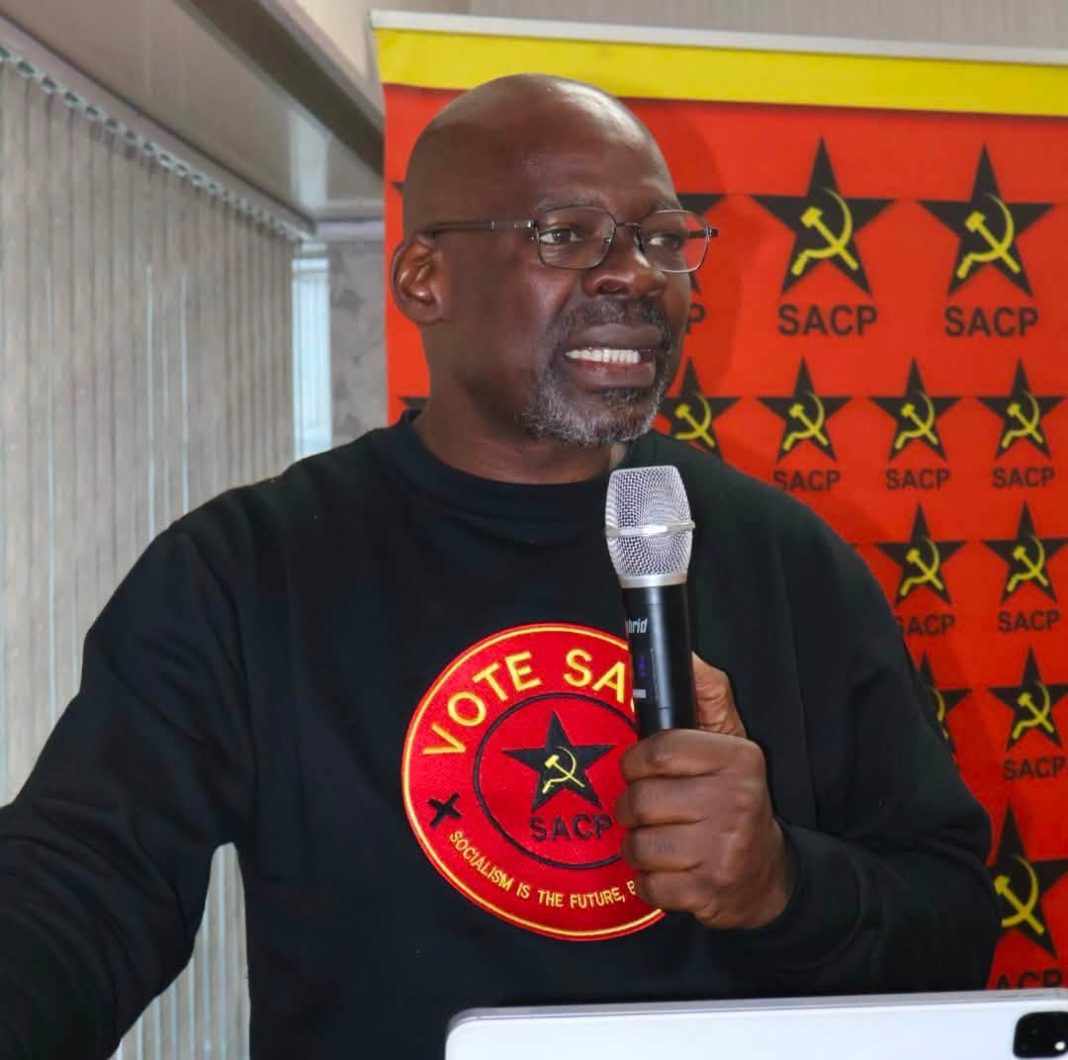
Addressing the media in Johannesburg on Sunday following the party’s Central Committee plenary, SACP general secretary Solly Mapaila said the party’s election campaign would be used not merely to win votes, but to mobilise workers and poor communities around corruption, crime, unemployment and the rebuilding of state capacity.
ALSO READ: Maj-Gen Khan reportedly re-admitted to hospital as Popcru defends his salary in Labour Court
“Not only did we submit our candidate list ahead of and in compliance with the IEC deadline, but we are also decisively confirming for all in our country and the world that we are pressing ahead with exercising our long-reserved, hard-won democratic right to contest elections both directly and independently in our own name,” Mapaila said.
The SACP said it would field 4,418 ward candidates across the country while also contesting proportional representation seats.
Mapaila said the party’s candidate lists emerged from extensive engagement with communities and included people who were not necessarily SACP members, including community development activists, members of faith-based organisations and representatives of traditional communities.

“This confirms that we’re not going it alone, as others have suggested,” he said.
The decision marks a significant shift in the SACP’s electoral strategy after decades of contesting elections through the African National Congress-led alliance.
However, Mapaila strongly rejected suggestions that the Communist Party’s independent election campaign amounted to a withdrawal from the Tripartite Alliance.
“The SACP has not walked away from the alliance, but firmly remains part of it while pursuing its reconfiguration. Like all alliance partners, we are exercising our political, ideological, and organisational independence,” he said.
He said the party had spent more than two decades pushing for the reconfiguration of the alliance without achieving what it regarded as meaningful progress.
“Our independent electoral contest is not a withdrawal from the alliance, the NDR, or the struggle for socialism. It is an exercise of our democratic and organisational independence and forms part of the struggle to rebuild working-class political representation and secure the reconfiguration of the alliance,” he said.
Mapaila accused elements within the government and the broader political establishment of side-lining alliance partners while accepting policy preferences from parties outside the historic alliance, particularly the Democratic Alliance.
“The issue is therefore not personalities. It is the chosen class and political direction of those at the helm of the state at the moment,” he said.
He pointed to the recent Cabinet reshuffle as an example, claiming it highlighted contradictions in the government’s approach to consultation.
“The reshuffle was first announced by the DA as its decision but subsequently implemented by President Cyril Ramaphosa,” he said.
The SACP’s election campaign, Mapaila said, would focus heavily on fighting corruption and what the party described as the destructive influence of the tender system.
Among its manifesto priorities is the creation of “municipalities free from tender corruption and capture”, alongside reliable public services, decent work, land, housing, food security and accountable councillors.
“We will use our election contest to strengthen our campaign against the corrupt tender system, privatisation and unnecessary outsourcing of government functions, including in this case at the municipal level,” Mapaila said.
“The SACP is calling for an insourcing and capable, democratic and properly funded people’s municipalities with adequate resourcing and equipping of municipal workers, participatory planning, local production and public representatives accountable to communities,” he added.
The party argues that rebuilding state capacity is essential to improving service delivery and reducing dependence on private contractors.
Mapaila said the SACP’s broader economic programme was rooted in reversing de-industrialisation, which it blamed for worsening unemployment and poverty.
According to Statistics South Africa’s latest Quarterly Labour Force Survey figures cited by the party, the official unemployment rate rose to 33.6% in the second quarter of 2026, with 8.5 million people unemployed.
“Instead of industrialising, South Africa has been experiencing and continues to experience factory closures and mass retrenchments. De-industrialisation is the reason why unemployment has increased, and the retrenched workers pushed into deeper levels of poverty under South African capitalism,” he said.
The SACP called for an ambitious programme of industrialisation, expanded public ownership, major infrastructure investment and stronger support for manufacturing, mineral beneficiation and agro-processing.
Mapaila also launched a sharp attack on the government’s Operation Vulindlela reforms, describing them as a “capitalist class project” that was opening public infrastructure sectors to private accumulation.
“Our fundamental disagreement with the Vulindlela capitalist class project concerns ownership, control and class power. The neoliberal structural reforms contradict the Freedom Charter and represent another form of outsourcing and privatisation,” he said.
On crime, the SACP called for a fundamental reconstruction of the criminal justice system, saying the evidence emerging from the Madlanga Commission of Inquiry suggested deep criminal infiltration of state institutions.
He said the party will use the electoral campaign to organise workers and poor communities, fight corruption and crime, strengthen democratic participation and build organisational foundations of a broader left and socialist movement.






