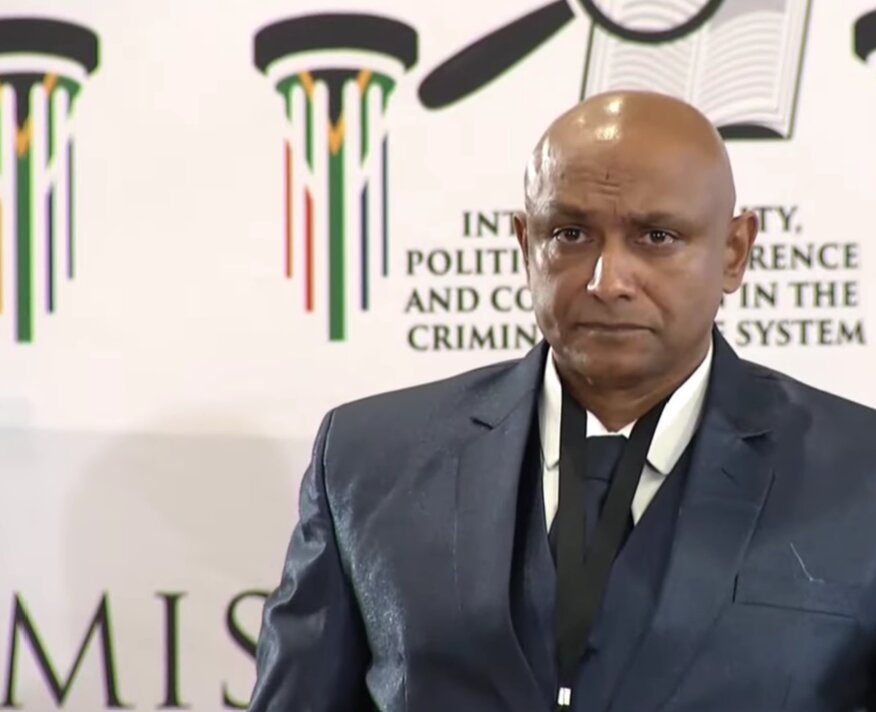


By Johnathan Paoli
KwaZulu-Natal Hawks tracing team head Lieutenant-Colonel Deenadayalan ‘Deena’ Govender has denied being paid by tow-truck operator Clive Naicker to arrange the murder of rival tow-truck operator Bevan Loftus, saying the allegation was fabricated.
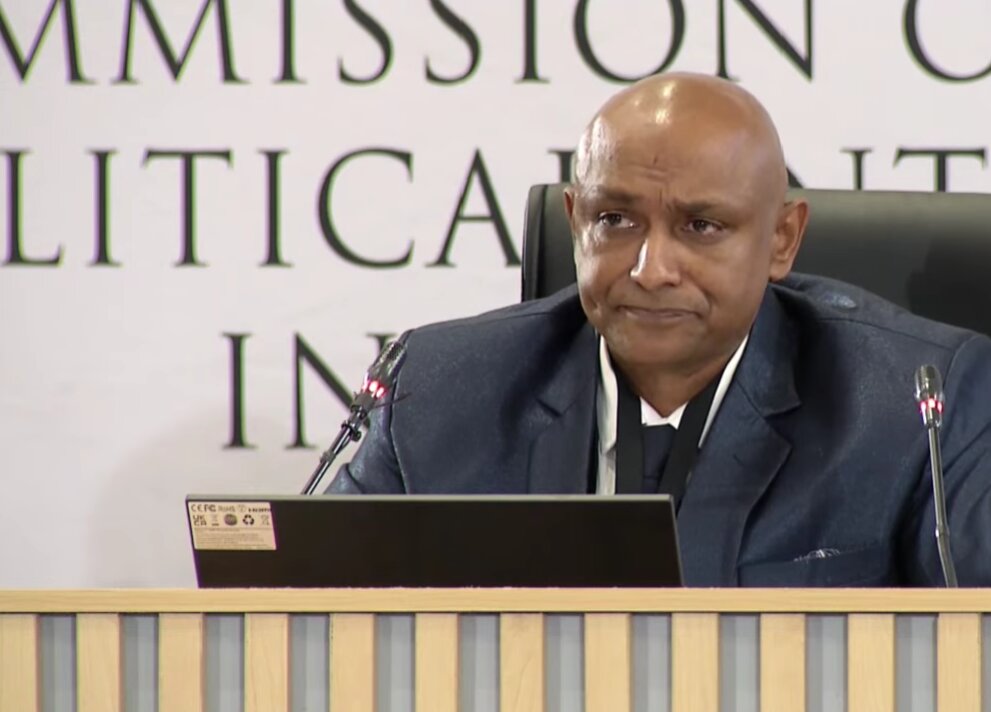
Govender dismissed the allegations – made by Bevan’s father, former police officer Gregory Loftus – at the Madlanga Commission on Monday.
“[F]irst of all, that is not true. By leaving out details, the father makes up a story, or the son makes up a story that I received money to kill his son, which is not true at all. I don’t work on my own. I work on the strict protocol; in terms of, there were Lieutenant Colonels, Colonels, there was a Brigadier in charge of me, the Provincial Head,” Govender said.
Loftus previously alleged that his son’s killing during a police operation at a Morningside flat in 2023 was an assassination carried out under the guise of a legitimate police operation, claiming that a R2.5 million “hit” had allegedly been offered for Bevan’s murder.
The commission has separately heard evidence relating to a financial trail of about R2.7 million involving Govender and his wife, which investigators linked to suspicions surrounding Bevan’s killing. The amount was distinct from the R2.5 million which Loftus alleged had been offered for the hit.
Govender said his encounters with Gregory Loftus occurred while police were searching for Bevan in connection with gang-related investigations and alleged shootings, insisting that he repeatedly tried to persuade the businessman’s father to bring his son in for questioning or arrest.
Govender said Loftus repeatedly promised to cooperate but allegedly allowed his son opportunities to evade police.
“So, all we [wanted was] to question him, or arrest him on the two matters in question. But his father refused to bring him,” Govender said.
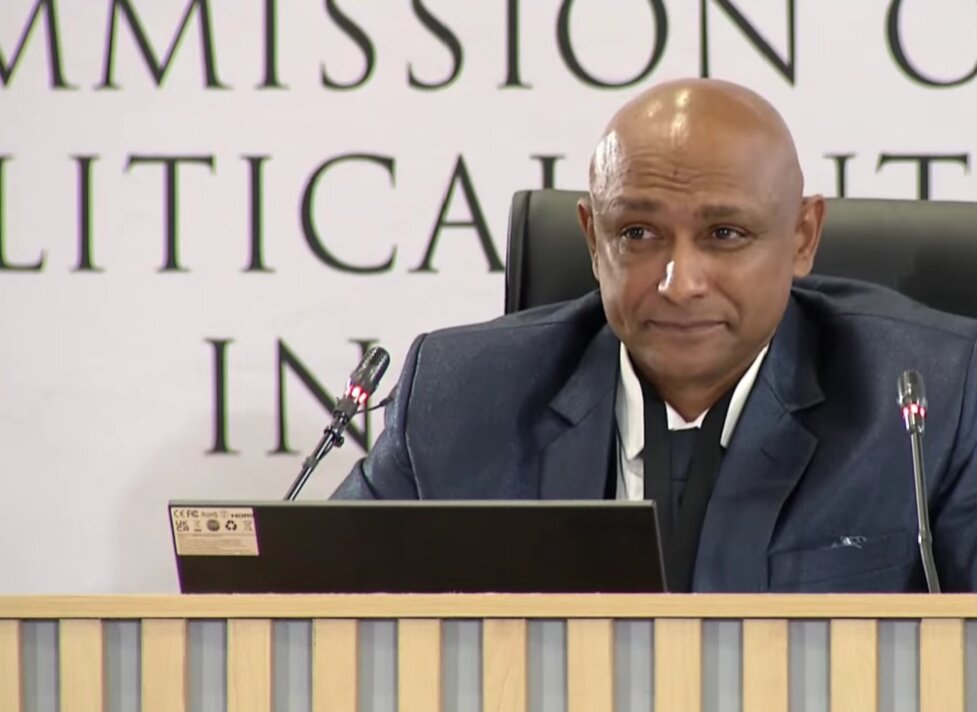
He rejected the suggestion that he had operated independently or had been running a “rogue police” unit targeting Bevan on behalf of Naicker.
Govender said that KwaZulu-Natal police commissioner Lieutenant-General Nhlanhla Mkhwanazi was a strict commander and would not have allowed officers under his command to operate outside the law.
“I don’t think so any commander would ever allow, or any Provincial Commissioner or Provincial Head, this person like myself to go, what he perceived to be a rogue unit, to go around intimidating or threatening people,” he said.
He also denied Gregory Loftus’s allegation that he had threatened to kill Bevan rather than arrest him, an allegation which Loftus said formed part of the reason he sought a court interdict against police.
“That’s absolutely not true, Commissioner. I would not go. Remember, whenever we went to the house, Commissioner, he wasn’t alone. There was a number of people. So definitely, that didn’t happen. He’s lying, Commissioner,” Govender said.
Commissioner Sesi Baloyi asked Govender why Loftus would seek an interdict if no threats had been made, but he said he could not explain the decision.
“We said that, please bring your son in. We at no stage threatened, I myself, I speak for myself, threatened his son or himself. It was a cordial conversation between myself and him. He’s lying. I don’t know why he did that, Commissioner,” he said.
Govender also denied that his relationship with Naicker was personal, describing it instead as strictly work-related and saying the businessman had assisted police investigations since the two first met around 2015 during conflict in the tow-truck industry.
He admitted visiting Naicker’s home and business premises on several occasions, sometimes alone and sometimes with other police officers, but insisted these meetings were connected to investigations.
Govender denied receiving money from Naicker, and similarly denied ever receiving gifts or any other form of gratification, including a birthday present, vehicle or watch.
He also rejected allegations that his task team collected dockets involving Bevan Loftus in order to harass him and benefit Naicker in an alleged business rivalry.
He said the exercise formed part of an integrated anti-gang task team involving the DPCI and police.
Earlier in his testimony, Govender claimed that Police Minister Senzo Mchunu, who is on leave of absence, instructed him to implicate Mkhwanazi in relation to police shootings in KwaZulu-Natal.
Govender has also testified that he was threatened with arrest in 172 cases if he did not cooperate with alleged attempts to implicate Mkhwanazi.
Govender said he attended a meeting on 20 August with a man he identified as Mavuso Ntandani, an alleged political fixer, during which he was handed a phone and spoke to a person he said he recognised as Mchunu.
“Maybe I’ll start with the conversation with the minister. So the minister speaks to me and asks me if I’m OK. I said yes. He then goes on to say that, do I like this country? I said yes, I like the country. He also goes ahead to say that it’s a beautiful country. We must not let anyone spoil this country,” he said.
“He goes on to say that I must not worry about anything. I will be protected. And he goes on to talk about the shootings. I said yes. He says that I must implicate General Mkhwanazi for the shootings. And that’s the gist of that conversation that the minister is speaking to me [about],” he added.
Mchunu has denied Govender’s allegations.
Govender said he had recorded meetings connected to the alleged attempts to persuade him to implicate Mkhwanazi and that the recordings had been provided to the commission.
According to Govender, the alleged plan was to claim that Mkhwanazi had personally instructed him in relation to shootings carried out during police operations.
Govender said Mkhwanazi supported his team with resources and regularly attended crime scenes, but denied that the provincial commissioner directed his operational reporting structure.
He said he believed he was being pressured to falsely implicate Mkhwanazi because he was being threatened with imprisonment and told he should not “go down alone”.
The commission continues.