



Lebone Rodah Mosima
South Africa’s defence exports reached a record R10.1 billion in 2025, with munitions accounting for R4.8 billion, close to half of the total, Trade, Industry and Competition Minister Parks Tau said on Thursday.
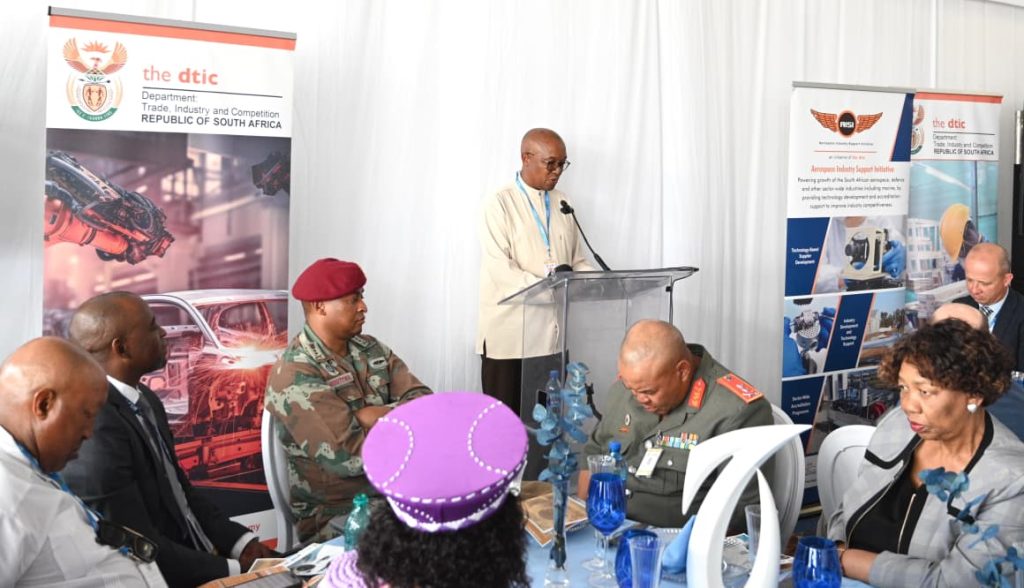
Tau was speaking at the AAD 2026 Exhibition in Pretoria, where the Aerospace Industry Support Initiative (AISI) is marking 20 years of supporting South Africa’s aerospace, defence, marine and advanced manufacturing industries.
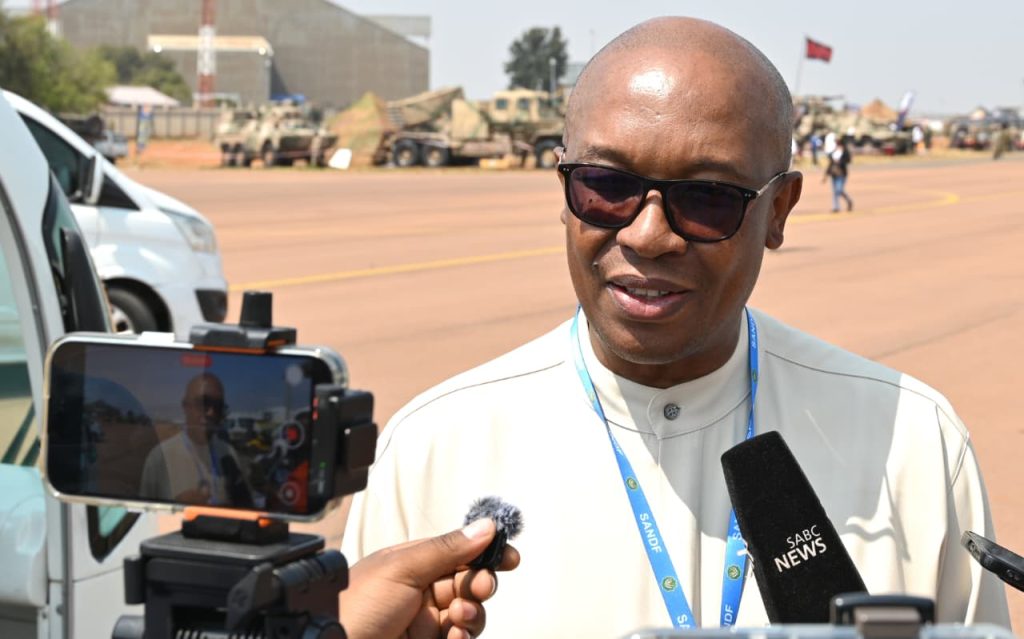
The exhibition at Waterkloof brings together more than 300 exhibitors and more than 50 official delegations, including global aerospace and defence companies such as Airbus, Embraer, Leonardo and Saab.
Tau said Rheinmetall Denel Munition (RDM) had committed to a further multi-billion-rand investment over the next three years to expand its South African operations.
“Earlier this year, RDM committed a further multi-billion-rand investment over the next three years, on top of the roughly R1 billion it already spends annually upgrading its four South African plants, in order to double capacity in response to global demand,” he said.
“That is what happens when local capability meets global market access, and it is precisely the outcome our Industrial Development Strategy is designed to multiply across our three key pathways of decarbonisation, diversification and digitalisation.”
Tau said South Africa had made a deliberate choice 20 years ago to develop its own aerospace and defence capabilities rather than remain dependent on imported technology.
“Twenty years ago, South Africa made a deliberate choice, not to remain consumers of imported defence and aerospace technology, but to build the capability to research, design, develop and manufacture it ourselves,” he said.
“Standing here today, among the entrepreneurs, engineers and innovators of this exhibition, I can tell you that choice is paying off.”
He said the AISI was created following recommendations from the Aerospace Strategy for a Sustainable, Economical and Growing Aerospace Industry (ASSEGAI).
The programme began with an annual budget of about R300,000 and now operates at close to R50 million a year, with additional co-investment from companies it supports.
Over the past decade, AISI has supported 142 small and medium enterprises, helped create and sustain more than 1,236 jobs, supported the development of 148 technologies and products, and assisted companies in securing 49 international certifications and standards.
These interventions have generated about R381 million in local industrial output and more than R332 million in direct exports, Tau said.
“Together, these interventions have generated approximately R381 million in local industrial output and more than R332 million in direct exports,” he said.
Tau cited several companies as examples of the programme’s impact.
Jonker Sailplanes, supported by AISI and the CSIR through flutter analysis and ground vibration testing for European certification, is exporting its JS5 sailplane to Europe. Its export revenue has exceeded R30 million and it is commissioning new production facilities this year, he said.
LambdaG has developed a space-qualified Global Navigation Satellite Systems antenna for low-Earth-orbit satellites, while Kutleng Dynamic Electronic Systems has developed a flight-certifiable avionics platform being integrated into a South African Air Force programme.
AutonoSky has developed and manufactured the A22 Manqoba unmanned aerial vehicle for military applications, Tau said.
He also pointed to South Africa’s “New Space” cluster, comprising Simera Sense, NewSpace Systems and Dragonfly Aerospace, which has placed locally built satellite technology into orbit.
Tau said the ability to design, build, maintain and export South African platforms was a matter of national sovereignty.
He said the global economic, technological and trade order was undergoing a fundamental shift, with artificial intelligence and cybersecurity transforming the aerospace and defence sectors.
“Nations are reconfiguring supply chains around critical minerals and strategic technologies, and reshoring the industrial capabilities they consider sovereign,” he said.
“Artificial intelligence and cybersecurity are transforming the aerospace and defence sectors.”
Tau said countries that failed to innovate risked becoming dependent on those that did.
He said Armscor’s acquisition and localisation requirements remained an important mechanism for developing local industrial capacity.
“Every defence contract that specifies local content and local skills development builds industrial capability in a way that no grant or subsidy can replicate on its own,” he said.
Tau said technologies including artificial intelligence, autonomous systems, advanced materials, additive manufacturing, space technologies, digital engineering and unmanned aerial vehicle technology would shape the sector’s next phase.
He said AISI needed to continue helping emerging companies overcome barriers to entry in high-technology industries.
“AISI requires the firms it funds to hold at least Level 4 B-BBEE status, and it is deliberately building a pipeline of black industrialists, innovators and technology entrepreneurs able to compete in local and global markets,” he said.
“Capital intensity, certification requirements and decades of concentrated ownership have kept these industries largely closed to black entrepreneurs and emerging enterprises.”
“If we do not deliberately open that door, the next 20 years will simply repeat the exclusions of the last.”
ALSO READ: Gallery: Four killed on KZN roads as heavy rain floods settlements and swells rivers
Tau said a sovereign industrial capability also needed broad ownership to be sustainable.
He said the government’s new Industrial Development Strategy had identified defence and aerospace as critical sectors and that it was looking at financing mechanisms to support their development.
“Twenty years ago, AISI was created to answer one question: how do we build a sustainable, globally competitive aerospace industry in South Africa?” he said.
“Today, the answer stands all around us, in the aircraft, satellites and defence systems built by South African hands, and exported to the world.”
Asked about concrete commitments towards expanding aerospace manufacturing over the next five years, Tau said the government was developing mechanisms to support the sector, including through the Industrial Development Corporation (IDC).
“We’re investigating other mechanisms of supporting industrial development. So what we can say is that it is a collaboration between ourselves as the Department of Trade, Industrial Competition, with the Department of Defence and Military Veterans, and all the agencies that fall under it, but also many other role players in the defence industry that we’re supporting as a country,” he said.






