



By Johnathan Paoli
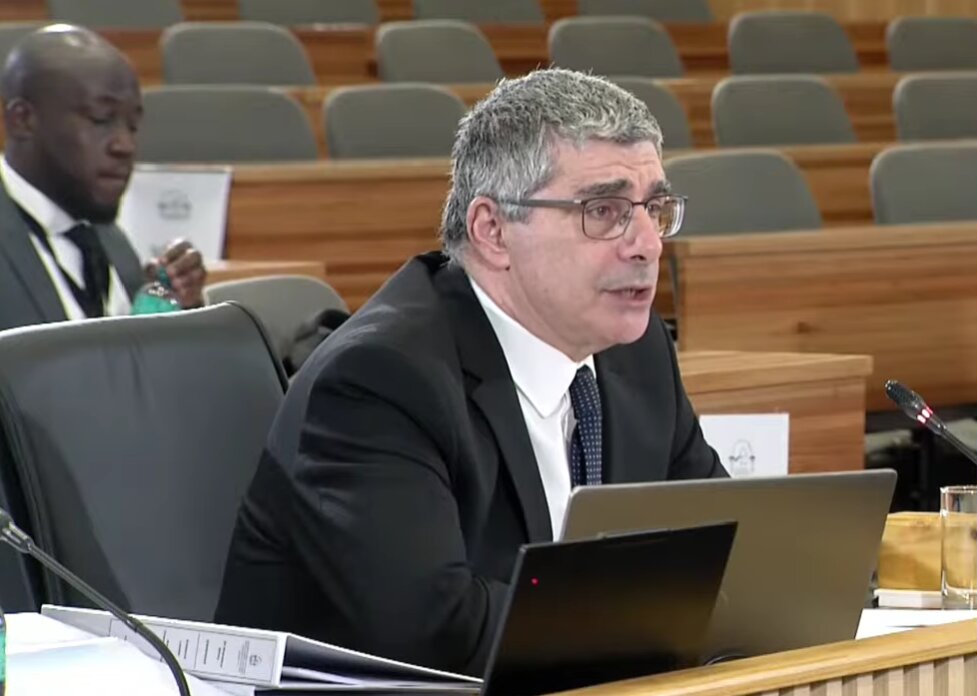
Chief evidence leader Matthew Chaskalson SC has argued that the Madlanga Commission of Inquiry has no legal authority to override restrictions on classified intelligence documents, saying only the High Court can order their disclosure to the public.
The commission considered the matter on Wednesday during a break from its in-camera hearings and recess, amid concerns from media houses that blanket secrecy could undermine public accountability and the inquiry’s ability to expose failures in the criminal justice system.
The dispute centres on whether the testimony of acting National Intelligence Co-ordinating Committee (Nicoc) coordinator Ntandazo Sifolo should be heard behind closed doors.
“The commission is not a high court. It has no power to set aside a decision to classify information or to override a decision on the terms on which classified information is declassified. The commission just does not have that power,” Chaskalson said.
He said Sifolo’s testimony would deal extensively with several hundred pages of classified material, including four national intelligence estimates issued between 2022 and 2025, 11 intelligence briefs, a special report, and additional minutes and reports of Nicoc meetings from 2025.
Although the documents had been declassified for use by the commission, Chaskalson said the authorisation expressly prohibited their public dissemination.
He outlined three options for the commission: urgently approach the High Court to challenge the restrictions, hear Sifolo’s evidence publicly without questioning him about the classified material, or hear his testimony in camera and allow media houses to seek access to the record through the courts.
The evidence leaders supported the third option, which Chaskalson said would allow the inquiry to continue without disrupting its timetable.
“The second option is self-defeating. If the commission were to refuse to hear the evidence of Dr Sifolo, it would deprive itself of the opportunity to question Dr Sifolo,” he said.
He warned that an urgent High Court application could divert commissioners and evidence leaders from their work, delay other witnesses and jeopardise the commission’s already constrained schedule.
Chaskalson said that even if the court granted an application, it was unlikely that all the documents would be declassified for public dissemination.
He maintained that the commission could preserve a full record of the closed proceedings, allowing media houses to approach the High Court retrospectively for access to some or all of the material.
“If the commission, having inspected the documents, having even questioned Dr Sifolo, is of the view that this is of such public importance that the public should know, then the commission could itself proactively go to the High Court for an order to that effect. But it’s the High Court that has the power, not the commission,” he said.
Chaskalson also cautioned against making an order affecting Sifolo without hearing from him, arguing that the evidence leaders should first engage with the intelligence official about whether he would agree to relax the restrictions.
Media houses, represented by advocate Ben Winks, challenged the evidence leaders’ argument, saying the issue was not simply whether the commission had the same powers as the High Court, but what it was authorised to do under the Commission’s Act, regulations, proclamation and rules.
Winks argued that the proposed closed hearing effectively presented the commission with an ultimatum.
“He is saying either you hear my evidence and look at my evidence in total secrecy or I won’t give you those documents and I won’t be able to say anything meaningful,” Winks said.
He argued that the commission’s rules required witnesses to answer questions unless they could rely on legally recognised grounds for refusing, such as privilege.
Winks also questioned the legal basis of the classification system, arguing that the Minimum Information Security Standards (MISS) were not legislation and that the Protection of State Information Bill had never been assented to by President Cyril Ramaphosa.
He said intelligence officials should be required to explain why particular information needed protection rather than rely solely on a classification decision.
“Post-1994, it’s untenable for an executive or administrative functionary to say we will tell you what we decide we will tell you. That is not the culture of justification,” Winks said.
He argued that classification should not automatically justify withholding entire documents from public scrutiny, saying sensitive passages could be redacted while the remainder was disclosed.
Winks said the media houses were not insisting that every intelligence document be made public, but wanted the commission to distinguish between genuinely sensitive operational information and evidence relevant to understanding what the intelligence community knew about organised crime, when it knew it and what action followed.
He warned that allowing intelligence agencies to determine the extent of disclosure could undermine the commission’s public mandate.
Commission chairperson Justice Mbuyiseli Madlanga questioned whether the public’s right to open justice would be compromised if Sifolo’s testimony was heard privately and access could only be sought through a subsequent court application.
Chaskalson acknowledged that a closed hearing would limit open justice but maintained that the commission could not legally override the restrictions itself.
Proceedings adjourned for the day, with Madlanga confirming that the commission was still considering the competing arguments and would deliver its ruling in due course.
INSIDE POLITICS






