



By Marcus Moloko
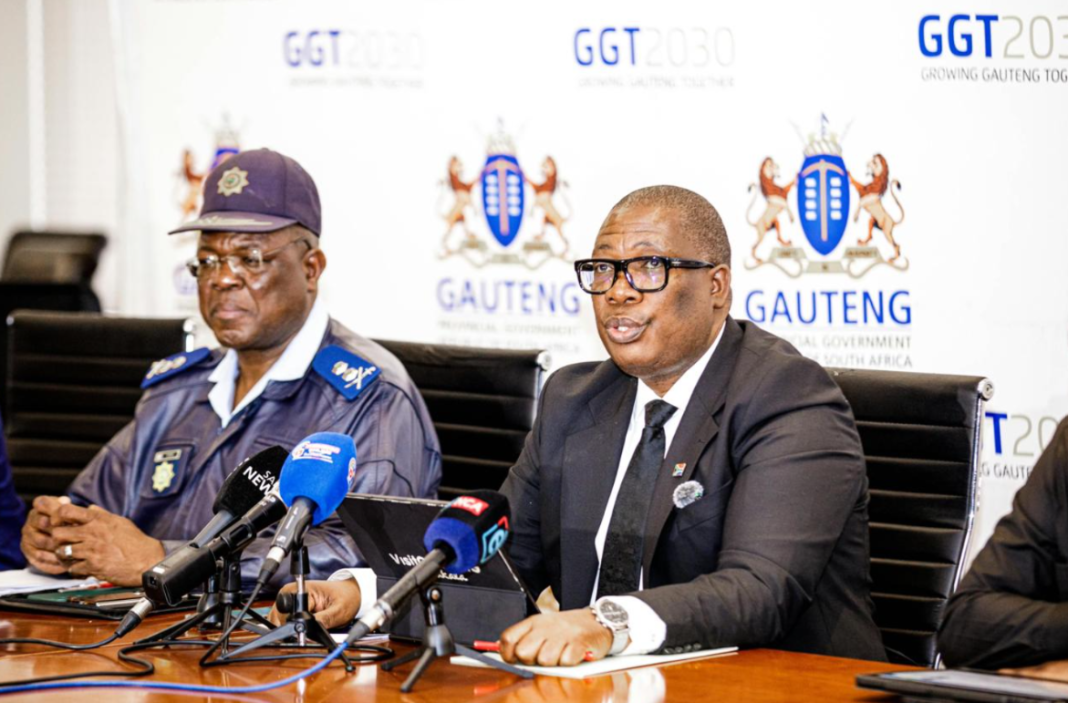
Gauteng Premier Panyaza Lesufi has outlined progress in the implementation of the province’s response to Gender Based Violence and Femicide (GBVF).
Lesufi said the provincial response builds upon four immediate national directives issued by President Cyril Ramaphosa following an intergovernmental meeting on September 29, 2026.
The first was auditing unresolved cases of murder, attempted murder, rape, and serious sexual offenses against women and children.
The second was to establish a funded plan to track backlog sizes, ages, equipment shortages, and staff constraints to speed up resolutions. Others were mandating municipalities to work with police and the provincial government to fix safety hazards, such as broken streetlights, overgrown grass, abandoned buildings, and unsafe transport routes, with published findings.
The fourth was to strengthen municipal and provincial liquor enforcement against unlicensed or non-compliant establishments in partnership with the national Department of Trade and Industry.
Lesufi said the provincial government had made steady progress in implementing interventions aimed at combating gender-based violence and femicide (GBVF), with renewed focus on improed forensic investigations, recovering critical evidence and enhancing women’s safety across municipalities.
Providing an update on the province’s response to GBVF, Lesufi said several directives are already yielding results, with more interventions moving from planning to implementation.
According to Lesufi, the province has successfully recovered crime kits from Thuthuzela Care Centres across all five districts. The kits have since been submitted to the Forensic Science Laboratory for processing.
“The kits have been collected and submitted to the Forensic Science Laboratory for processing,” he said.
To improve evidence management and reduce delays in investigations, Lesufi said investigating officers are now required to carry crime kits to medical examinations to ensure crucial evidence is collected and not left behind.
Further measures were implemented to reduce forensic waiting lists, improve police station intake compliance, recover lost dockets and strengthen the monitoring and reporting of missing persons cases.
Addressing forensic backlogs, Lesufi said the provincial government has completed three key deliverables. These include the establishment of an Identification Task Team to conduct a digital fingerprint audit of unidentified women and children.
He said priority DNA and forensic samples linked to rape and murder cases involving women and children have also been secured for focused processing.
He noted that several outstanding deliverables remained, including a forensic backlog baseline assessment, age profiling, costed backlog reduction measures and the ring-fencing of priority samples.
“These are targeted for completion by early November,” he said.
The premier also highlighted progress in municipal safety audits aimed at creating safer public spaces for women and vulnerable residents.
He said seven critical municipal tasks have been completed, while Johannesburg, Tshwane and Ekurhuleni metropolitan municipalities are fully compliant with safety standards and are submitting regular progress reports.
Among the achievements, Johannesburg mapped major risk zones and prepared 10 previously hijacked or illegally occupied buildings for public reuse.
Tshwane has cleared overgrown vegetation around high-risk transit stations to improve commuter safety, while Ekurhuleni has conducted inspections at local taxi ranks and identified defective CCTV systems requiring repairs.
Lesufi said municipalities in the West Rand district have also completed cataloguing high-risk structures and neglected public spaces.
With safety audits between 60% and 80% complete across most municipalities, Lesufi said local governments have entered the final assessment phase.
He committed that all urgent safety hazards identified through the audits would either be repaired or incorporated into funded action plans within 90 days.
“Detailed audit results and updates will be published online for public tracking,” Lesufi said.
The latest progress report forms part of Gauteng’s broader strategy to improve support for victims of gender-based violence, strengthen criminal investigations and create safer communities through coordinated action between provincial and local government structures.






