
CHARLES MOLELE
BEING leader of a ‘broad church organisation’ like the African National Congress (ANC) is almost Mission Impossible. You are often given a short time to complete your mission before being booted out; or everything just self-destructs.
Take the case of the incumbent ANC President Cyril Ramaphosa.
As head of government, Ramaphosa’s focus at the moment should be on pressing national issues such as fixing the country’s ailing economy, state-owned entities (SOEs) and addressing the rollout programme of the COVID-19 vaccines to millions of South Africans.
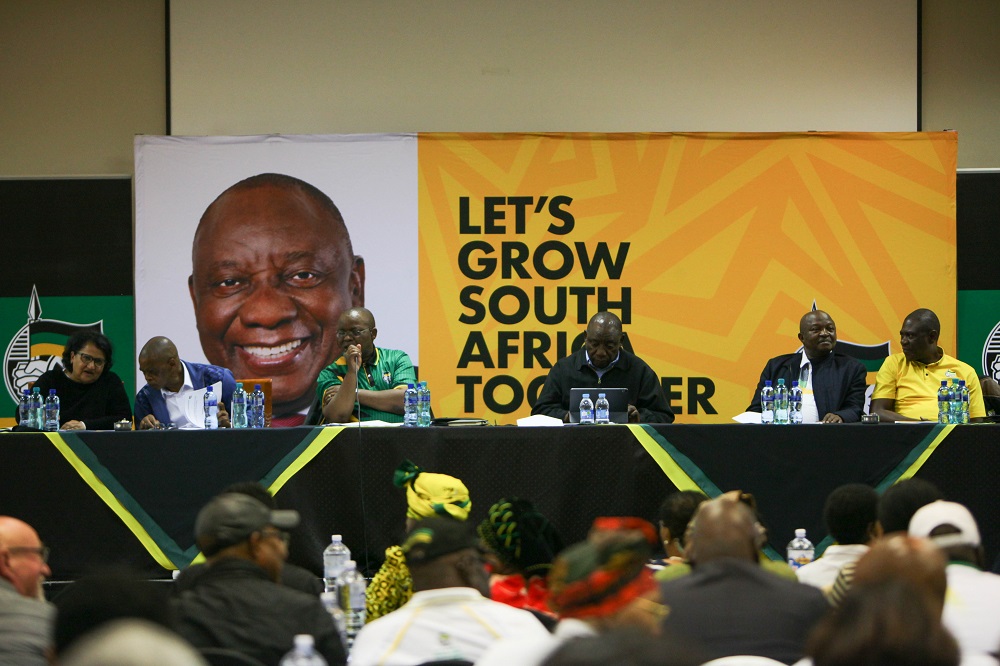
But instead Ramaphosa was forced to take a bold decision on Monday along with the party’s national executive committee (NEC) to endorse the suspension of ANC Secretary-General Ace Magashule, one of the most senior leaders of the governing party.
He read the riot act to the Magashule, accusing him of failing to abide by the party’s Constitution and its Code of Conduct.
As if that was not enough, former president Thabo Mbeki warned the ANC leadership on Saturday to prepare for a split due to “irreconcilable ideological differences.”
However, addressing the media on Monday following the party’s NEC meeting at the weekend, Ramaphosa said it was apparent from all the reports the NEC received that the work of the ANC was proceeding despite the party’s internal and external challenges
“We need to be more pro-active in communicating these aspects of ANC life to counteract this false impression of an ANC on the verge of collapse. We must remember that the trust and support of the South African people should never been taken for granted,” said Ramaphosa.
“For as long as we are divided as a leadership, for as long we fail to act against corruption, and unless we put the needs of our people first, we will struggle to restore the credibility of the ANC.”
Earlier this year, Ramaphosa promised to take a hard stance on corruption and criminality in the ANC, telling members that the party will account for its actions.
Ramaphosa, who ran on a campaign promising a ‘New Dawn’ that would put the days of ‘state capture’ behind the governing party, said the ANC would rely on the ‘revolutionary conscience’ of members and leaders to come forward when they are at fault, and not rely on party structures to make findings against them.
But the rot has deepened within the governing party, and the ‘step aside’ policy has divided the membership.
A faction aligned to Magashule has challenged him since he took power at Nasrec, accusing him of failing to implement conference resolutions such as the expropriation of land without compensation, and the nationalisation of the Reserve Bank.
Magashule faces corruption charges over a contract to audit homes with asbestos roofs when he was premier of the Free State province.
He has denied any wrongdoing.
Magashule’s supporters say the suspended ANC Secretary-General is being singled out, arguing that he is not the only person accused of corruption in the party, citing, among others, Deputy President David Mabuza, Treasure-General Paul Mashatile and ANC national chairperson Gwede Mantashe.
His supporters argue that Ramaphosa, too, has a case to answer for the R300 million he raised to fund his presidential campaign in 2017.
The ANC’s rules do not allow for fundraising for internal campaigns.
Magashule’s supporters also argue that state institutions are once again being used to deal with Ramaphosa’s detractors.
In recent years, Ramaphosa has been beefing up the prosecutions authority with leaders and prosecutors capable of bringing corruption to book, including within his own party ranks.
However, Ramaphosa, a crafty politician, has played his cards close to his chest; holding behind-the-scenes meetings with alliance leaders, business and trying to fix Eskom, the state-owned company at the centre of the ‘State Capture’ project.
But far more important is that Ramaphosa has also shown he has a long-term strategy than his detractors.
At the moment, while he is certainly powerful, he is also vulnerable.
Ramaphosa faces massive challenges on the grandest scales; a high rate of employment and the severe impact of the global coronavirus pandemic on the South African labour market, slow economic growth, and the poor rollout of COVID-19 vaccines millions of South Africans.
The poor have become poorer, while the rich have become richer.
For now, Ramaphosa has an institutional guarantee of support, and looks sets to emerge from the next congress stronger than ever, both domestically and on the international stage.
He has taken down senior leaders in his anti-corruption drive like the ANC Secretary-General of the party, launched an unprecedented crackdown on ill-discipline and factionalism.
Ramaphosa won the presidency of the ANC by a whisker, following a narrow victory against a faction loyal to former President Jacob Zuma.
And, since his narrow victory, Ramaphosa has struggled to assert himself in the ANC in order to achieve a number of goals calculated to consolidate his power in the party before a leadership contest in 2022.
The next coming months are going to unravel the strength of both sides, and test Ramaphosa’s determination to rebuild the ANC into a solid organisation.
This is as much a crunch time for Ramaphosa as it is for Magashule’s supporters.
We have not seen the end of the political drama.
- Inside Politics





