
By Johnathan Paoli
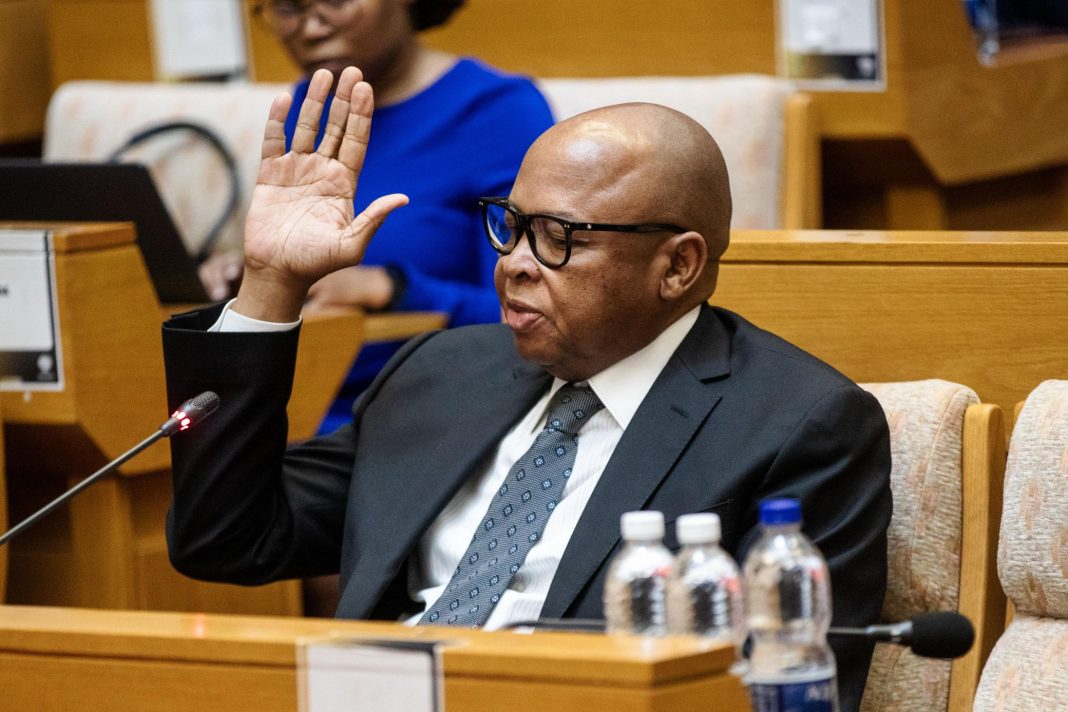
Deputy Police Minister Cassel Mathale told Parliament’s Ad Hoc Committee on Tuesday that he first learned of the disbandment of the Political Killings Task Team (PKTT) through social media.
Mathale said he initially dismissed the letter announcing the task team’s dissolution as “fake news.”
Appearing before the committee in Cape Town, he stressed that the disbandment of such a specialised unit should involve consultation with all relevant stakeholders, including the task team’s leadership and the national commissioner.
“When I first saw the letter on social media, I dismissed it, because it was odd to see something like that. Later, when [Police] Minister [Senzo] Mchunu confirmed it, I couldn’t understand what motivated him. The way it was written, it was not practical to implement. The word ‘immediately’ was the problem,” he said.
Mathale, who served as deputy minister under both Bheki Cele and Mchunu, testified that he had discussed with Mchunu the idea of strengthening the Murder and Robbery Unit, but that this was never meant to immediately replace or disband the PKTT.
Evidence leader and senior counsel Norman Arendse led Mathale through his testimony, focusing on whether Mchunu had consulted his deputies or the police leadership before issuing the directive to dissolve the PKTT.
Mathale confirmed that no consultation took place with him before the letter was written.
He described the process as problematic and not the right way for such a major structural change to be communicated.
“Once something is immediate, on the day-to-day use of immediate, it is immediate,” he said, emphasising that operational structures cannot be dissolved overnight without consequences.
Mathale added that he later spoke to Mchunu about the letter but did not challenge him directly.
Mathale confirmed that during his tenure under Cele, he had attended two briefings in KwaZulu-Natal where the work of the PKTT was discussed.
“Their effectiveness has never been an issue that was questioned. They were doing their job, and I believe they were doing a good job,” he said.
He explained that discussions about restructuring the police service, including folding certain task teams into the broader Murder and Robbery Division, took place as part of a long-term organisational review of the SAPS.
However, he stressed that the PKTT’s disbandment was never specifically discussed or approved as part of that process.
Mathale said the letter’s demand for “immediate” disbandment created confusion and was effectively ignored at operational level.
“The national commissioner responded in a manner that the immediate part of it was not operationalised, because the PKTT is still there,” he noted.
He confirmed that discussions about reassigning leadership roles within the PKTT, particularly whether Lieutenant General Dumisani Khumalo, head of Crime Intelligence, should take over certain responsibilities, were still ongoing.
Arendse pressed Mathale on whether poor communication between Mchunu and the police’s top leadership contributed to the fallout.
Mathale agreed, suggesting that if Mkhwanazi had been granted a meeting with Mchunu when he first requested it, “we probably wouldn’t be where we are now”.
He said Mkhwanazi’s decision to hold a public media briefing on 6 July was perhaps a step too far, but that it was a consequence of being repeatedly ignored.
Asked about allegations of factionalism within the SAPS, Mathale denied any evidence of organised divisions.
“Rogue elements are rogue elements. Many people in the police serve with integrity. The individuals who create problems remain individuals, they are not reflective of the organisation,” he said.
Mathale reiterated that the PKTT should not have been disbanded unilaterally, stressing that it was not practical to make such a decision without consulting those directly involved.
The committee continues its hearings after lunch, with Mathale expected to be cross-examined by members of Parliament.
INSIDE POLITICS





