
By Lebone Rodah Mosima
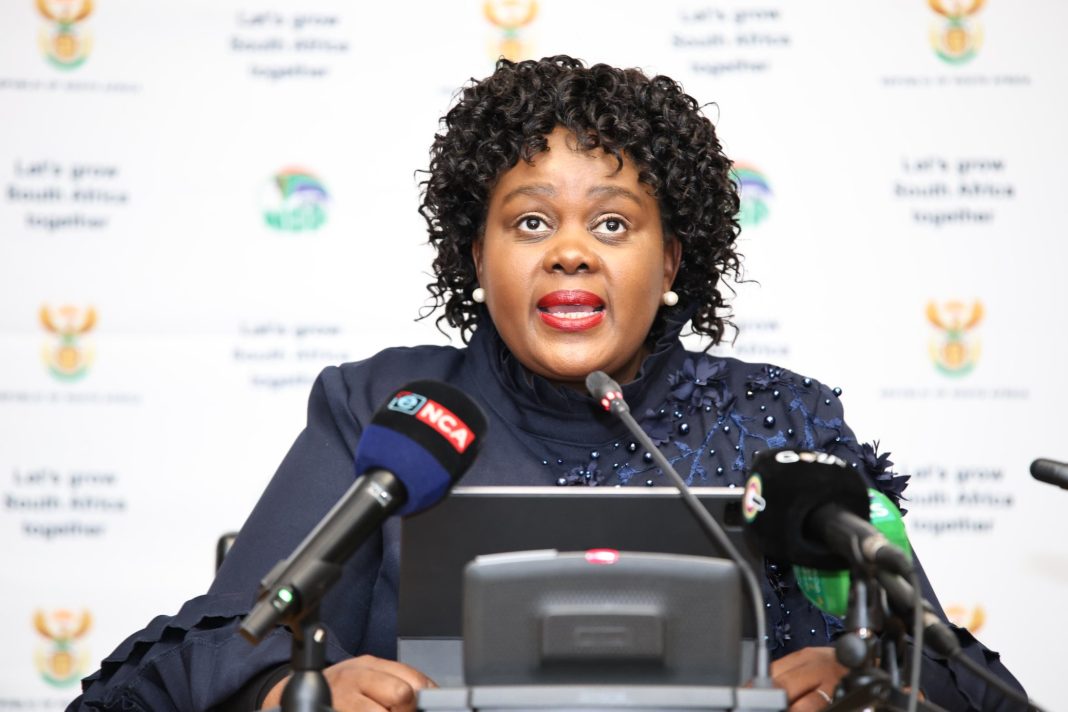
Justice Minister Mmamoloko Kubayi has told members of parliament about how the department was improving South Africa’s response to gender-based violence and corruption.
Answering questions in the National Assembly, Kubayi said the justice department was strengthening oversight of the National Prosecuting Authority (NPA), bolstering the justice system’s response to gender-based violence and femicide (GBVF), and updating anti-corruption legislation, including whistle-blower protection.
She said a new complaints and accountability mechanism for the Investigating Directorate (ID) and the Investigating Directorate Against Corruption (IDAC) would be headed by retired judge Takalani Joseph Raulinga.
The section has not yet come into force and several steps remain, including regulations, parliamentary scrutiny and a presidential proclamation.
“In this regard, I approved the regulations on 10 October 2025,” Kubayi said, adding that the remaining processes — submission of the regulations to Parliament, finalisation of the appointment and the proclamation — were underway.
She said Raulinga had not yet started work and would only be paid for services rendered once the section commenced. A public announcement would follow once all legal requirements were met.
Kubayi mostly focused on GBVF, a long-running crisis that has driven protests and policy pledges and remains a test of the justice system’s credibility.
“In the previous financial year, 19 sexual offences courts were established, and in this financial year, 16 courts are being established,” she told MPs, adding that one of the new courts would be officially opened on Thursday in Botshabelo, Free State.
She said 40 courts were being upgraded this financial year “to provide a catalogue of survivor-centred support services”.
Thuthuzela Care Centres, specialised facilities for rape and sexual assault survivors, had grown to 66 since 2022, she said, “and it is our plan to increase the footprint with [an] additional four”.
The department has introduced a multisectoral “100 Days Challenge” to cut the time it takes to finalise domestic violence and sexual-offence cases.
A directive now requires that protection orders be served by court clerks within 24 hours of being issued, she said, and the department has appointed ad hoc intermediaries to prevent cases being postponed because of staff shortages.
She said the National Register for Sex Offenders (NRSO) was increasingly being used to screen people who work with vulnerable groups.
“In the protection of vulnerable groups, from April 2025 to October 2025, a total of 40 063 NRSO clearance certificates have been issued. The ultimate goal is to make the register public, the review of existing Legislation is underway as a draft Bill has been developed and currently under consultation,” she said.
Regarding corruption, Kubayi said the department had prepared a draft bill to amend the Special Investigating Unit and Special Tribunals Act, to clarify the powers and funding of the Special Investigating Unit (SIU), strengthen remedial action and improve preservation and forfeiture procedures through the Special Tribunal.
A second bill focuses on whistle-blower protection.
The Protected Disclosure Bill “has been finalised” and is currently being processed in the Justice, Crime Prevention and Security (JCPS) Cluster of Cabinet, she said.
Further amendments to the NPA Act are also being worked on inside the department, while the South African Law Reform Commission was in the final stages of reviewing the Criminal Procedure Act.
Kubayi said the department had also studied the report of the National Anti-Corruption Advisory Council (NACAC), which was submitted to President Cyril Ramaphosa earlier this year. A technical consultation workshop with law enforcement agencies had already been held. Preliminary comments received would be processed to the JCPS ministerial cluster.
INSIDE POLITICS



