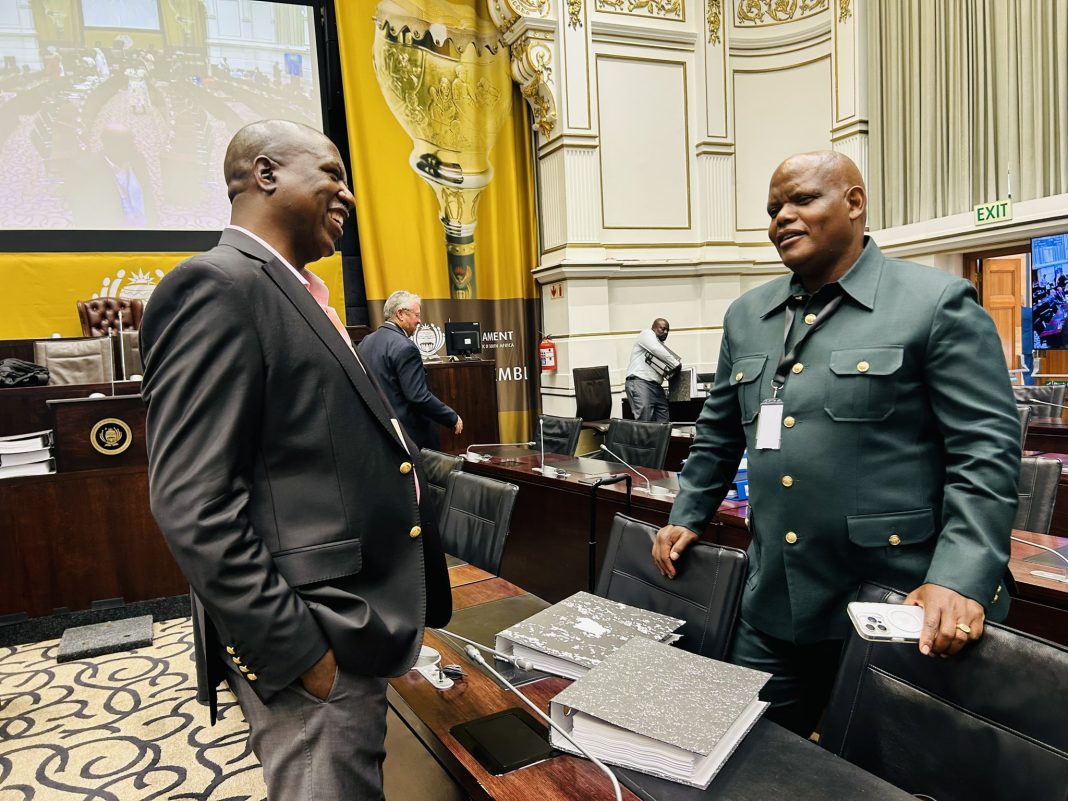


By Johnathan Paoli
Former acting National Police Commissioner Lt-Gen Khomotso Phahlane has told Parliament’s Ad Hoc Committee that a coordinated “project”, allegedly led by former IPID head Robert McBride and forensic investigator Paul O’Sullivan, was aimed at destroying his reputation, career and personal life.
He claimed the campaign involved media manipulation and fabricated investigations, and followed a violent attack on him and his wife.
Addressing the committee after lunch on Wednesday, Phahlane said the campaign against him culminated in what he described as a sustained propaganda drive, amplified by selected journalists, under the guise of fighting corruption.
He detailed how he and his wife were attacked by three armed men while visiting a spa in Johannesburg on 5 June 2016, an incident he said remains deeply troubling.
Phahlane told MPs that the first person to contact him after the attack was McBride, who sent him a WhatsApp message offering assistance.
“The message said, ‘offer still stands’,” Phahlane said.
Phahlane further alleged that McBride later obtained CCTV footage of the spa attack and that it was circulated to O’Sullivan’s associates and ultimately disseminated online, accompanied by what he described as distorted narratives that fed into media reports about him.
Central to Phahlane’s testimony was his claim that McBride and O’Sullivan worked together to establish what he called the “Phahlane task team”, aimed at pursuing him through complaints, investigations and media exposure.
He told the committee that this campaign relied heavily on journalists whom he named, including Abraham Mashego, Barry Bateman and Karyn Maughan, and others alleging they were used to “push propaganda” against him.
He also mentioned the late Karima Brown and Marianne Thamm as part of what he characterised as a broader media machinery.
Phahlane insisted that many of the allegations made against him lacked substance and were never supported by sworn affidavits.
He claimed that despite numerous dockets being opened, none contained a formal affidavit by O’Sullivan.
Phahlane told MPs that his version of events had been vindicated in court.
He confirmed that a full bench of the High Court recently ruled in his favour in civil litigation arising from allegations made against him, ordering costs against his accusers and directing them to retract claims and issue an apology.
He said this judgment followed an earlier ruling in his favour by the late Judge Norman Davis, reinforcing his assertion that the allegations were baseless.
Beyond the personal attacks, Phahlane also addressed substantive policing matters, including the controversial R92 million 360-degree camera contract.
He rejected claims of irregular procurement, saying he would never authorise public spending on equipment that could not be used.
The technology, he said, had been instrumental in major cases, including the Oscar Pistorius trial.
He alleged that while certain service providers sought the full R92 million, they ultimately received R31 million without delivering a single camera.
Phahlane also reflected on political interference within the South African Police Service, which he said became more pronounced after the ANC’s 2007 Polokwane conference.
He criticised the appointment of former crime intelligence boss Richard Mdluli, saying it did not follow proper legal and administrative procedures and undermined governance in SAPS.
However, he insisted he had no personal issue with Mdluli.
INSIDE POLITICS