

By Johnathan Paoli
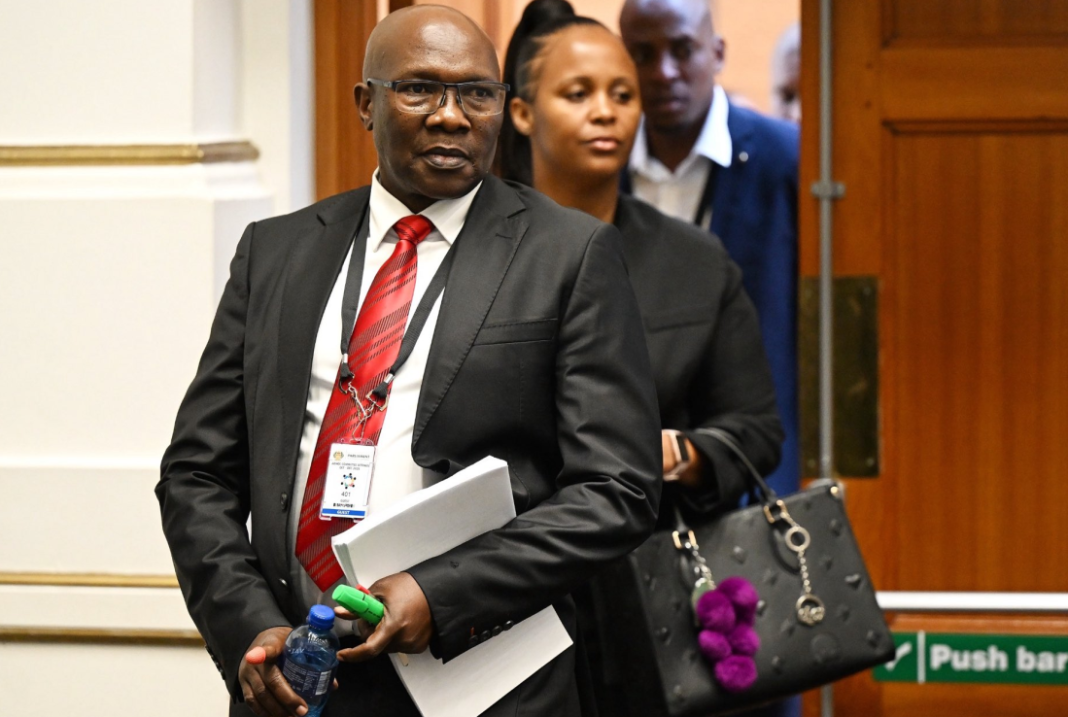
Head of Crime Intelligence Lieutenant General Dumisani Khumalo on Thursday told Parliament that a sustained “misinformation campaign” was deliberately waged against him as he attempted to reform a division he described as lawless, corrupt and operating “on a free mode”.
Khumalo was testifying before the ad hoc committee investigating allegations of criminal infiltration, corruption and political interference in the criminal justice system.
ALSO READ: WATCH: Creecy seeks total ban on drinking when driving
Opening his testimony, Khumalo said his tenure since January 2023 was marked by resistance to reforms aimed at restoring legality and accountability within Crime Intelligence, telling MPs that misinformation, often amplified through social and print media, was used to undermine each major reform decision he took.
“Crime Intelligence was operating without proper legal controls, serving internal interests rather than SAPS priorities, and the moment we began correcting that, a coordinated misinformation campaign was unleashed to discredit every reform decision we took,” he said.
He described widespread misuse of state vehicles, irregular employment of family and friends, and the appointment of about 250 “agents” who were later found to be ghost employees.
Some, he said, held senior ranks such as colonel despite not having worked for more than a decade while continuing to draw salaries.
Khumalo said his priority was fixing the legal framework governing Crime Intelligence, including compliance with the Regulation of Interception of Communications and Provision of Communication-Related Information Act (RICA).
ALSO READ: Zuma, Mbeki: Khampepe’s NPA and TRC roles disqualify her from stalled apartheid cases inquiry
He said that many intelligence-gathering procedures were taking place outside the law and that exceptional approvals from Parliament and National Treasury were required to regularise equipment procurement through the Secret Services Account.
Implementing changes, he said, created resentment within senior management ranks.
That resistance, he said, manifested as misinformation.
As an example, Khumalo said that when he withdrew state vehicles from senior managers for redistribution to operational units, photographs of parked vehicles were leaked to media and portrayed as “SAPS vehicles gathering dust”.
Claims that informer payments were being capped at R3 000 were also misleading, he said, explaining that payments above that threshold were subject to additional committee scrutiny to prevent abuse.
He detailed how enforcing consequence management against senior officials led to allegations of victimisation, abuse of whistleblower protections, and prolonged sick leave to delay disciplinary processes, often shielded by claims of “secrecy”.
ALSO READ: Phahlane tells Parliament of alleged McBride–O’Sullivan plot to destroy his life
Turning to the Political Killings Task Team (PKTT), Khumalo rejected the narrative that it was a flawed or illegitimate structure.
He confirmed the PKTT was established in 2018 during a surge of political killings in KwaZulu-Natal, following the creation of an Inter-Ministerial Committee (IMC) chaired by then Police Minister Bheki Cele.
“The PKTT was formed through the national commissioner, without specific legislation, as an ad hoc intervention,” Khumalo said, adding that the IMC provided strategic oversight, resources and coordination with the National Prosecuting Authority.
He said the same IMC processes used to establish the PKTT should have been followed, in reverse, if disbandment was ever contemplated.
Khumalo told MPs the last IMC briefing on the PKTT took place in September 2023, with resolutions that the task team should continue, with the final briefing to the President occurring in March 2024.
Since then, he said, the IMC had not reconvened, despite the PKTT continuing to operate and report to national and provincial steering committees.
At the time of its disbandment, the PKTT was handling 612 dockets, including 333 political killings in KwaZulu-Natal, 120 firearm-related cases, 51 traditional leader killings, and 18 cases linked to Fort Hare University.
Of these, 297 cases had been finalised, 141 were before courts, and 121 remained under investigation.
Khumalo said that the success of the PKTT could not be measured by numbers alone.
“The unique value of the PKTT comes from its methodology,” he said.
Rather than focusing solely on identifying hitmen, investigations centred on motive and beneficiaries, enabling the prosecution of those who ordered hits through charges such as fraud and corruption.
He credited the multidisciplinary approach for improved bail outcomes, with most accused in political killing cases remaining in custody, and for reducing the withdrawal of charges through early prosecutorial involvement.
While agreeing that task teams should not exist indefinitely, Khumalo urged SAPS to use the PKTT as a transitional model for modern investigations.
He described the team as “pioneers of modern investigating”, saying that its expert-driven structure was better suited to combating organised crime than traditional detective-heavy units.
The hearings continue.
INSIDE POLITICS