


By Thebe Mabanga
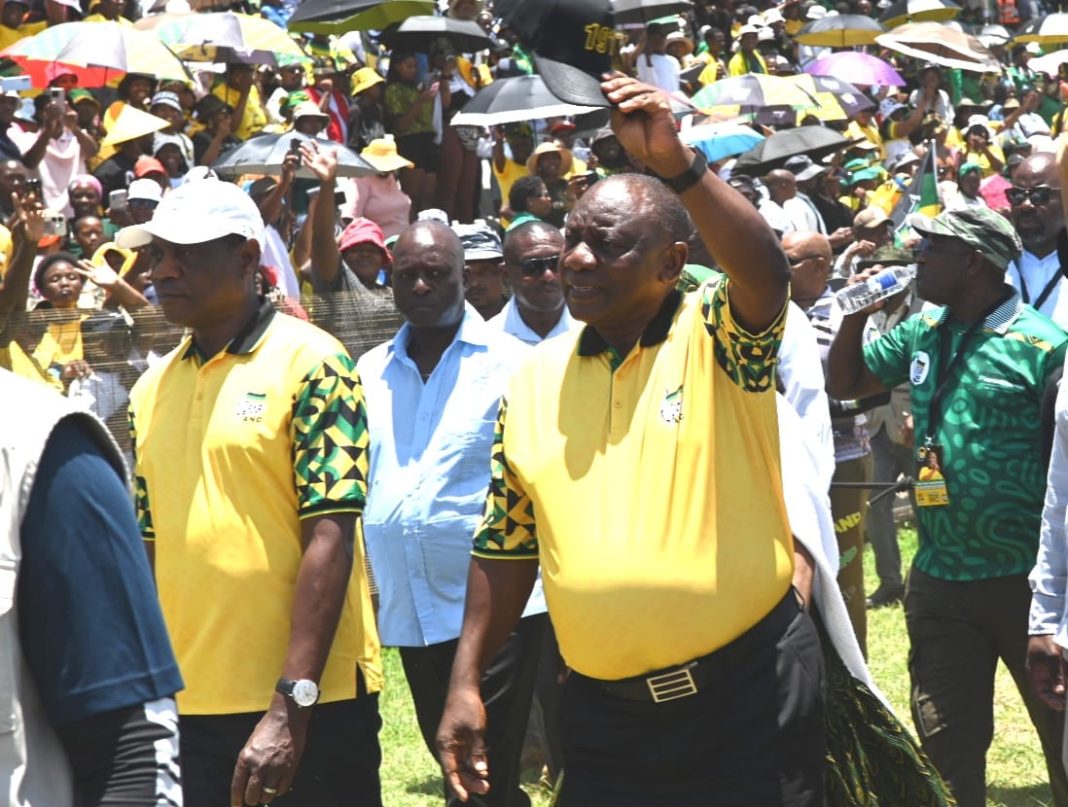
The empty seats in the 30,000-seater stadium told a story of their own. The ANC attributed the gaps to logistical challenges, including traffic congestion and supporters lingering outside the venue to escape the heat.
But it is also worth asking whether the sparse turnout reflects a deeper sense of apprehension and disillusionment among the party’s membership.
The problem with the ANC it appears to have run out of ideas about what to do about South Africa’s economic growth and unemployment crisis.
What currently sustains the economy are high commodity prices — including a record gold price — alongside relatively low oil prices. Together, these factors have underpinned a stronger rand, lower inflation and subdued interest rates.
The two areas where the ANC can claim some credit are the implementation of reforms in energy and logistics, and the improved performance of key state-owned enterprises such as Eskom, Transnet, the Airports Company of South Africa (ACSA) and South African Airways (SAA).
But a large portion of this success is due to private sector involvement.
Another problem with the ANC is that it does not know where it wants to position South Africa’s economy in the global value chain.
China is a global manufacturing hub with inherent comparative advantages but also self-made efficiencies that are hard to compete against.
Asian economies like Vietnam, South Korea and Singapore have built their own areas of advantage to complement China but also find niche areas.
South Africa must identify and play to its strengths.
Being mineral-rich is an inherent, natural advantage. But beneficiating those minerals and selling them as intermediate, value-added goods requires deliberate policy interventions, long-term planning and bold decisiveness.
Such a shift would inevitably disrupt established global players in beneficiation from India to Europe and China.
It is a decision the ANC has long avoided, but one it must make and follow through on.
Infrastructure is another area of deep frustration. South Africa’s infrastructure programme was unveiled as a R400 billion initiative in a January 8 statement by former president Thabo Mbeki ahead of the 2004 elections.
It has since ballooned into a R1 trillion programme over three years, yet, as one banking executive observed, progress remains glacial.
Too much is planned for too long, with too little execution.
Another inherent advantage is favourable weather, arable land and an advanced agricultural sector.
This should position South Africa as a major global agricultural export hub.
The deal that opened the Chinese market to South Africa’s stone fruit exports came about largely as a result of United States President Donald Trump’s tariff wars, but it should have been pursued much earlier. Many similar opportunities exist in untapped markets, but without political will and decisive leadership, none of this will materialise.
A further sign of desperation emerged over the past week when ANC Secretary-General Fikile Mbalula revived talk of nationalising the Reserve Bank and exploration without compensation.
He reportedly told a group of young people that the ANC would nationalise mines, including those in the North West, to create jobs.
He was fortunate they did not laugh him out of the room.
The ANC will not, or rather cannot, nationalise the mines.
It is too fearful of market backlash and lacks both the political will and the managerial capacity to run state-owned mining operations.
Moreover, the private sector is increasingly confident that the courts would block any serious attempt at nationalisation.
This leaves a leader proposing solutions he knows cannot be implemented — and no longer believes are viable — merely to placate disgruntled voters. That is either desperation or indifference.
The ANC today resembles not a sinking ship, but a cruise liner stranded in shallow waters, unable to move forward or turn back.
On the top deck sit the leadership: sipping champagne, eating cake and enjoying live music, largely oblivious to the struggles below.
The deck beneath is occupied by the deployment class – premiers, mayors, MPs and councillors — whose livelihoods are tied to ANC membership.
Below them are civil servants, black professionals and tenderpreneurs whose jobs, incomes and contracts depend on the state and, by extension, the ANC.
On the bottom deck, in the cabins, are grant recipients and ordinary ANC members who campaign in dust and heat, hoping for opportunities in public works programmes or municipal employment.
For now, the party continues, punctuated by mild anxieties about future election results.
But when the champagne runs dry — when economic growth falters to the point that South Africa can no longer plug into the global economy — panic will set in.
By then, electoral decline may already be irreversible.
INSIDE POLITICS