
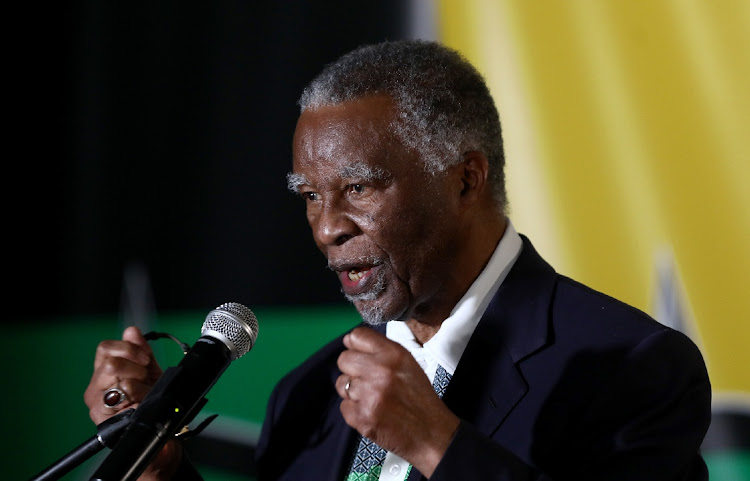
FORMER President Thabo Mbeki says unless the ANC renews itself, it will gradually die and cease to exist as a governing party.
Mbeki, a veteran of Africa’s oldest liberation movement, was speaking at the memorial service of the late struggle stalwart Rita Ndzanga in Soweto, Gauteng.
“If we don’t renew the ANC, the ANC will die,” said Mbeki.
The renewal process, which Mbeki says will be painful, seeks to return the ANC to its former glory following widespread decline of the governing party at most of the local government elections.
Mbeki reiterated that the renewal of the ANC would be a painful process because the party was attracting the wrong people in its ranks.
He said many new ANC members viewed the joining the party as a stepping ladder to power, which is why people wanted to be seen as members.
“We are beginning to attract people who think that the ANC is a step ladder that they can use to put money in their pockets,” said Mbeki.
“The ANC has decided at Conference to undergo a process of renewal. But how can renewal be credible if people who joined for wrong reasons and are heavily implicated in wrong doing are still in the party.”
Mbeki said the behaviour of ANC members needed to change.
He added that people were not happy with the current state of the party, which is evident from the ANC’s waning support in places such as Soweto.
“The number of people that vote for the ANC in Soweto keeps dropping. Why is that? There is something wrong with what we are doing, something must change,” said Mbeki.
“As we say farewell to comrade Rita Ndzanga, we must commit to rebuild this party of which she was very worried about.”
“This phenomenon of killing other people because you want to be a councillor needs to stop. That’s why I am asking this question? How do we produce more Rita Ndzangas.”
Born on 17 October 1933 in Mogopa, 16 km from Ventersdorp in the North West, Nfzanga’s first job was as a Secretary for the Brick and Tile Workers Union in 1995.
The same year, she went to work for the Railway Workers Union with her husband, Lawrence.
The couple belonged to an underground cell and were banned in 1964.
They were detained on 12 May 1969, under Section 6 of the Terrorism Act, and Ndzanga was in prison with Winnie Madikizela-Mandela, Thoka Mngoma, Martha Dlamini and Joyce Sikhakane.
Upon her release in 1970, she was banned for another five years.
Neither the torture of detention or the death of her husband, in detention in January 1977, deterred her continued involvement in the trade union movement.
The Federation of Transvaal Women was formed in December 1984, bringing together close to 200 women from all over Gauteng.
In 1999, Nfzanga was elected as a Member of Parliament in the National Assembly. She served in the first, second and third democratic Parliament and was awarded the Order of Luthuli by Mbeki in 2004.
INSIDE POLITICS





