
THEBE MABANGA
PRESIDENT Cyril Ramaphosa has pinned his hope of an economic recovery on what some might call misplaced optimism, questionable targets and plans that have thus far proven inadequate.
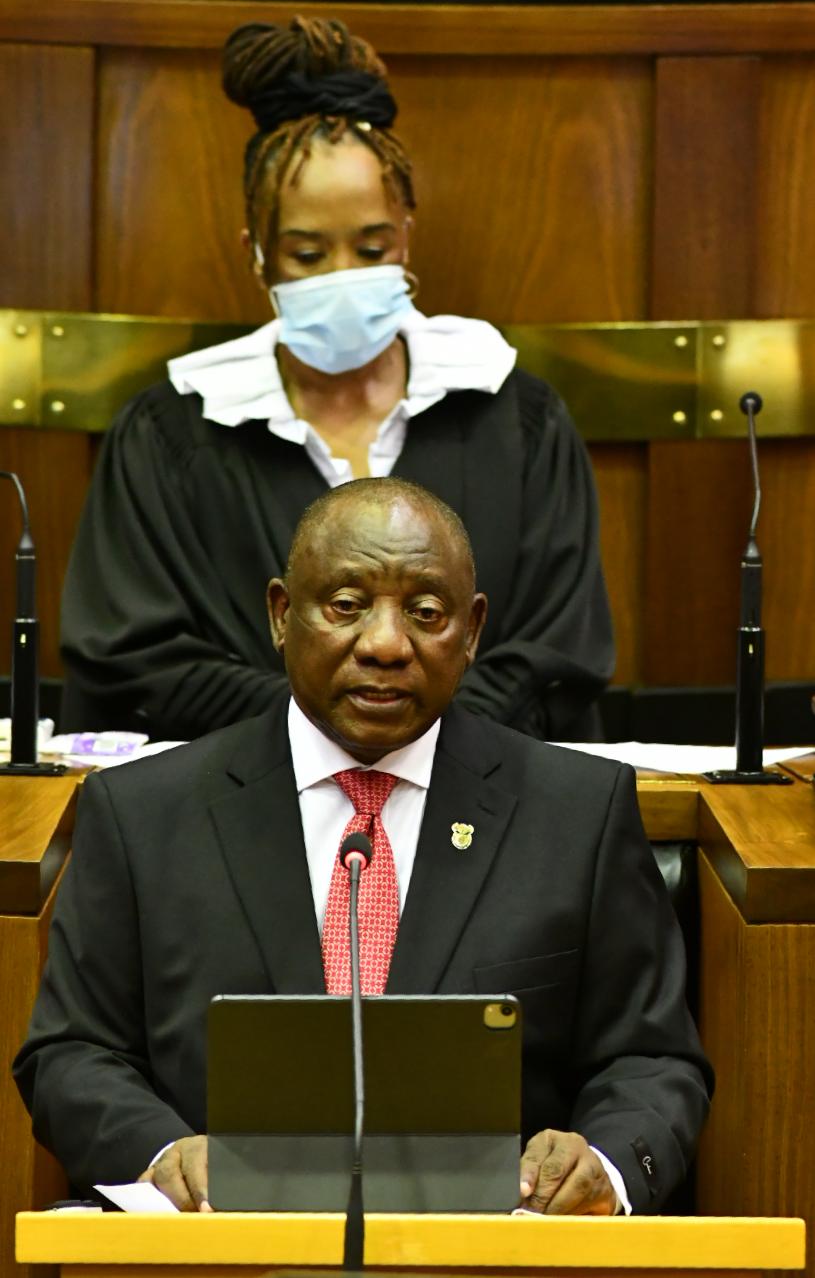
Presenting the State of the Nation Address (SONA) in parliament in Cape Town on Thursday, Ramaphosa prioritized the acceleration of economic recovery and implementation of reforms, alongside defeating the COVID-19 pandemic and fighting corruption.
The president sees economic recovery as a task that is as defeating the pandemic.
“We must overcome poverty and hunger, joblessness and inequality,” said Ramaphosa.
Poverty is on the rise. Inequality is deepening, he said without quoting any statistics.
Ramaphosa noted that in the third quarter of 2020, the economy shrank by 6% from a year earlier and there were 1.7 million fewer people employed in the third quarter of 2020 than there were in the first quarter, before COVID struck.
The president then expressed an unlikely hope of job recovery.
“Our unemployment rate now stands at a staggering 30.8%. As a result of the relief measures that we implemented and the phased reopening of the economy, we expect to see a strong recovery in employment,” he said, before pausing as if to make sure “by the end of 2020.”
The South African economy has never displayed such job growth – at least not since the ‘Global Financial Crisis’ of 2008.
The president then referred to the R 500 billion economic stimulus package, or 10% of GDP.
But that figure includes R200 billion Loan Guarantee Scheme which has seen only R18,9 billion or less than 10% disbursed to 13 000 businesses.
The parts of the R500 billion that have worked include R57 billion in wage support that has been paid to over 4.5 million workers through the Special UIF TERS scheme.
More than R1.3 billion has been provided in support, mainly for small- and medium-sized businesses, as well as R70 billion in tax relief that was extended to businesses in distress.
The president pointed out the success of the three investment conferences hosted since he took office have now received R773 billion in investment commitments towards the country’s five-year target of R1.2 trillion.
But this week, the United Nations Conference on Trade and Development (UNCTAD) released figures which showed that foreign direct investment flows into South Africa in 2020 almost halved to $2.5 billion from $4.6 billion in 2019, which was from around $5.4 billion in 2018.
The cumulative total over the three years amounts to $12.5 billion, which is way lower than the figure suggested by Ramaphosa.
The president then gave an update of the implementation of the Economic Reconstruction and Recovery Plan (ERRP).
This a massive rollout of R340 billion infrastructure projects throughout the country, an increase in local production to improve export competitiveness and generate R 200 billion of local output – an employment stimulus to create jobs and support livelihoods that has already supported 430 0000 job by end of January as well as the rapid expansion of our energy generation capacity.
Ramaphosa highlighted progress made on four sector master plans which are already showing results.
Since the finalisation of the poultry Master Plan, the industry has invested R80 million in production capacity and South Africa now produces 1 million chickens a week.
The finalisation of the automotive Master Plan partly led to Ford Motor Company announcing a R16 billion investment in Rosslyn, outside Pretoria, the largest investment in the company’s history.
The Clothing Textile Footwear and Leather industry Master Plan has led to R500 million investment in new production capacity while the sugar industry’s Master Plan promises to stabilise an industry that is reeling from cheap imports and threatens the viability of some of the 85 000 jobs it sustains.
Trade union federation Cosatu has called on government to finalise 15 sector master plans as these carry the promise of jobs and growth.
“However other sector master plans remain worryingly far behind. Sectors of particular concern include renewable energy, hemp, mining, digital communications, and technology.” Cosatu said ahead of SONA.
On energy supply, South Africa is to procure 2000 MW of emergency power required to fill the gap left by Eskom’s faltering stations.
Government will amend Schedule 2 of the Electricity Regulation Act within the next three months to increase the licensing threshold for embedded generation.
This is after waiving licensing for self-generation projects under 1 MW last year.
Ramaphosa also pointed out the pending separation of Eskom into three units.
But while the legal leg of this process is now advanced or complete, Eskom has placed no timeline on when the actual separation will occur.
Other reforms include the repositioning of two strategic harbours, the Durban Port and the Ngqura Port in Port Elizabeth, and the global export and container harbours, respectively, and improve rail efficiency in order to move freight from road to rail.
This is a long mooted but as yet unrealised goal. Ramaphosa hopes this time it will be different.
(SOURCE: INSIDE POLITICS)





