
- Advertisement -spot_img

BUDGET: Gauteng Boosts Government Spending While Fighting COVID-19 Pandemic

- Advertisement -spot_img

Must read

THEBE MABANGA  

THE Gauteng provincial government is to spend an additional R5.9 billion over the next three years fighting COVID-19 and maintain spending on housing, health and infrastructure to revitalise the province’s economy, which has lost R80.9 billion and shed more than 600 000 jobs partly as a result of the pandemic.  

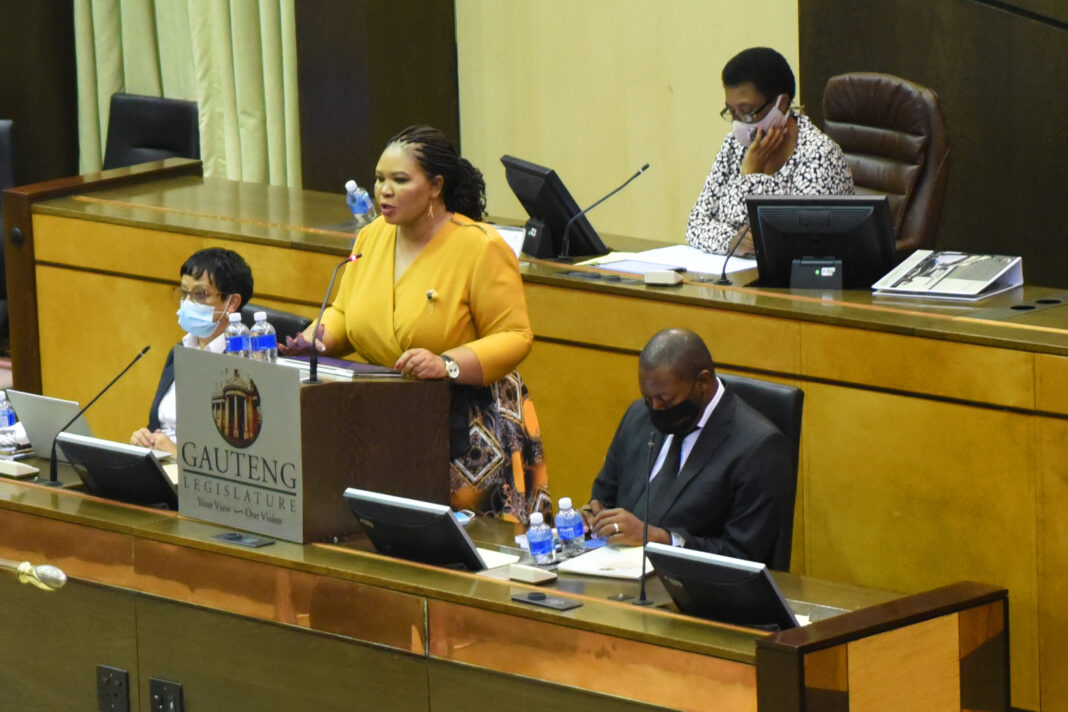
This was revealed by the Gauteng MEC of Finance, Nomantu Nkomo-Ralehoko, who delivered the 2021/2022 Budget at the Gauteng Legislature on Thursday.

Beyond defeating COVID-19 pandemic and re-igniting the Gauteng economy, the government’s other priorities are recalibrating social policy and improving governance.

Ralehoko revealed that the Department of Health will receive R 2, 8 billion in once off allocations over the Medium-Term Expenditure Framework (MTEF), or the next three years. 

R624 million will go towards boosting the purchase of medicines while R565 million will be allocated for the rollout of the COVID-19 vaccine.

Nkomo-Ralehoko reflected on the first anniversary of the discovery of the first positive case COVID-19 in the country on the 5th of March last year, which coincided with the delivery of her maiden budget.

“When the news broke that our country recorded the first confirmed case of COVID-19, I reflected deeply on the essence of the budget I had presented earlier. I then realised that our budget had suddenly become moot, because it was not going to be able to respond adequately to the unfolding pandemic,” she said, before paying tribute to health workers as well as Gauteng citizens for their resilience in the face of a crisis.

Nkomo-Ralehoko said the provincial government must maintain spending in order to respond the COVID crisis and boost the economy, even as national government undertakes fiscal consolidation over the next five years, which reduces what is distributed to provinces in equitable share and puts pressure on the province to improve its own revenue collection.

The overall Gauteng budget is R142 billion and will rise to R149 billion over the next three years.   

Of this, R136 billon, or 95%, comes from national government through the equitable share and conditional grants.

The balance of 5% is from the province’s own revenue.

This comes from car license registration, gambling taxes and patient fees and currently stands at just over R6 billion.

The Gauteng government is soon to approve a revenue enhancement strategy which aims to increase revenue without raising taxes and fees.

The government aims to raise R20 billion from its own sources over the next three years.

The education department receives R53 billion and will this year see an expansion of Information and Communication Technology for curriculum expansion and enable more public schools to improve facilities for remote learning, Nkomo-Ralehoko announced that all categories of subsidies per learner no fee, fee paying, and independent schools will be increased.

Nkomo-Ralehoko emphasised how battered the Gauteng economy, which contributes 34% of South Africa’s GDP, has been.

“Gauteng’s economy, given its size and centrality to the country’s economy as whole, has received the harshest beating arising from the onset of this pandemic a year ago.”

Gauteng has seen its Gross Domestic Product by Region (GDP-R) shrinking by about R80.9 billion from R1.1 trillion in 2019 to R1 trillion in 2020.

“Just too many people have lost their jobs, businesses, especially SMMEs have gone under and unemployment is ravaging all communities,” said Nkomo-Ralehoko.

The South African economy declined by 7.2% last year, is expected to grow by 3.3 % this year from a lower base and then average 1.9% per year until 2024.

The Finance MEC reveals that the open tender system has been used to approve transactions worth R29 billion and is now to be decentralized on a pilot phase to three government departments and three government entities.

Critics remain divided as to whether decentralising the tender process does not increase the scope for corruption Gauteng is to spend R35.3 billion on infrastructure over the next three years, starting with, starting with R11.3 billion this financial year.  

Of the three-year amount, R13.8 billion will be devoted to new or replacement infrastructure, while R20.4 billion goes towards the maintenance, refurbishment and upgrades to existing infrastructure.  

The Departments of Human settlements, Education, Health, Roads and Transport, and Infrastructure take up 97% of the infrastructure budget allocation.

The upgrade of informal settlement receives R2.4 billion over the next three years while R 10 billion is allocated over the same period for the construction of mega housing projects. R156 million Is allocated to the refurbishment of hostels

“In addition to the new money, there is already R14.4 billion allocated in 2021/22 towards economic services, and R44.2 billion over the MTEF, allocated to the Departments of Roads and Transport, Economic Development and Agriculture and Rural Development,” the MEC announced. 

“Economic Development will continue with the revitalisation of township economies, proactively linking communities to economic opportunities by increasing the participation of small, medium and micro enterprises (SMMEs) and co-operatives (Co-ops) in the province’s mainstream economy, as well as promoting and attracting trade and investment to the economy.”

The MEC revisited several key themes from last year’s including the importance of getting value for money on government spend especially now that resources are constrained.

She also emphasised the provinces new approach to infrastructure spending, designed to ensure that infrastructure projects are delivered on time and within budget.

Under this approach, only projects that are construction ready will be prioritised for allocation while delayed projects will have funds ring fenced.

The department also reiterates the government instruction for departments to pay valid invoices on time, urging departments to strive for an improvement on the standard 30 days and aim for 15 days.

  • Inside Politics

More articles

LEAVE A REPLY

Please enter your comment!
Please enter your name here

CATHSSETTA

spot_img

AVBOB STEP 12

spot_img

Inside Education E-Edition

spot_img

Inside Metros G20 COJ Edition

spot_img

JOZI MY JOZI

spot_img

QCTO

spot_img

Latest article



