
- Advertisement -spot_img

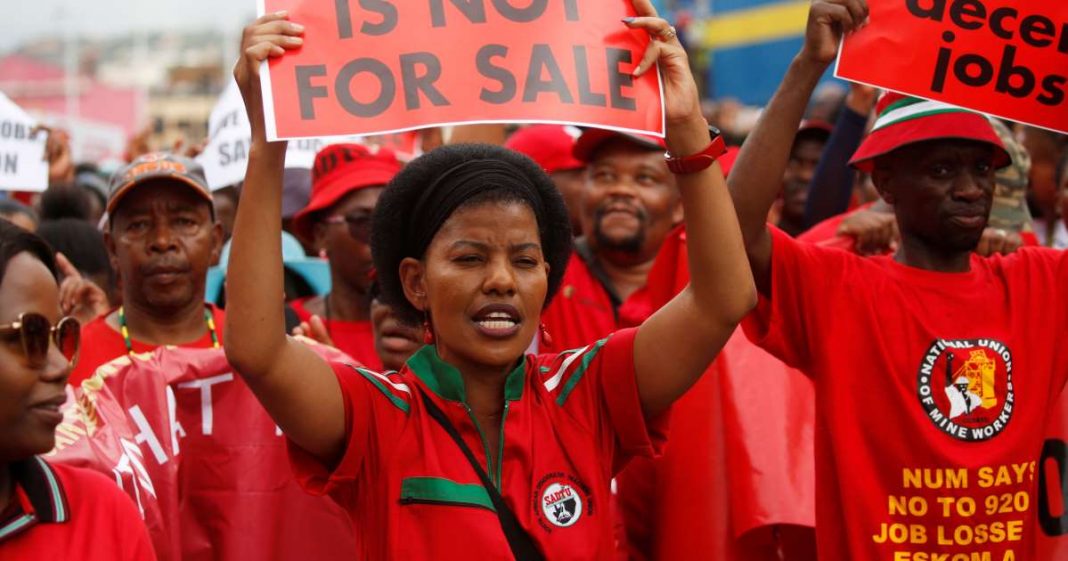
Cosatu Takes To The Streets Over Job Losses, PPE Corruption And Public Sector Wages

- Advertisement -spot_img

Must read

THEBE MABANGA

SOUTH African workers are set to show their muscle, virtually by staying away from work on Wednesday.

In a remarkable display of worker unity, the strike was called by the Congress of South African Unions (Cosatu) and supported by the South African Federation of Trade Unions (SAFTU).

The stay away has been called to protests a range of issues including retrenchments, gender-based violence (GBV), but most notably government’s plans to cut the public sector wage bill and reneging on implementing this year’s increase from the multi-year wage agreement.

It is interesting that workers organised in the private sector are being called upon to support public service workers and raises the question of whether the same will happen when private sector workers face retrenchments as they did even before the outbreak of COVID-19 pandemic.

The Public Sector Wage Bill presents a conundrum for President Cyril Ramaphosa, who has to balance the need to contain costs in the face of deteriorating fiscal position while pleasing an important constituency of workers.

According to the budget released in February, government spent R629 billion in the year to March to compensate South Africa’s 1.2 million civil servants.

Assuming government honours the three-year wage agreement, this amount was set to rise to R697 billion in 2022/2023 fiscal year.

This represents more than a third of non-interest spending.

This was before the supplementary budget released in June in response to the COVID-19 pandemic.

The supplementary budget now raises the debt to GDP ratio from below 70% in 2022/2023 to 89.7% and raises the budget deficit from 6.8% to 14 %, which makes the Public Sector Wage Bill unsustainable.

The question that government has to answer first is whether the South African public service is of the correct size and configuration.

South Africa needs more teachers, nurses, doctors and policemen but the question is whether it needs many of its senior and middle managers whose ranks has swelled over the past decade.

The public sector is the only sector that increased employment in the years following the 2008 Global Financial Crisis, and the wage bill has tripled between 207 and 2019.

The International Monetary Fund (IMF) says South Africa’s spending on its public servants is more than most developed countries and advanced nations but is in line with developing countries in South America, sub-Saharan Africa and Asia.

This is because developing countries tend to be vast, with lower levels of literacy and lack the technological advancement to simplify some public services, like applying for an Identity Document (ID).

Civil servants can argue that the way to afford the salary bill is to grow the economy from its current R5 trillion GDP and thus grow revenue, which will make wages account for a lower proportion.

They might also argue that growing the economy, attracting investment and creating jobs to grow the tax base is the private sector’s responsibility, not theirs.

Government can then point out that far too many things required to attract investments like approving working permits and water licenses, or zoning application still take far too long, and the bureaucracy and red tape lies with the civil service. 

The reality is the economy and revenue are unlikely to grow significantly over the medium term to sufficiently finance unions’ demands.

Government needs to use natural attrition and other measures to reduce numbers.

Something has to give.

(COMPILED BY INSIDE POLITICS STAFF)

More articles

LEAVE A REPLY

Please enter your comment!
Please enter your name here

AVBOB STEP 12

spot_img

Inside Education E-Edition

spot_img

Inside Metros G20 COJ Edition

spot_img

JOZI MY JOZI

spot_img

QCTO

spot_img

Latest article



