
- Advertisement -spot_img

‘Disruptions caused by climate change increase the cost of doing business… and dampen employment growth’ – Ramaphosa

- Advertisement -spot_img

Must read

Johnathan Paoli

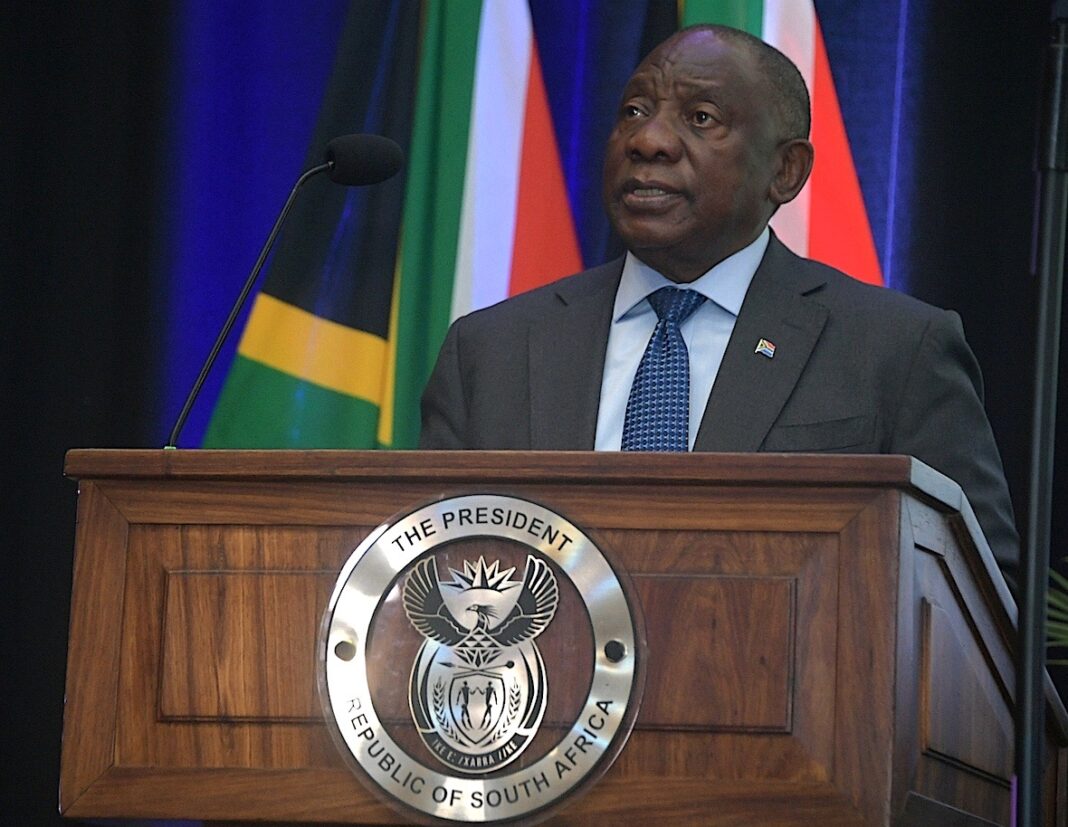
President Cyril Ramaphosa has highlighted the economic dynamics of climate change as a serious concern for the country, while delivering the opening address at the Climate Resilience Symposium, hosted by the National Treasury, on Monday at the Council for Scientific and Industrial Research (CSIR) International Convention Centre in Tshwane.

The three-day symposium is expected to focus on the integration of climate goals into macro-fiscal and finance policy and mainstreaming climate change considerations into the intergovernmental fiscal system and will finish on Wednesday.

Ramaphosa said the symposium was taking place at a time when the country was witnessing first-hand its extreme vulnerability to the impact of a changing climate.

He cited the recent storms which hit parts of the Western Cape, resulting in a shut down of the port of Cape Town as indicative of the fact that climate change is as much an economic issue as it is a scientific, social justice, human rights and development one.

“Disruptions caused by climate change increase the cost of doing business, undermine competitiveness and dampen employment growth,” Ramaphosa said, adding that the disruptions resulted in a decrease in tax revenue and an increased expenditure on disaster relief, health care and social support for the affected communities.

Ramaphosa highlighted the crucial role played by the National Treasury, in light of the manner in which climate change causes infrastructure damage, straining of public finances and the limitation of the government’s ability to invest in other critical areas.

“The National Treasury is therefore central to our response to both the shocks of climate change and the potential opportunities to use the just transition as a springboard to build a more inclusive, resilient and sustainable economy,” he said.

The President called for a strengthening of adaptation and mitigation systems, the building of resilience in communities and the acceleration of decarbonization efforts and the pace of a just energy transition.

“For decades our reliance on coal was a competitive advantage because it allowed us to produce electricity cheaply. But the world has changed and this dependency has come to pose significant risks,” he said.

Ramaphosa however, said there was a need to ensure that decarbonisation happened at a pace and scale that is affordable to the country’s economy and society.

“If we act too fast, we risk damaging huge sections of our economy before we have built alternative energy and industrial capabilities. At the same time, not acting now risks our economic stability,” he said.

The President called for the embracing of a managed transition to a low-carbon economy, in order to safeguard the nation and environment, in addition to ensuring economic resilience and growth.

He said inclusive growth has been prioritised, and the government was busy implementing the necessary reforms needed to lift growth and pursue a fiscal strategy which protects the sustainability of public finances.

Ramaphosa praised Operation Vulindlela as a successful partnership between the National Treasury, the Presidency and a range of departments to enable significant reforms in energy, water, telecommunications and transport.

“Our strategy involves preparing ourselves to withstand the economic risks posed by climate change while taking full advantage of the opportunities of the energy transition,” the president said.

He said the government’s revised Nationally Determined Contribution balances developmental needs and economic realities, and takes into account the feasibility of undertaking a climate response through a set of just transition pathways.

Several initiatives the government has embarked upon to meet the country’s emissions target, namely: the Renewable Energy Independent Power Producer Procurement Programme, the Integrated Resource Plan and the Just Energy Transition Investment Plan, he said.

While he called for the continuation of collaboration between government, business, labour, civil society, communities and international partners in order to address the complexity of climate change.

“If we work together, if we understand the risks and if we appreciate the urgency, we can make our country climate resilient,” Ramaphosa said.

Deputy Finance Minister David Masondo emphasised the need for comprehensive green growth strategies and innovative financing models to support a low-carbon, climate-resilient economy.

Masondo said various strategies to mobilise financial resources for sustainable development, including public and private sector participation and new institutional arrangements were needed, and highlighted the importance of combating illicit financial flows to enhance Africa’s ability to finance climate action.

INSIDE POLITICS

More articles

LEAVE A REPLY

Please enter your comment!
Please enter your name here

CATHSSETTA

spot_img

AVBOB STEP 12

spot_img

Inside Education E-Edition

spot_img

Inside Metros G20 COJ Edition

spot_img

JOZI MY JOZI

spot_img

QCTO

spot_img

Latest article



