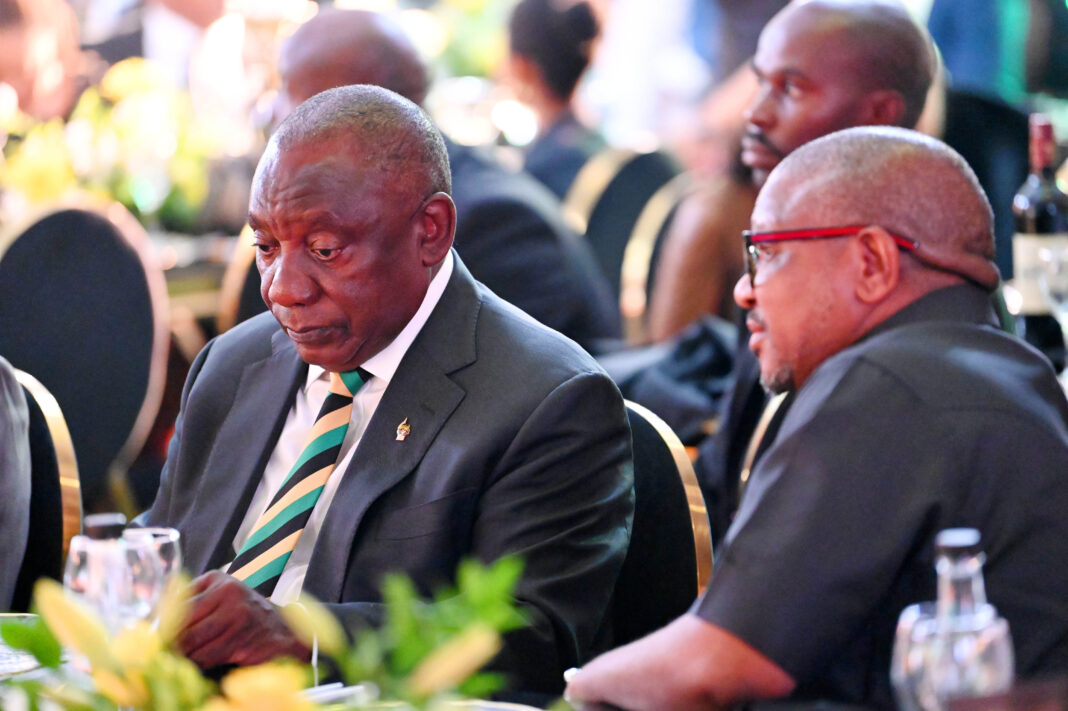
PRESIDENT Cyril Ramaphosa says resolving the energy crisis and putting an end to loadshedding was one of the most immediate and pressing challenges facing government.
Ramaphosa was addressing the ANC NEC Lekgotla on Sunday at Esselen Park, Johannesburg following the induction of 80 NEC members on Thursday.
He said due to loadshedding, companies were reluctant to invest, productivity was dampened, economic growth cannot be sustained and jobs cannot be created on the necessary scale.
“Critical services like water provision, health care and education are disrupted. Persistent loadshedding also adds to safety and security concerns, especially in areas plagued by gangsterism and criminality,” said Ramaphosa.
“Government held briefings with a number of stakeholders over the past two weeks. The National Energy Crisis Committee and Eskom led these briefings to update stakeholders on progress made in implementing the July 2022 Energy Action Plan and outline the work currently underway to accelerate this work.”
Ramaphosa said a team of independent experts has been established to work closely with Eskom to diagnose the problems and take action to improve plant performance, particularly at the six power stations with the most breakdowns.
“These interventions will take some time to have an effect and we must be honest with the people that loadshedding – in one form or another – will be with us for some time. Our objective is to lower the stages of loadshedding to the lower levels whilst we address the overall challenge of ensuring security of energy supply,” he said.
“We need to explain that, in addition to the historical reasons for load shedding, another factor contributing to the current levels of load shedding is Eskom’s effort to correct the mistakes of the past. Eskom has intensified its maintenance programme to reduce unplanned breakdowns and extend the life of power plants. Maintenance is crucial for energy security and this has meant that more generating capacity is taken off-line to be maintained.”
He said the government was not prepared to abandon coal.
“We also need to address the perception that we are called upon to make a trade-off between energy security and a just transition to a low-carbon economy; that we must make a choice between coal and renewable energy,” he said.
“We must not forget that South Africa’s future mix of energy sources is outlined in the Integrated Resource Plan 2019. It envisages a diversity of energy sources, including coal, renewables, nuclear, gas, hydro, storage, bio-mass and other forms of energy.”
He said in terms of the Integrated Resource Plan 2019 (IRP19), several coal-fired power stations are due to be decommissioned between now and 2030, as they have reached the end of their life-cycle.
“We have now embarked a process of repurposing some of these coal-fired power stations to extend their life-cycles. We will also re-skill and retrain some of the workers at these power stations to safeguard jobs,” he said.
“This is necessary not only to reduce carbon emissions, but to address the deteriorating performance of older coal plants which are nearing their end of life. Most of our coal-fired power stations, including Medupi and Kusile, will remain in operation and will continue to provide the ‘base load’ supply.”
The two-day lekgotla in Kempton Park, Johannesburg, is expected to end on Monday.
The lekgotla will also prepare for the president’s State of The Nation’s Address set down for 9 February.
INSIDE POLITICS