
PHUTI MOSOMANE
THE government has terminated, with immediate effect, the National State of Disaster declared by the Minister of Co-operative Governance and Traditional Affairs on 9 February 2023.
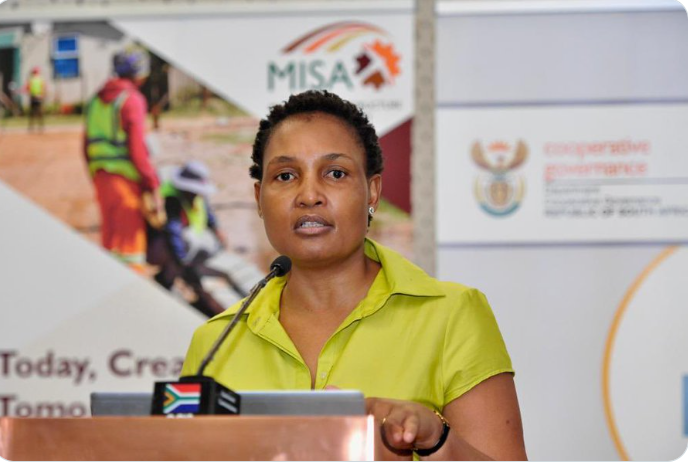
Minister of Cooperative Governance and Traditional Affairs Thembisile Nkadimeng said on Wednesday the State of Disaster was a necessary response to the impact of critical levels of load shedding on the economy and the vulnerable sectors such as health and small businesses.
Following the declaration of the State of Disaster in February, the government adopted wide-ranging regulations which set out the responsibilities of the different organs of the state to mitigate the impact of severe load shedding, prevent the escalation of electricity supply constraints, and avert a national emergency.
These regulations and the underlying actions were put in place in support of the Energy Action Plan.
This was to support an effective and integrated response across all spheres of government. Nkadimeng said the state of disaster enabled the government to enhance interventions by the National Energy Crisis Committee in terms of the Energy Action Plan to fix Eskom and improve the availability of existing supply.
Throughout the declaration, the government also aimed to fundamentally transform the electricity sector to achieve long-term energy security.
The appointment by President Cyril Ramaphosa of Dr Kgosientso Ramokgopa as Minister of Electricity is seen as a significant enabler of the improvement in the supply of electricity.
Ramokgopa has in recent weeks undertaken oversight visits to power stations and consultations within government, including with Eskom, to identify and resolve electricity supply constraints.
However, on Wednesday, Nkadimeng announced the termination the National State of Disaster.
The disaster declaration was published in Government Gazette No. 48009 in Notice No.3019 in terms of Section 27(5)(b) of the Disaster Management Act, 57 of 2002 as amended.
Following the termination of the state of disaster, all regulations and directions made in terms of Section 27(2) of the Act pursuant to the declaration of the national state of disaster to deal with the impact or the severe electricity supply constraint are repealed with immediate effect.
Ramokgopa said the withdrawal of the National State of Disaster on Electricity will have no impact on the ministry’s work going forward.
“The fact that we are terminating the State of Disaster does not degrade our ability to accelerate the delivery of new generation. We can draw from the provisions of the Infrastructure Development Act. We designate those strategic integrated projects and we are able roll them [out].”
“What we know… from an Eskom point of view is that the PFMA [Public Finance Management Act] does make provision… If there are issues around emergencies and if as a result of inaction, we are likely to see loss of life, harm to the environment. The PFMA does provide for us to use provisions on procurement on an emergency basis. There are provisions that allow for deviations and [some of] those deviations address… for example harm to critical infrastructure.”
“Those provisions from a procurement point of view are made possible in the PFMA and therefore, the termination of the State of Disaster has no impact on that,” Ramokgopa said.
Government will, through the Energy Crisis Committee continue to engage, cooperate and coordinate its actions to reduce and eradicate load shedding using existing legislation and contingency arrangements.
These include measures already taken to protect critical infrastructure, facilitate emergency energy generation and protection consumers in terms of relevant competition law.
A range of interventions and support measures introduced by departments as an accelerated response at the time the state of disaster was declared will be sustained in terms of existing legislation.
Nkadimeng expresses her sincere appreciation for the constructive and collaborative way in which stakeholders in civil society have worked with government in a short space of time to achieve progress in keeping the lights on and enabling the economy and public services to function more productively.
EFF Chief Whip, Floyd Shivambu, said: “The National State of Disaster was declared as a measure to contain load shedding! It’s now cancelled with immediate effect and before load shedding is contained. This and the initial attempt to impose an irrational PFMA exemption on ESKOM are symptoms of an imploding government.”
INSIDE POLITICS





