
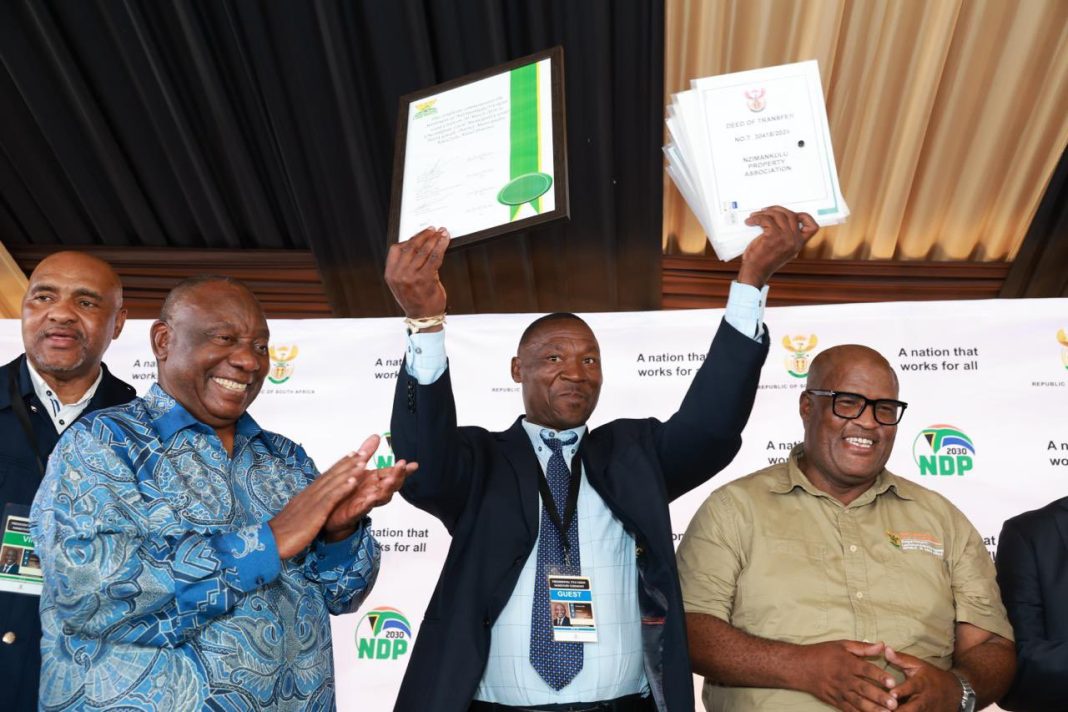


By Akani Nkuna
President Cyril Ramaphosa on Saturday defended South Africa’s land restitution program, saying it is not only about correcting historical injustices but also about restoring dignity to people still excluded from the economy.
“There are some who say that there is no longer any need for affirmative action and employment equity, and they say there is no need for land reform or restitution,” Ramaphosa said.
“Yet we know that restitution is not only about compensation or redress for what happened in the past. It is central to building a just society that upholds the dignity for all.”
Ramaphosa was speaking at a Human Rights Day event in Kimberley in the Northern Cape, marking 66 years since the Sharpeville Massacre, when police shot and killed dozens of black protesters demonstrating against apartheid laws.
His remarks come as the government continues to implement land reform under the Restitution of Land Rights Act, aimed at addressing dispossession caused by apartheid-era laws.
The country is marking Human Rights Month and 30 years since the adoption of the Constitution, which guarantees the right to land restitution under Section 25 of the Bill of Rights.
Ramaphosa said South Africa must fully implement the Constitution and ensure broader participation in the economy.
“And if we are to give effect to the promise of our Constitution, we must pursue the policies of redressing what was done wrong in the past. We must continue with our restitution processes. We must ensure that our economy and the ownership of our economy are extended to those who were prevented from owning a portion of our economy,” he said.
“We must also ensure that it reflects the diversity of the people of our country. We must continue until we fully deliver the social justice that our people deserve.”
Ramaphosa also pointed to progress in women’s empowerment, saying more women now lead key institutions — a sign of constitutional gains.
He described South Africa’s Constitution as among the most progressive in the world but acknowledged ongoing challenges, including poverty and inequality that continue to affect Black South Africans disproportionately.
“These shortcomings have contributed to us not being as far along as we had hoped on this journey, because the economic inequality that still dogs many of our people remains a challenge to the promise of restoring dignity to all South Africans,” he said.
Ramaphosa called on stakeholders to support government efforts through partnerships and coordinated programs to improve living conditions.
Earlier, he addressed the launch of a Human Rights Day Legacy Project at Re Tlameng Special Needs School in Kimberley, saying it promotes inclusion and support for vulnerable communities.
He said more investment is needed to improve infrastructure and expand access to education for children with special needs.
“This school is a beacon of hope for the community, for the province and for the country. It is an example of what is possible with the support of all our social partners,” he said.
INSIDE POLITICS