
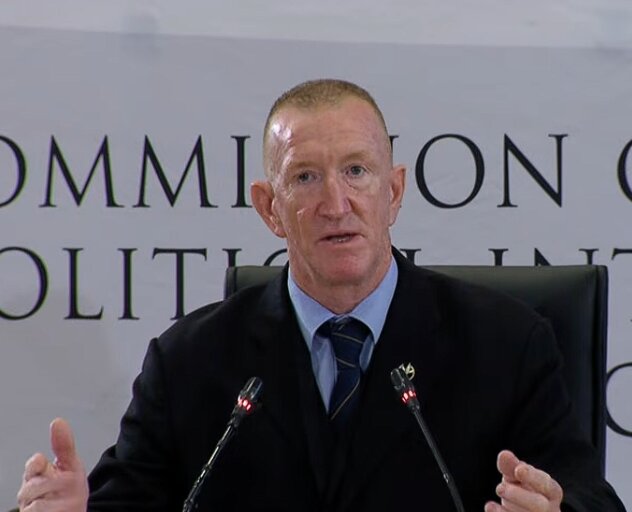
By Johnathan Paoli
KwaZulu-Natal Hawks investigator Warrant Officer Karl Sander told the Madlanga Commission of Inquiry he was wrongly treated as a suspect in the disappearance of 541kg of cocaine from a Port Shepstone Hawks office in 2021 while he was on leave.
The commission resumed hearings on Monday after a two-week recess during which its second interim report was prepared and submitted to President Cyril Ramaphosa last week.
Sander, a veteran narcotics investigator whose name has repeatedly surfaced during testimony relating to major drug busts in KwaZulu-Natal, was called to testify about his involvement in drug investigations and his knowledge of the Port Shepstone matter.
Giving evidence, Sander said he found himself under suspicion after returning from leave following the theft.
“I was a suspect. I was called in. I was polygraphed for it. I was never there, that’s all I know about the Port Shepstone matter,” he said.
He said he learned about the disappearance through media reports while away from work.
“I was on leave, came back to work. It was all over social media that the drugs had been stolen. Got back to the office, our senior managers came into the office one day. Said what they needed to say and we were all told that we are suspects,” he said.
Sander testified that suspended KZN Hawks head Major General Lesetja Senona instructed him and other officials to undergo polygraph examinations as part of the investigation into the missing drugs.
Evidence presented by evidence leader and advocate Lee Segeels-Ncube before the commission indicated that Sander’s polygraph results allegedly reflected signs of deception.
However, Sander said Monday was the first time he had heard of those findings.
“The witness says he was not informed of the polygraph test results or any findings made against him as a result of the test,” Segeels-Ncube said.
Sander also said there appeared to be inconsistencies in documentation related to the investigation.
He told the commission that two reports relating to testing of the seized drugs had been produced, but only one carried a signature while the other did not.
Addressing the handling of narcotics exhibits, Sander explained that experienced drug investigators can often identify cocaine through its appearance and smell, although officers refrain from making definitive claims before laboratory confirmation.
He further testified that alternative storage options existed at the time and suggested the cocaine could have been stored at Isipingo Police Station if suitable facilities had been available.
The commission also heard evidence about Sander’s transfer from operational narcotics work to a support services position.
Commission chair Mbuyiseli Madlanga questioned why an investigator with extensive drug enforcement experience had been moved into procurement-related functions.
Sander said the transfer followed corruption allegations that were presented to him by Senona and other senior Hawks officials.
According to Sander, he was accused of supplying drugs to a Florida Road nightclub syndicate.
He denied the allegations and said he was never shown the email that allegedly contained the claims against him.
“I was informed of the allegations, but I have never seen the email that allegedly contained them,” he said.
Sander suggested that his removal from the narcotics environment may have been linked to the impact of his investigations on organised crime networks.
“I believe I was stepping on many toes while working in the narcotics unit,” he said.
The veteran investigator later turned his attention to what he described as a far broader problem facing South African law enforcement, namely inadequate facilities for storing seized drugs and hazardous chemical exhibits.
Questioned about the condition of SAPS storage facilities, Sander gave a stark assessment.
“If I answer this question honestly, I will get fired today. I would say no. It’s chaos. The problem is working in that chaos is the people that work there are exposed to hazards,” Sanders said.
He said officials handling drug exhibits often require full personal protective equipment due to the dangerous nature of the substances involved.
“In all honesty, I believe the storage facilities is a big problem. It is very expensive to handle them and dispose of them,” he said.
Sander highlighted the dangers posed by methaqualone exhibits, the same substance recently seized during a major operation at the Beitbridge border post involving the Hawks, Border Management Authority (BMA) and other law enforcement agencies.
He warned that methaqualone exhibits can be highly toxic, adding that the substance remains a key ingredient in the manufacture of Mandrax and that South Africa remains a major market for the illicit drug.
INSIDE POLITICS





