- Advertisement -spot_img

Lekota remembered: Courage, sacrifice, and the promise of freedom

- Advertisement -spot_img

Must read

By Thebe Mabanga

Struggle stalwart, Congress of the People (COPE) founder and former Defence Minister Mosiuoa “Terror” Lekota was laid to rest in Bloemfontein, Free State, at a Special Official Funeral in recognition of his patriotism and the role he played in the anti-apartheid struggle.

Political allies, mourners, and family members described Lekota as an extraordinary patriot who lived a life of service and sacrifice, and a constitutionalist who believed that freedom had to be defended even after it had been won.

They said he was willing to reach across political divides to unite South Africans of different persuasions, first to defeat the unjust system of apartheid and later to help build a democratic South Africa.

Lekota’s funeral was held on Saturday in Bloemfontein, Free State.

The funeral was attended by former Presidents Thabo Mbeki, in whose cabinet Lekota served between 1999 and 2008, when he resigned to protest Mbeki’s recall.

Another high-profile attendee was Kgalema Motlanthe, who succeeded Mbeki as President, National Assembly speaker Thoko Didiza, and National Council of Provinces (NCOP) chairperson Refilwe Mtsweni Tsipane, who occupies a role Lekota held between 1997 and 1999.

In her welcome address, Free State Premier MaQueen Letsoha Mathae celebrated Lekota as a visionary and selfless leader who foresaw and warned against many of the problems that now plague the democratic state, including corruption and a detached self-serving leadership.

The premier noted that Lekota was “not a passive observer but an active participant in the creation of a democratic South Africa.”

His political activism prior to the attainment of democracy was captured by three fellow giants of the struggle who were with him in the trenches.

Dr Diliza Mji, an activist, recalled first meeting Lekota in 1972 at St Peter’s in Hammanskraal during a meeting of the South African Students’ Organisation (SASO), where Lekota expressed the unpopular view that the organisation should engage with those who differed with it.

This trait was to serve Lekota throughout his decades of activism.

Mji described the 70s as a “decade of revival” through the emergence of the Black Conscious Movement (BCM) with leaders such as Steve Biko and Barney Pityana.

Lekota was shaped by this era prior to his expulsion and subsequent detention from the University of the North in Limpopo.

Mji also recalled how, while in Natal, they managed to recruit Lekota and nominated him to the predominantly white General Workers Union (GWU) as an organiser, a move that did not go well with white workers, who wanted Lekota expelled.

Following the unbanning of the ANC, they were co-convenors of the ANC Southern Natal, where they worked with leaders such as former Trade and Industry Minister Alec Erwin and established 100 branches in nine months.

Mji was surprised Lekota was not elected regional chair as the province hosted the ANC’s first conference in 1991, following its unbanning.

Lekota went on to be elected to the ANC NEC and rose to become the party’s national chairman until the watershed Polokwane Conference in 2007.

Former Finance Minister Trevor Manuel worked with Lekota from the struggle into democracy.

He described him as having a “giant heart in every respect” and his death allowed the country to “peer into its own collective heart”.

Manuel noted Lekota’s early contribution to democracy as his belief that the ANC should forgive the perpetrators of apartheid as a sign of reconciliation and unifier that he was.

Lekota and Manuel were among those who founded the United Democratic Front (UDF), where they were elected to its National Executive Committee (NEC), where Manuel described Lekota as a ”builder, visionary and public face of UDF” as its Publicity Secretary.

Manuel said Lekota “took the struggle to small towns” and was indefatigable, happiest talking to crowds in such far-flung places than at major rallies in urban centres.

He traversed these towns at a great cost to see his family, and in the two-year period leading to the State of Emergency in August 1985, when UDF activities were disrupted, Lekota had done much of the work establishing its structures.

Manuel noted that, like many Robben Islanders, Lekota was a brilliant raconteur who had the ability to retell familiar anecdotes with fresh humour.

Manuel also noted a deeply and intensely personal time in Lekota’s incarceration when he would retreat to solitude and wrote Letters to my Daughter, addressed to her late daughter Masechaba, and offer his intense reflection of the struggle and its multi-faceted nature, which cut them off from families, even when not in prison.

Manuel also noted Lekota’s quality of reaching out to people who were different backgrounds, most famously to Afrikaner farmers when he became Premier of the Free State, an Afrikaner province when South Africa became a union and bolstered by apartheid.

Manuel said Lekota “valued diversity and did not suffer fools” and alluded to this trait as being partly responsible for his recall as Premier of the province for a willingness to confront those he disagreed with.

Manuel ended his tribute with an extract from Pablo Neruda’s So is my Life.

Another comrade of many decades was former North West Premier Popo Molefe, who was a Delmas Treason trialist with Lekota.

Molefe described Lekota’s life, and his own indirectly as “a tapestry of episodes and political phases that brought us the freedom we enjoy today.”

He notes that a common thread that runs through these phases is the “determination to dismantle apartheid as overarching goal of various formations.”Molefe praised Lekota’s energy, which would not be dampened by incarceration and had the ability to mobilise people into action.

He also praised his “generosity of spirit,” which distinguished him and earned him the title, “Hero of the People.”

Their role at the UDF was to set up the national office and set up five other regions.

This took them to small towns such as Kroonstad and Tumahole near Parys in the Free State, and Huhudi near Vryburg in the North West.

It was this mobilising work, specifically in the Vaal, that set them on a collision course with the apartheid state.

Lekota had mobilised the community in events that led to clashes with authorities and the death of five councillors.

This led to them being charged with five murders, high treason, sedition, terrorism, and overthrowing the state by violence, among a litany of charges.

Molefe says they realised that Judge Kees van Dijkhorst had determined their fate and Lekota decided that they would instead use the trial as a platform to spread the UDF message of a democratic future of non-racialism that they fought for.

Molefe further described Lekota as being “part of a great generation of heroes whose determination inspired hope in the future they were building as non-racial and non-sexist.”

ANC Secretary General Fikile Mbalula, also a native of the Free State, said Lekota recognised that “leadership requires courage to confront injustice and freedom must be defended even after its obtained.”

He also knew that “power without moral purpose is dangerous”.

Mbalula said it is this principled stance that led to Lekota to famously serve the ANC with “divorce papers” to form COPE as he felt the ANC “had strayed from its values.”

Mbalula said Lekota “never concealed that his political heart rested with the ANC and its guiding mission.”

He described Lekota’s burial as planting “a seed of hope and optimism.”

He told COPE: “You have lost a selfless leader who carried the burden of leadership with courage,” and that he was “a servant of the people.”

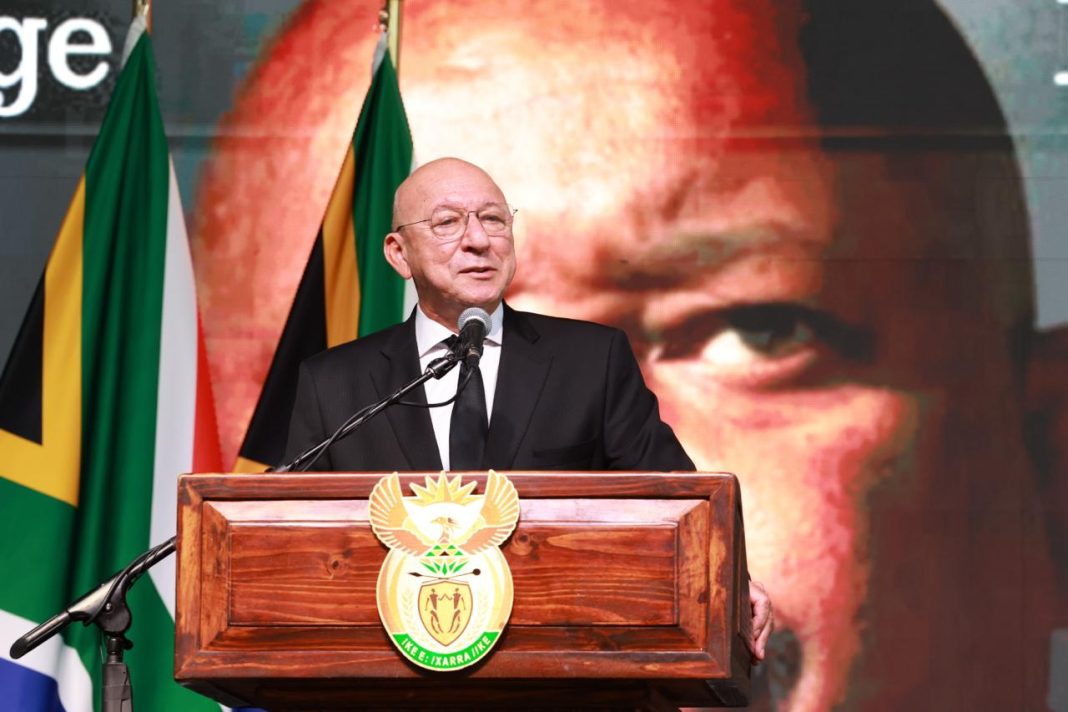
In his eulogy, Deputy President Paul Mashatile praised Lekota’s ethical leadership and how he valued unity, or the notion of “Congress”.

He also highlighted how Lekota abhorred corruption, as it divides the nation and steals resources meant for the poor.

Mashatile then outlined the key achievements of each of his key appointments.
“As the first Premier of the Free State, Honourable Lekota stepped into a province scarred by apartheid and laid the foundations of a unified, non-racial government.” Mashatile said.

“He was instrumental in forming the provincial administration, in advocating for, and in embarking on the long journey to build a government that served all citizens.”

“As Chairperson of the National Council of Provinces and later Minister of Defence, he carried the burdens of leadership with dignity. He envisioned a Defence Force not as an instrument of repression, but as a guardian of democracy and peace, a vision that continues to guide us today.”

Lekota’s time in KwaZulu-Natal brought him to meet his wife, the actress Cynthia Shange who was praised as having held their family together through Lekota’s incarceration, travel through UDF activism, and later government business.

Ayanda Shange recalled Lekota as a senior “who became an uncle to the uncles in his family” and gave his family love and warmth, with transcended marital bonds into family.
KwaZulu-Natal. Before the funeral, a maternal cousin, the journalist Matshediso Setai acknowledged the extended family structure he was raised in and embraced it with love and warmth, especially to the family’s young ones.

He was described as warm-hearted who valued family.

And thus, Mosiuoa Lekota, the firstborn son and oldest of nine, of Mapiloko Meshack Lekota and Mamosiuoa Aphaphia Lekota (nee Setai), whose life journey took him from Senekal, to Kroonstad, then Marianhill in KwaZulu-Natal.

It then briefly took him to the University of the North and then to Robben Island then throughout South Africa to fortify the resistance to apartheid through the UDF, then to prison as a treason trialist.

His life journey culminated in the upper echelons of power as premier and cabinet minister in a democratic state he helped bring about.

He was interred as a hero in Phahameng cemetery at Mangaung in his home province of the Free State.

INSIDE POLITICS

More articles

LEAVE A REPLY

Please enter your comment!
Please enter your name here

CATHSSETTA

spot_img

AVBOB STEP 12

spot_img

Inside Education E-Edition

spot_img

Inside Metros G20 COJ Edition

spot_img

JOZI MY JOZI

spot_img

QCTO

spot_img

Latest article