

By Johnathan Paoli
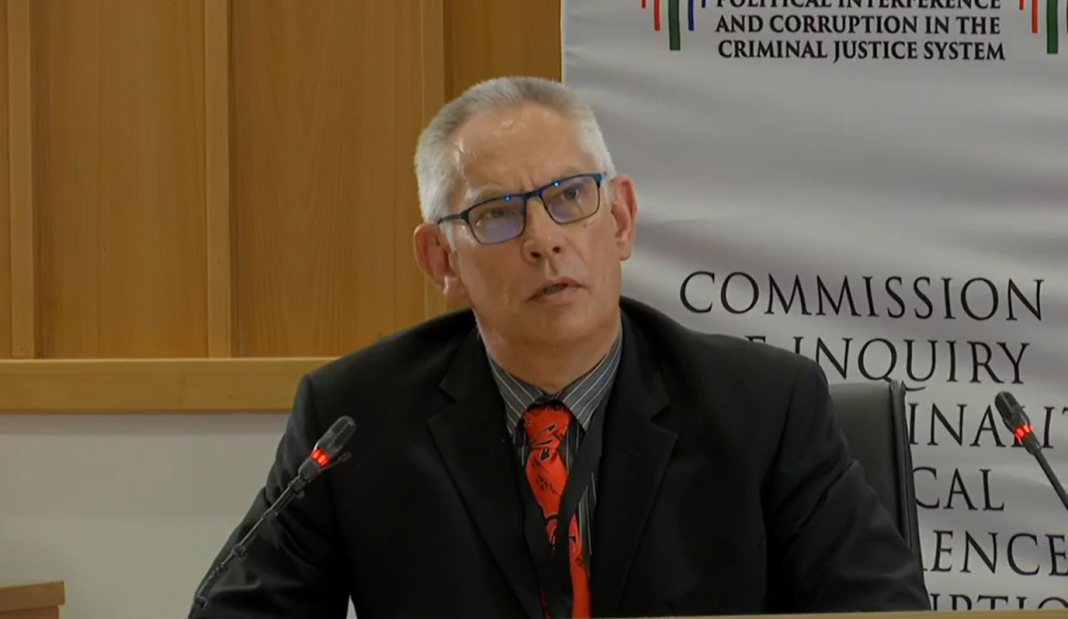
The Madlanga Commission’s investigation into corruption and criminal infiltration within South Africa’s justice system took a dramatic turn on Tuesday as retired Ekurhuleni Metro Police Department (EMPD) deputy commissioner Revo Spies revealed that over 200 metro police officers remain in active service despite having criminal convictions.
“There’s no policy if an officer gets a criminal record during his or her career. There are no interactions between the different data systems of the metro police departments. An officer can go to Durban on holiday, commit a rape, and come back to work, and we would not know. I, as a municipal officer, do not have access to the criminal records of my officers,” Spies said.
Spies also testified that suspended acting EMPD Chief Julius Mkhwanazi personally refused to undergo vetting or submit his fingerprints for vetting, and actively blocked the same process for his subordinates.
Spies told the commission that a 2021 directive issued by then-chief Isaac Mapiyeye had required all EMPD personnel to submit fingerprints for background checks as part of a standardised vetting process.
The decision followed discussions at a SAPS Metro Police Chiefs Forum which had recommended that municipal police officers be subjected to the same vetting procedures as members of the national police service.
Spies said that the directive was grounded in law, allowing all employees of state organs to be vetted, and warned that any officer refusing to comply could face disciplinary action.
However, when the time came to implement the directive, Mkhwanazi’s Specialised Services Division, which included roughly two hundred officers, refused to cooperate.
According to Spies, when he raised the matter in a meeting, Mkhwanazi became enraged, accused him of implying that he had a criminal record, and publicly phoned then-city manager Imogen Mashazi, claiming she had instructed that the vetting process not proceed.
Shortly after that call, EMPD’s head of Human Resources halted the entire process, effectively protecting a significant portion of the force from scrutiny.
Spies said that by the time the process was suspended, the partial results already revealed the depth of the problem within the department.
Out of 3,760 EMPD employees, 3,174 had no criminal record, but 275 officers were found to have criminal convictions and another 100 were awaiting trial.
A further 211 officers had not submitted fingerprints at all, many of them belonging to Mkhwanazi’s unit.
The convictions ranged from assault and theft to drunk driving, reckless driving, rape and murder.
Spies said four officers had been found guilty of murder and another four of rape, while fifteen others were awaiting trial for murder and fourteen for fraud.
Some of these convictions, he said, dated back decades, yet the officers had remained on the payroll and in uniform.
In one case, an officer who had been convicted of murder but never sentenced continued to serve for years before being arrested again for a separate offence.
Spies explained that the absence of a policy dealing with officers convicted while in service had allowed such individuals to remain within the system.
He recalled one instance in which an officer convicted of murdering his wife was later reinstated after serving his sentence and successfully challenging his dismissal on the grounds of unfair labour practice.
He said such cases demonstrated how deeply the problem had taken root within the institution.
Spies also told the commission that Mkhwanazi himself had repeatedly and “blatantly” refused to be vetted, insisting that the process was not part of his employment contract and that he was exempt from such checks, which would have included a lifestyle audit and polygraph test.
Even after a 2024 meeting in which HR officials promised to restart the process, Mkhwanazi reportedly dismissed the effort, saying those conducting the vetting could not be trusted.
The entire exercise was eventually abandoned, leaving the department paralysed on a critical governance issue.
The revelations come after Spies’ earlier testimony that Mkhwanazi had been involved in covering up the alleged 2022 torture and murder of a civilian, whose body was allegedly disposed of by officers under his command.
Despite a civilian turning state witness in that case, no one has ever been charged.
Spies has also alleged that Mkhwanazi orchestrated a plot to assassinate him after their relationship deteriorated over corruption allegations.
The commission continues.
INSIDE POLITICS