
By Thebe Mabanga
Africa needs its leadership, across politics, business, labour and civil society, to assert control over the continent’s mineral wealth and negotiate better terms of access with the rest of the world, including on beneficiation.
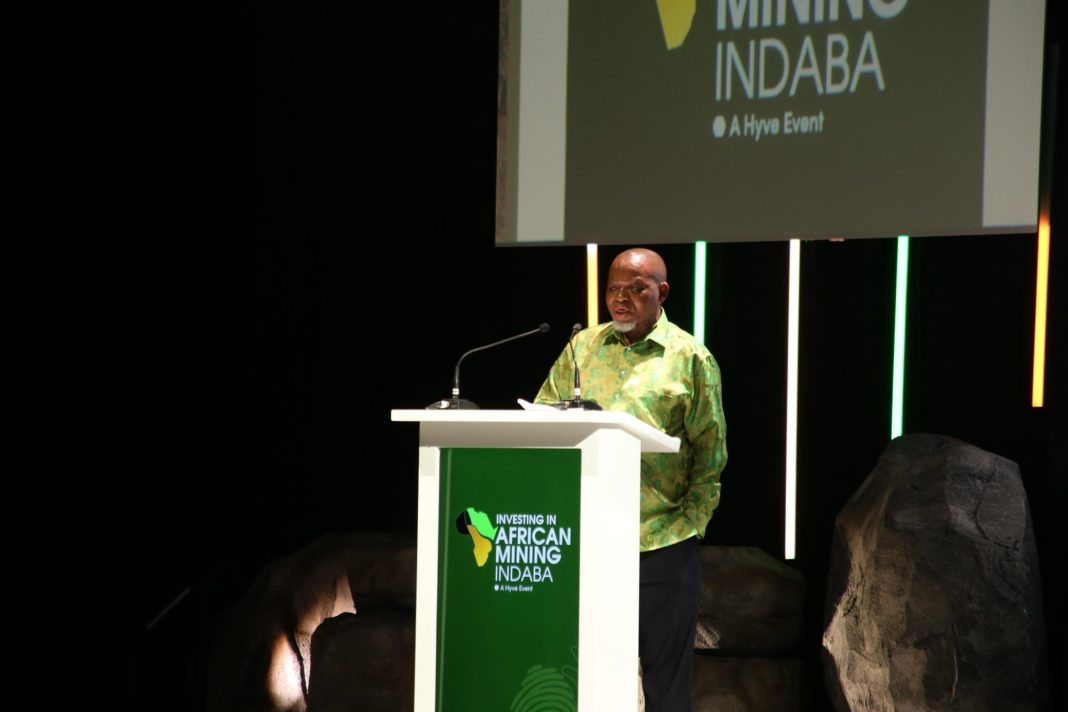
This was the view expressed by Minister of Mineral and Petroleum Resources Gwede Mantashe in his traditional opening address at the 32nd Investing in African Mining Indaba, currently under way in Cape Town.
“This year’s Indaba convenes at a moment of profound global uncertainty. We are witnessing heightened geopolitical tensions, driven largely by competition among some developed economies seeking greater control over the natural resources of developing nations,” Mantashe said.
“This dynamic represents a serious threat to the sovereignty of resource-endowed countries, the majority of which are here on the African continent.”
Mantashe said this context informed the organisers’ decision, under the theme Stronger Together: Progress through Partnerships, to convene the second African Ministers’ Critical Minerals Roundtable in partnership with the African Union.
The Roundtable brought together governments, investors and strategic partners to strengthen continental leadership on critical minerals.
Addressing the Roundtable, traditionally held behind closed doors on the Sunday ahead of the conference, Mantashe said, “Africa does not have a minerals problem, but rather a leadership problem.”
He argued that African countries with shared mineral endowments should negotiate export terms collectively rather than as individual states.
Drawing on his trade union background, Mantashe likened this approach to collective bargaining, which he said benefits both workers and mineral-rich countries.
Mantashe reiterated his long-standing criticism of the term “critical minerals”, arguing that while minerals used in clean energy transitions, such as rare earths, are deemed critical for different reasons — from defence industries in the United States to electronics and technology sectors in China — all minerals are critical.
He added that minerals such as coal, often labelled “dirty” alongside oil, remain critical to countries where they are abundant.
He announced that the Junior Mining Exploration Fund currently stands at R2 billion and urged mining companies to contribute to it, noting that it supports exploration by junior miners.
The fund currently backs eight projects, four of which have reached the mining development stage.
Supported projects include a rare earth exploration initiative in Bothaville in the Free State.
Mantashe further revealed that since last year’s Mining Indaba, government has issued 328 exploration licences and 32 mining licences.
He also defended Black Economic Empowerment, which has recently come under criticism and cited as a deterrent to investment.
Mantashe rejected this view, saying BEE is “necessary for including people who were denied access by the apartheid government”.
He concluded by commending the mining industry for recording a historic low of 41 fatalities in 2025, while acknowledging that the sector remains some distance from achieving Zero Harm.
He contrasted the figure with tragedies such as the September 1986 Kinross Mining Disaster, in which 177 miners were killed, at a time when the industry recorded about 500 deaths annually.
That disaster led to sweeping safety reforms, including the elimination of plastic materials in underground equipment, and to the Leon Commission, which culminated in the promulgation of the Mine Health and Safety Act in 1996.
INSIDE POLITICS





