
By Johnathan Paoli
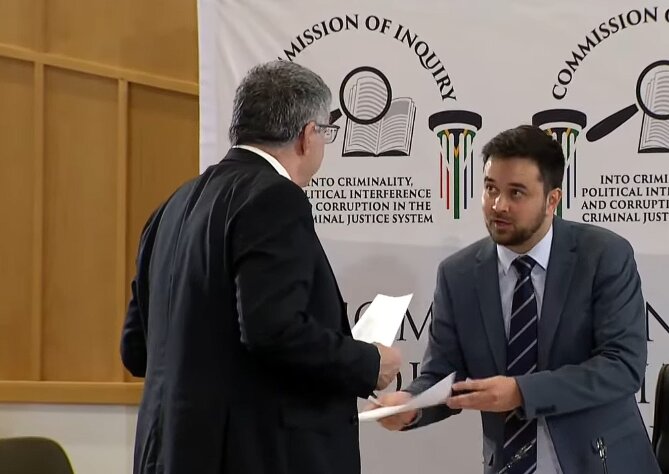
World Bank anti-corruption expert Albertus Schoeman has told the Madlanga Commission of Inquiry that South Africa’s corruption prevention framework is failing to detect criminal infiltration of the criminal justice system because of weak financial disclosure rules, ineffective lifestyle reviews, and inadequate sanctions.
Testifying before the commission on Thursday, Schoeman revealed that no full lifestyle audits have been conducted on senior South African Police Service (SAPS) officials over the past five years, despite persistent corruption concerns within the police.
ALSO READ: Former SA Air Force General jailed in US for acting as foreign agent
“The gaps in the financial disclosure form’s requirements and the vulnerabilities of a weak institutional framework help explain why no misconduct or unexplained wealth has been detected among SAPS officials over the last five years,” he said.
Instead, SAPS has relied on lifestyle reviews and investigations, which Schoeman said have produced virtually no meaningful results.
His evidence examined whether South Africa’s financial disclosure regime is capable of identifying corruption and conflicts of interest among senior public officials, and what reforms are needed to strengthen integrity across the criminal justice system.
Schoeman said that while South Africa has an extensive anti-corruption framework on paper, the systems intended to prevent corruption are fundamentally ineffective in practice.
His report to the commission states that evidence heard during the inquiry points to “systematic conflicts between the duties of public officials and their personal interests”, including interference in investigations, the disclosure of confidential information to criminal syndicates and the manipulation of procurement processes for personal gain.
He argued that corruption prevention should not focus solely on investigating wrongdoing after it occurs, but on establishing systems capable of detecting conflicts of interest and unexplained wealth before corruption becomes entrenched.
Schoeman distinguished between lifestyle reviews, lifestyle investigations and full lifestyle audits. He explained that reviews are preliminary assessments based largely on officials’ financial disclosure forms, while full lifestyle audits involve forensic analysis of an individual’s complete financial affairs.
ALSO READ: WATCH: One year after Mkhwanazi’s explosive briefing, here’s what has happened
He said lifestyle reviews have significant limitations because investigators rely heavily on information voluntarily disclosed by officials.
According to Schoeman, officials can withhold key financial information, including bank records, making it difficult to identify unexplained wealth.
By contrast, full lifestyle audits allow investigators to access financial records and verify whether an official’s assets and spending patterns are consistent with their lawful income.
His report found that no SAPS officials were referred for lifestyle investigations between the 2021/22 and 2023/24 financial years.
In 2024/25, only five of SAPS’ 823 senior managers underwent lifestyle investigations, all of whom were cleared. None of the cases progressed to a full lifestyle audit.
Schoeman said the figures demonstrated that the existing integrity management system was failing to detect misconduct despite extensive allegations of corruption before the commission.
He also criticised the current financial disclosure framework, describing it as the cornerstone of integrity management but one that contains significant loopholes.
Among the weaknesses he identified were the exclusion of family members from disclosure requirements, the absence of beneficial ownership declarations, insufficient information on when and how assets were acquired, and the omission of several asset categories, including cryptocurrencies, bank accounts, high-value movable property and loans made to third parties.
He warned that these shortcomings make it easier for officials to conceal illicit wealth through spouses, children, trusts, nominee arrangements or associates.
The report also found that South Africa’s integrity management system is fragmented across multiple institutions, including the Department of Public Service and Administration, the Public Service Commission, departmental ethics officers and the Special Investigating Unit, resulting in duplication, inconsistent standards and weak oversight.
Schoeman argued that decentralising verification and consequence management allows departments to “self-police”, creating opportunities for political pressure, institutional capture and inconsistent disciplinary action.
Figures presented to the commission show there has been only one dismissal across the public service in the past two years for financial disclosure misconduct.
He said such limited consequences undermine the credibility of the system and fail to deter officials from submitting incomplete or false declarations.
Schoeman recommended a comprehensive overhaul of South Africa’s corruption prevention framework through stand-alone financial disclosure legislation, expanded disclosure requirements covering family members and beneficial ownership, stronger verification powers, greater automation of the eDisclosure platform and tougher sanctions for non-compliance.
He also recommended introducing civil mechanisms to recover unexplained wealth where officials cannot account for assets exceeding their lawful income, rather than relying solely on criminal prosecutions.
“Where an official’s assets cannot be explained by their lawful income, the most effective recourse is not necessarily a new criminal offence but a civil or administrative mechanism to recover the unjustified portion of that wealth,” he said.
“Non-conviction-based confiscation allows the state to recover assets exceeding an official’s lawful income without having to prove the underlying criminal conduct through which they were acquired, and without the higher evidentiary burden and procedural safeguards that a criminal prosecution demands.”
Schoeman concluded that South Africa had reached the limits of incremental reform and required a comprehensive restructuring of its integrity management framework to prevent criminal infiltration of the public sector and restore confidence in the country’s anti-corruption institutions.
The commission adjourned, with testimony from Witness M, relating to suspended Gauteng Crime Intelligence head Major-General Feroz Khan, set to continue in the afternoon.





