
By Johnathan Paoli
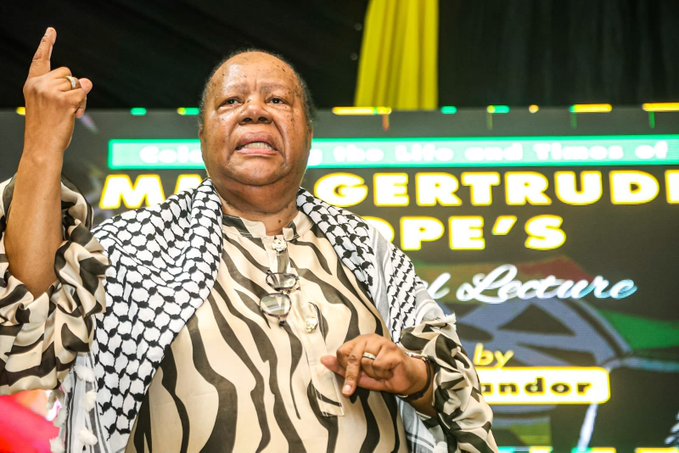
Former International Relations Minister and ANC veteran Naledi Pandor has called on the ANC Women’s League (ANCWL) to honour struggle stalwart Gertrude Shope by urgently tackling the party’s internal challenges and restoring its glory.
Delivering the Gertrude Shope Memorial Lecture in Pretoria under the theme “Bearing the Burdens of History with Dignity and Courage,” Pandor said Shope would have been dismayed by corruption, dysfunction and the erosion of ANC values.
Using Shope’s life as a mirror for the movement’s present struggles, Pandor acknowledged the ANC’s decline in cohesion and credibility, but stressed that renewal must be rooted in service to the people.
“We have lost our glory, the people are looking at us with horror and shame. We need the copper-wire scourer, not the sponge, to clean the pot. Renewal must be practical, not rhetorical,” she said.
Paying homage to Shope as a multifaceted leader of resilience and humility, Pandor described her as a figure who carried turbulence with calm and dignity.
“Ma Shope had a look which said, ‘I can cope with whatever is sent my way.’ That is the kind of strength urgently necessary today,” she said.
The memorial lecture, hosted in partnership with the Shope family and the Baleka Mbete Foundation, marked the centenary of the liberation stalwart.
Born in 1925, Shope rose to prominence as a fearless activist, international organiser, parliamentarian, and lifelong champion of women’s emancipation.
The programme celebrated her extraordinary life while also offering pointed reflections on the state of the ANC, South Africa, and the African continent.
Tributes from the Shope family were followed by a memorial tree-planting ceremony, symbolising the deep roots she laid for future generations.
Senior leaders—including ANC Secretary-General Fikile Mbalula, members of the ANC Women’s League, former Deputy President Baleka Mbete, and former Minister Nkosazana Dlamini-Zuma—were among the dignitaries present.
Born in Johannesburg but raised in Zimbabwe, Shope trained as a teacher before joining the liberation movement.
Forced into exile from 1966 to 1990, she became a formidable figure in the global anti-apartheid struggle.
She represented the ANC at the Nairobi Women’s Conference, worked with the World Federation of Trade Unions, and served as secretary to Florence Mophosho, helping establish the influential Voice of Women publication.
She was also among the leaders of the historic 1956 Women’s March to the Union Buildings, where 20,000 women protested against pass laws.
Pandor highlighted that Shope and her contemporaries sought neither accolades nor material reward, but were driven by commitment, comradeship, and conviction that apartheid could be defeated.
Returning from exile, Shope played a central role in rebuilding the ANC Women’s League, stabilising the Kimberley Conference alongside Albertina Sisulu, and later serving in parliament from 1994, where she was admired for her discipline, advocacy for children, and promotion of social services.
Pandor argued that Shope would have urged today’s leaders to confront crises with boldness—whether domestic challenges or global instability—by strengthening multilateralism, advancing African unity through the African Continental Free Trade Area, and harnessing the continent’s natural resources for development.
“We did not say we are fighting against men, but that as one family we need to fight together,” she said.
Looking ahead, Pandor identified four urgent priorities for South African women in Shope’s spirit: tackling gender-based violence, empowering rural women, building a global women’s movement, and mentoring younger generations through intergenerational cooperation.
She also linked Shope’s solidarity with liberation struggles worldwide to today’s conflicts, highlighting the plight of Palestinians under Israeli occupation.
Pandor said Shope would have been appalled by Israel’s assault on international law and proud of South Africans who continue to stand with oppressed peoples across the globe.
As the lecture drew to a close, Pandor returned to the central theme of Shope’s life—courage in the face of turbulence.
“Ma Shope would say there is nothing worse in an organisation or a country than a leader without solutions. Her legacy to us is simple: aluta continua—the struggle continues,” she said.
INSIDE POLITICS





