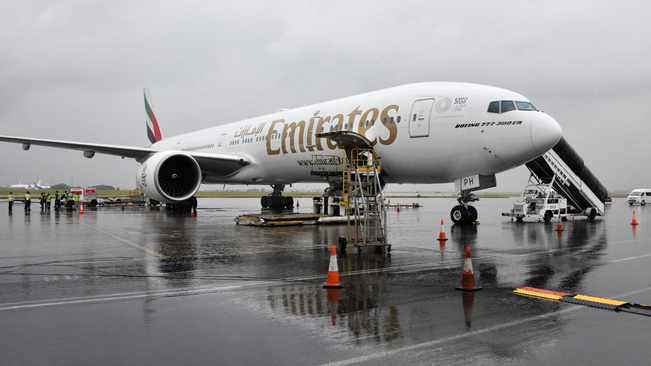
THE Emirates plane carrying South Africa’s first batch of COVID-19 vaccines arrived on Monday at the OR Tambo International Airport.
The consignment of vaccines was received by President Cyril Ramaphosa and deputy-president David Mabuza.
“Today marks a major milestone in our fight against the coronavirus pandemic as we receive our first consignment of the vaccine. This batch will benefit our healthcare workers who have been at the forefront of keeping us all safe,” said Ramaphosa.
“We thank all South Africans and all the researchers who have contributed toward ensuring the successful development of the vaccine.”
Once the consignment has undergone quality checks, which are going to take between 10 and 14 days, the country will begin its long-awaited, three-phase immunisation campaign. Following the inoculation of front-line healthcare workers, other high-risk groups such as the elderly, people with comorbidities and essential workers such as minibus drivers, police and teachers are going to receive their shot. The third phase targets everyone else above the age of 18.
The arrival of the jabs comes a month after the United Kingdom was the first to roll out the vaccine developed by the University of Oxford and the pharmaceutical company AstraZeneca, and some two months after the UK and the United States began using the Pfizer-BioNTech vaccine.
Responding to accusations that the delay was caused by the South African government starting negotiations too late, Deputy Director-General for the National Department of Health Dr Anban Pillay told Al Jazeera: “We could not procure a vaccine without knowing that it is effective, safe and when it would be delivered. This info only became available in December for some vaccines. We had to wait to have this info before we make a financial commitment.”
Under its agreement, South Africa is paying $5.25 per shot, $2 more than what is going to cost when the same vaccine arrives within the deal the African Union (AU) has secured for African countries.
Professor Barry Schoeb, who chairs the Ministerial Advisory Committee (MAC) on COVID-19, said South Africa prioritised the AstraZeneca-Oxford vaccine as “it is the one that was immediately available”.
Authorities aim to vaccinate 40 million South Africans by the end of 2021, or 65 percent of the population of almost 60 million. “But efficiency will depend on a whole lot of factors,” Mkhize acknowledged in a public web briefing about the vaccine last week, including the uncertainty of whether South Africa is going to actually receive the ordered doses.
While he promised the government would do its best to get as many people vaccinated as possible, “many other countries are currently not getting the supplies they ordered”, the minister cautioned.
According to official sources, 21 million shots of the Pfizer (12 million) and the Johnson & Johnson (nine million) vaccines have been secured through collective programmes such as the World Health Organization-backed COVAX scheme and the AU, as well as bilateral deals with suppliers.
Meanwhile, Mkhize told a Sunday newspaper another 20 million shots had been ordered by Pfizer, taking South Africa’s expected supply to more than 40 million doses.
“These vaccines are secured and awaiting manufacturers to submit final agreements with details of delivery dates and exact amounts,” Mkhize told The Sunday Times.
South Africa is the African country most affected by the pandemic, counting almost 1.5 million confirmed cases and nearly 44,000 related deaths. In January, new daily infections peaking at more than 20,000, the vast majority of whom could be traced back to a new strain identified last year.
Meanwhile, President Cyril Ramaphosa will address the nation at 8pm on developments relating to the country’s response to the coronavirus pandemic.
(SOURCE: INSIDE POLITICS. Additional reporting by Al Jazeera)