By Johnathan Paoli
President Cyril Ramaphosa has defended the current policy path while acknowledging the ongoing need for better governance, service delivery, and regulatory efficiency.
He also stressed his administration’s focus on long-term structural reforms, economic inclusion, and growth driven by minerals.
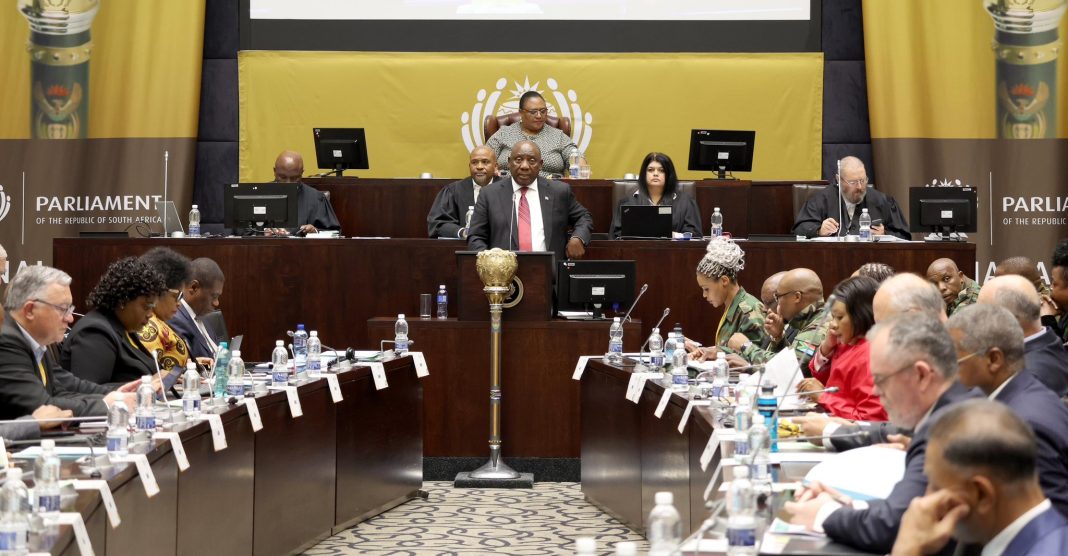
Despite disruptions by the EFF in Parliament, including interruptions regarding unidentified presidential protectors, Ramaphosa provided extensive responses in the National Assembly.
He addressed questions on mineral resource taxation, racial policy classifications, economic strategy, rising living costs, and South Africa’s diplomacy amid the Russia-Ukraine conflict.
In response to an ANC MP Mdumiseni Ntuli, Ramaphosa discussed enhancing South Africa’s mineral wealth management amidst global shifts towards renewable energy.
He noted a World Bank report revealing that South Africa currently captures only 40% of potential revenue from natural resources but clarified there are no immediate plans for a mineral royalty overhaul or a new resource rent tax.
“Any company that extracts a mineral resource in our country is required to pay the South African government a mineral royalty,” he said.
The president explained that the current royalty regime already integrates resource rent tax principles by adjusting rates according to profitability.
Mineral royalties doubled during the 2021–22 commodity boom, reaching R28.5 billion, though they declined to R16 billion in the 2023–24 fiscal year.
He also highlighted the recently adopted Critical Minerals Strategy, which aims to boost local beneficiation and value addition in minerals crucial to the green economy.
In response to a question by Marlon Daniels of the Patriotic Alliance (PA) regarding racial classification in policy, Ramaphosa reaffirmed the inclusive definition of “African” and the country’s commitment to redress.
“Every South African is by definition an African,” the President said.
However, he noted that the continued use of apartheid-era racial terms remains necessary for tracking progress in overcoming historical inequalities.
“Until we have reached our goal of equality for all people in our country, there will be circumstances when we need to use such terminology,” he explained, citing legislation like the Broad-Based Black Economic Empowerment Act and census classifications by Statistics South Africa.
Democratic Alliance (DA) MP George Michalakis raised concerns about the escalating cost of basic necessities, with food prices reportedly increasing nearly 40% above inflation.
Ramaphosa noted that food inflation has since dropped significantly—from 12.7% in 2022 to just 2.2% in March 2025.
He credited the country’s macroeconomic policy, VAT exemptions on staple foods, and redistributive fiscal spending.
The president confirmed that the government spends around 60% of its revenue on the social wage, referencing social grants, education, healthcare, and municipal support packages.
He also emphasised the expansion of food relief programs, such as the Department of Social Development’s 3,000 food centres, and infrastructure reforms to lower commuter costs.
Freedom Front Plus MP Corne Mulder questioned the government’s economic policy direction under the 7th administration.
The president outlined key interventions from the Medium Term Development Plan, which emphasises inclusive growth, infrastructure investment, industrialization, and job creation.
Over the next three years, the government has committed to spending R1 trillion on public infrastructure.
Reforms are also underway to boost public-private partnerships, support high-growth sectors (like green hydrogen and electric vehicles), and modernize the visa system.
Ramaphosa highlighted the expansion of the Operation Vulindlela programme, particularly in electricity, logistics, and digital infrastructure.
“Cabinet recently approved an ambitious Digital Transformation Roadmap,” Ramaphosa added, describing a future focused on integrated, tech-enabled governance and service delivery.
On foreign policy, the president reiterated South Africa’s call for peaceful resolution in the Russia-Ukraine war.
Answering ANC MP Moleboheng Modise-Mpya, he affirmed that diplomacy and inclusive dialogue remain South Africa’s preferred strategy.
He cited engagements with both Russian President Vladimir Putin and Ukrainian President Volodymyr Zelenskyy, including the African Peace Initiative and multilateral forums.
“We support initiatives that ensure food and energy security for the African continent,” Ramaphosa stated, emphasising the broader global impact of the conflict.
Finally, in response to a question from the Leader of the Opposition in the uMkhonto weSizwe party, John Hlope, the president addressed the slow pace of justice in prosecuting apartheid-era crimes.
He announced the formal establishment of a judicial commission of inquiry to investigate whether efforts were made to obstruct these prosecutions.
Ramaphosa detailed efforts already underway, including the creation of a Truth and Reconciliation Commission (TRC) Component within the National Prosecuting Authority, currently handling 158 cases.
Reparations exceeding R500 million have been paid out, with further support for victims and their families continuing.
“The delay in the investigation and prosecution of apartheid-era crimes has caused great pain. It is in the interests of justice that we establish the reasons for this delay,” he acknowledged.
INSIDE POLITICS