PHUTI MOSOMANE
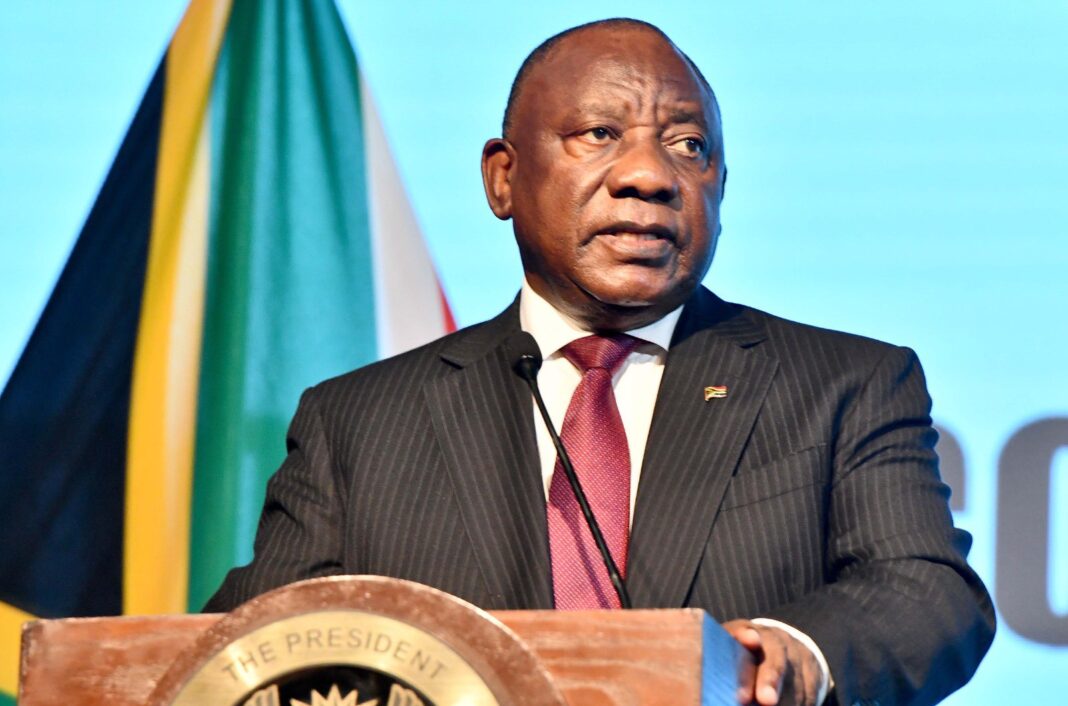
PRESIDENT Cyril Ramaphosa on Wednesday emphasized the need for increased efforts to utilize the constitution as a transformative tool to address the issues of poverty, unemployment, and inequality.
Ramaphosa delivered a keynote address at the first day of the three-day National Conference on the Constitution held at the Gallagher Convention Centre in Midrand, Gauteng, under the theme “Reflections on the Constitution: Rule of law, accountability, social and economic justice”.
The South African Constitution was adopted by the Constitutional Assembly on 8 May 1996 and certified by the Constitutional Court in October 1996. On 10 December 1996, former President Nelson Mandela signed the Constitution into law and it came into effect on 4 February 1997.
“Despite numerous achievements, there are still many challenges in the realisation of the vision, values and prescripts of our Constitution. South Africa’s constitutional project will fail if vast inequalities and existing levels of poverty are not addressed by all levels of government,” said Ramaphosa.
In his address, Ramaphosa noted that the continued existence of high levels of poverty, unemployment, inequality, corruption, and violence highlights the fact that the journey towards achieving the promised land is still ongoing.
“The contours of our racist and sexist past still feature in private and public institutions, in business, in access to skills, wealth and opportunity, and in the spatial configuration of our cities, towns and rural areas,” he said.
Ramaphosa, one of the key figures behind the drafting of the South African Constitution, referenced the landmark Soobramoney v Minister of Health case to illustrate the significance of the rights enshrined in the Constitution.
The case was decided by the Constitutional Court of South Africa in November 1997 (Soobramoney v. Minister of Health [Kwazulu-Natal]) and deal with the interpretation of the rights to emergency health care and to life contained in the South African Constitution.
“We live in a society in which there are great disparities in wealth, millions of people are living in deplorable conditions and in great poverty. There is a high level of unemployment, inadequate social security, and many do not have access to clean water or adequate health services. These conditions already existed when the constitution was adopted and a commitment to address them, and to transform our society into one in which there will be human dignity, freedom and equality, lies at the heart of our new constitutional order. For as long as these conditions continue to exist that aspiration will have a hollow ring,” the courts ruled.
Ramaphosa said that the ruling called for social justice in circumstances where a large proportion of South Africans live in poverty and where, despite substantial progress, many are still unable to access land, housing, water, food, health care and education.
The Constitution recognises that to advance this transformational promise, all spheres of government and all organs of state are required to provide “effective, transparent, accountable and coherent governance”.
He said ensuring that organs of state execute their constitutional mandates effectively, the legislative branch of government has the power to hold respective executive organs to account and have oversight over the implementation of legislation and the conduct of other organs of state.
Parliament, as a representative of the citizens, has a clear mandate to hold the President, Deputy President and Ministers to account, individually and collectively, for the exercise of their powers and performance of their functions.
“The success of our constitutional democracy will, to a large extent, depend on how these challenges are addressed,” he said.
He told delegates that the conference should reflect on issues such as progress on land restitution and reform, electoral reform and governance, and transformation of the economy.
It should also reflect on corruption, crime and national security, and how these issues impact on the exercise and protection of human rights.
Ramaphosa said the strengthening and entrenchment of constitutional democracy requires ethical, committed and effective leadership in all spheres of society, political will and the support of all our citizens.
He urged ordinary South Africans to be involved in the development of the country.
“There is no viable state or effective constitutional democracy without the support and involvement of citizens in the different public formations.”
“Apart from paying taxes, observing the law, and contributing to social and economic development, citizens also play an important role in the establishment of our various governance structures and in holding accountable those put in charge to serve the nation,” he said.
Over the past 25 years of the Constitution, he said a lot of progress has been made in redressing the injustices of the past.
“Some of these measures include the provision of housing, water and sanitation, and social grants for the elderly, persons with disabilities and children. There has been a distinct improvement in access to land, education and health care services.”
“These are part of ongoing efforts to address economic and social injustices,” he added.
The three days event is taking place at the Gallagher Convention Centre in Midrand, Gauteng, under the theme “Reflections on the Constitution: Rule of law, accountability, social and economic justice”.
The conference gives the nation an opportunity to reflect and engage in dialogue on the past 25 years of the Constitution, nation building, gender equality, youth economic empowerment, service delivery and social stability, with the objective of charting a way forward that builds on the gains of democracy.
As a platform for deliberating on continuous, robust debate on the purpose and effectiveness of the Constitution, the National Conference on the Constitution intends to broaden the discourse on the Constitution and encourage members of the public to participate in the conversation on constitutionalism and the state of democracy in the country.
Some of the focus areas in the programme include:
• Transforming and building an independent and resilient judiciary;
• Transforming and growing the economy as a constitutional imperative;
• Progress on land reform: restitution and distribution;
• Governance and electoral reform;
• Effectiveness of constitutional and independent statutory bodies in strengthening
constitutional democracy.
The conference will be attended by prominent figures of South African society including academics, members of legislatures, constitutional and independent statutory bodies, mayors, political parties, youth, students, business leaders, religious leaders, representatives of the legal fraternity, traditional leaders and the media.
INSIDE POLITICS