


By Thapelo Molefe
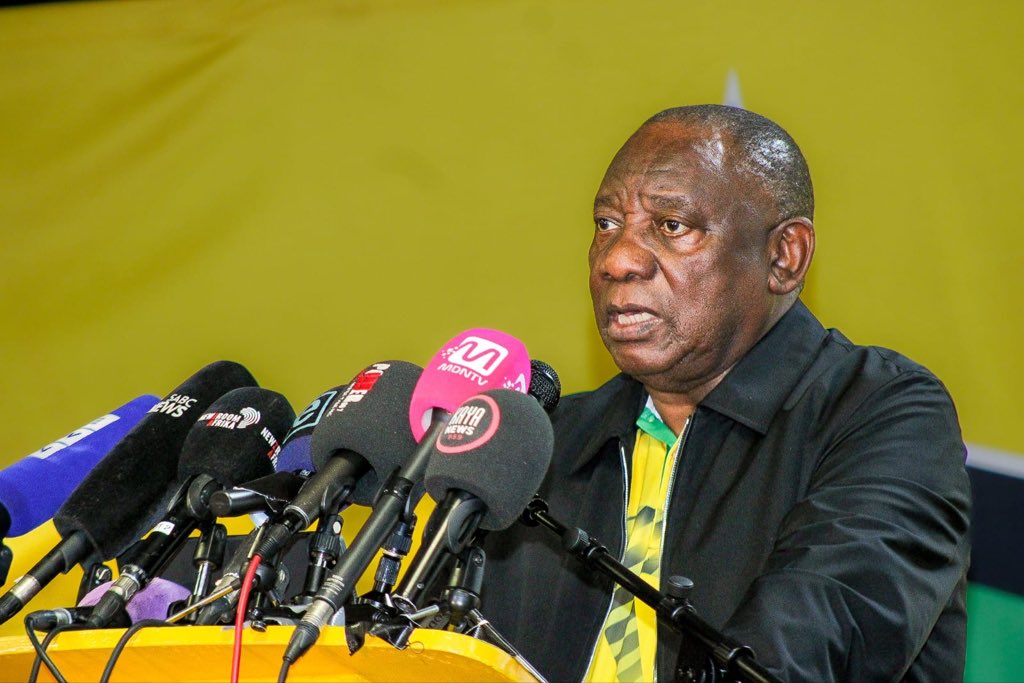
ANC President Cyril Ramaphosa on Monday unveiled the party’s new 10-point Economic Action Plan, aimed at lifting South Africa’s growth rate to 3% as the economy continues to struggle below the 1% mark.
Announcing the plan at the end of the ANC’s Special National Executive Committee (NEC) meeting at the Birchwood Hotel in Boksburg, Ramaphosa also revealed the establishment of a high-level Economic War Room in the Presidency to track and improve government performance.
The three-day NEC meeting comes at a critical juncture for the ANC, now governing through a Government of National Unity (GNU), as it faces sluggish growth, soaring unemployment at 33.2%, and waning public confidence following years of state dysfunction and corruption scandals.
Ramaphosa told the NEC that the ANC’s immediate task was to “move from policy to performance”.
“We are not here to start from scratch. We have made progress, but now we must move faster. This is going to be about implementation, implementation, implementation,” Ramaphosa said.
Ramaphosa said the ANC’s 10-point Economic Action Plan was designed to accelerate inclusive growth, create jobs, and restore confidence in both the ANC and the state.
The plan will use electricity tariffs and investments in transmission infrastructure to drive industrial growth and ensure reliable energy supply, while fast-tracking the recovery of freight and logistics through Transnet’s recovery plan and private sector participation.
It will further rebuild the chrome and manganese industries, improve the state’s capacity to manage large infrastructure projects, and drive local economic development with a focus on townships, rural areas, and small towns.
The plan also prioritises scaling up public employment programmes, expanding support and financing for SMMEs, strengthening provincial economies outside major centres, diversifying trade partnerships under the African Continental Free Trade Area and BRICS agreements, and ensuring effective budget and macroeconomic coordination across government.
These interventions are designed to work together to stimulate growth, create jobs, and ensure that the ANC’s developmental agenda delivers real results for ordinary South Africans.
Crucially, the ANC NEC resolved to set up an Economic War Room in the Presidency, a monitoring structure that will track delivery across government departments, publish progress reports, and ensure accountability.
Ramaphosa said the NEC reaffirmed the ANC’s commitment to professionalising the public service and rebuilding state-owned enterprises, which have been crippled by mismanagement and corruption.
“Corruption corrodes competitiveness,” he warned.
“We will insist on consequence management, lifestyle audits, and integrity standards across the public sector.”
He said the Special Investigating Unit (SIU) continues to play a key role in uncovering wrongdoing, and its recent reports show that government is serious about tackling corruption.
The NEC also endorsed stronger oversight mechanisms within municipalities and provincial structures, linking local economic development and infrastructure spending to national growth targets.
The tone of this Special NEC marks a clear shift for the ANC, from internal introspection to outward accountability.
After months of coalition negotiations and questions about its relevance in a changing political landscape, the party is now seeking to reassert itself as the central driver of South Africa’s recovery.
The ANC’s credibility has been tested in recent years by governance failures, persistent load-shedding, and corruption revelations at state-owned entities.
Ramaphosa acknowledged that while progress has been made in stabilising Eskom and improving Transnet’s freight operations, the impact has yet to reach ordinary South Africans.
“The intractable impact of poverty, unemployment and the high cost of living is unacceptable,” he said.
“We must accelerate the pace and massively scale up our efforts.”
INSIDE POLITICS