
- Advertisement -

Malema denied appeal on firearm conviction, granted leave to challenge sentence

- Advertisement -

Must read

By Des Erasmus 

Senior advocates for Julius Malema secured only a partial court victory on Thursday after East London magistrate Twanet Olivier refused the EFF leader leave to appeal his conviction on firearm charges, but granted him leave to appeal the five-year prison sentence imposed earlier in the day.

“With regards to the … conviction, this court abides by its decision, as stated on record. This court has not had a change of heart and clearly stands firm on its decision to convict. Therefore, leave to appeal in respect of conviction is not granted,” Olivier said. 

ALSO READ: Madlanga Commission delays Carrim testimony after hospitalisation

She reached a different conclusion on sentence after hearing arguments, saying there was “always a possibility that another court may come to a different conclusion regarding sentence”. 

Leave to appeal the sentence was accordingly granted.

Explaining how she dealt with the applications, Olivier said that a trial court is not called upon to decide whether an appeal will ultimately succeed, but whether there are reasonable prospects that an appeal court could take a different view. 

She said that magistrates should not “take the easy way out” by simply deferring to a higher court. 

Faced with an application for leave to appeal, she said, the trial court is “duty bound to make an honest reassessment of his or her decision” and, where warranted, should candidly acknowledge if it has had “a change of heart”, to save time and costs and to better serve the interests of justice.

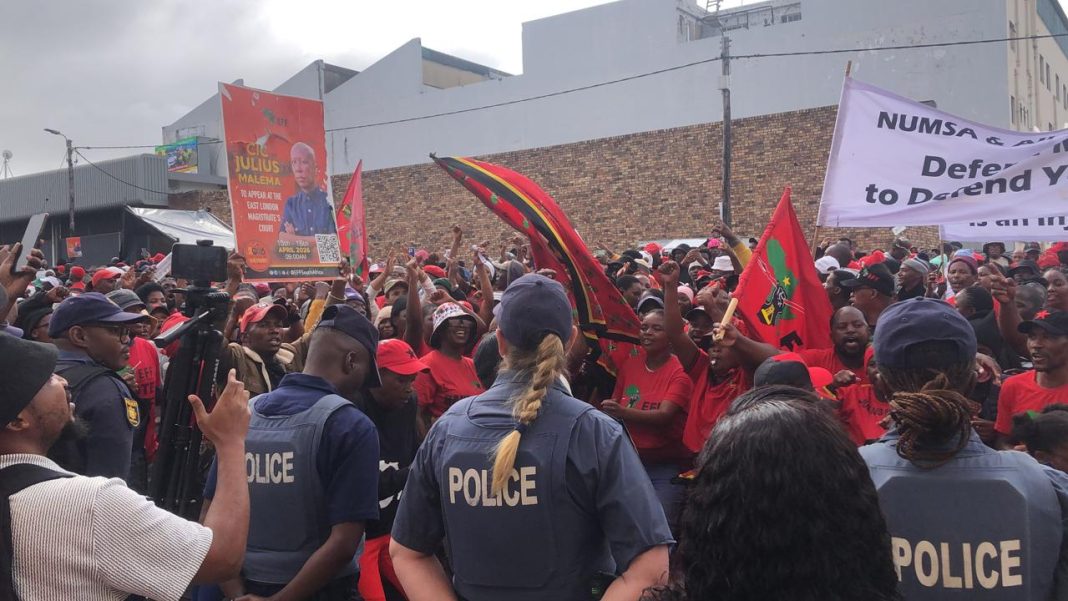
EFF members picketing outside the East London Magistrate’s court after Julius Malema’s sentencing.

Malema, who has remained on bail throughout the proceedings and complied with earlier court orders, was permitted to remain on warning pending the appeal process, including any petition to higher courts.

Olivier’s decision followed a sustained argument from Malema’s veteran legal team that both conviction and sentence were vitiated by legal misdirection and that another court could reasonably come to a different conclusion.

If the sentence survives the appeals process, Malema will be disqualified from serving in the National Assembly. 

Before sentencing was announced, Advocate Laurence Hodes SC, on behalf of Malema, submitted that another court could “realistically” reach a different conclusion on both the facts and the law. 

ALSO READ: WATCH: Day 2, Julius Malema attends pre-sentencing hearing

He said Olivier had adopted a “biased approach” by accepting the state’s case wholesale, particularly in her treatment of the state’s ballistics witness, Lieutenant-Colonel Mandisi Mgwadleka, whom she described as a “super qualified expert witness”, and then allowing that favourable assessment to inform her view of the rest of the state’s witnesses.

By contrast, Hodes said, the court had been unduly critical of the defence witnesses. “These findings by the court indicate the application of a type of reverse onus upon the accused to prove his defence, whereas … the accused’s version only had to be reasonably possibly true,” he said.

He also challenged the court’s treatment of the video footage from the 2018 rally at which Malema fired a semi-automatic rifle, saying it had been used as “real evidence” and then, in effect, diminished. 

The inferences drawn from it, he argued, could not safely stand without objective corroboration. “This could never be the case in the absence of any objective corroboration that one would have expected to be present at the scene,” he said.

Regarding the sentence, Hodes described the five-year term as “startlingly inappropriate” for conduct arising from a single episode lasting less than a minute and, he argued, one that ought to have been treated as a single incident for sentencing purposes.

He said the court had paid “insufficient regard” to Malema’s personal circumstances, in that he was a first offender, 37 at the time of the incident and was now 45, married with three children, employed full-time and involved in community work. 

“There is no basis to contend that he is a danger to society that ought to be removed from society,” Hodes said, adding that Malema had led a “blameless life” throughout the trial and had committed no further offences.

Hodes argued that there was no precedent for direct imprisonment for “celebratory” gunfire alone. 

He submitted that the possession, ammunition and discharge counts were so closely connected that “this could even be regarded as a duplication” because “discharge of a firearm with ammunition is impossible absent the firearm and ammunition”.

He also accused Olivier of straying into political terrain in her sentencing remarks, saying her references to the cost to taxpayers and the inconvenience to other court users amounted to a “material misdirection”. 

“With respect, it becomes something of a political speech,” he said. “Could you imagine if we had to take everything into account in every trial? … Why not blame [Malema] for the potholes and for the weather as well?”

For the state, advocate Joel Cesar opposed the application, contending that there were no reasonable prospects of success on either conviction or sentence. 

He submitted that Olivier had properly considered “all the evidence, including the video evidence, which the court deemed to be admissible”, and that there was ample proof that Malema fired the shots.

ALSO READ: Malema vows appeal as firearm case continues

“It’s our submission that … there was enough evidence for the court to come to that particular finding that the accused did indeed fire [those] particular shots, and that there are no prospects of success relating to the conviction and sentence in this regard,” Cesar said.

He added that a “mere possibility that another court might come to a different conclusion is not enough”. 

To grant leave in those circumstances would amount to a waste of judicial resources, he said. 

Regarding the sentence, Cesar said the prison term was fair and that there was similarly no basis for another court to interfere.

Advocate Tembeka Ngcukaitobi SC, also for Malema, said the state had not engaged meaningfully with the defence’s grounds, and that the threshold for leave to appeal was lower than that required on appeal itself.

“It seems that my friend wishes us to argue that your worship is wrong, but we don’t have to argue that you are wrong,” he told Olivier. 

“It is on appeal that we will argue that you are wrong. What we are dealing with today is merely a question of whether there is a realistic probability that another court might come to a different conclusion.”

Ngcukaitobi said the state’s response was both limited and generic, and that there were “many other grounds for leave to appeal that have been advanced. The reality … is that none of those have been responded to”. 

He said the sentence appeal had “the most excellent prospects of success”, particularly because the case law on the discharge of firearms was not settled. 

“It would be proper for your ladyship to say, ‘Look, I’ve done my job. Now let the High Court relook at this matter and decide what it wishes,’” Ngcukaitobi said.

INSIDE POLITICS 

More articles

LEAVE A REPLY

Please enter your comment!
Please enter your name here

AVBOB STEP 12

Inside Education Quarterly Print Edition

Inside Metros G20 COJ Edition

JOZI MY JOZI

QCTO

Latest article



