
By Akani Nkuna
The Minister of Electricity and Energy, Kgosientsho Ramokgopa has moved to downplay concerns over suspected and widely reported airborne radioactive leaks at Koeberg Nuclear Power Station, insisting there is no threat to public safety while reaffirming the government’s commitment to pressing ahead with its nuclear power expansion programme.
“I really want to say to the country that we are safe, there is reason to be suspicious. Some apprehension, anxiety, we will clarify that with a great level of detail. The exposure that is Koeberg is in fact the exposure that we encounter in our daily lives,” he said.
ALSO READ: Mashatile welcomes water acceleration programme launch in Babanango, KZN as a victory for dignity
“The message I want to convey as a minister is that we are proceeding with the nuclear build programme. We are looking forward to an additional 20 years of the lives of the two units at Koeberg as we introduce 5GW of Nuclear built programme.”
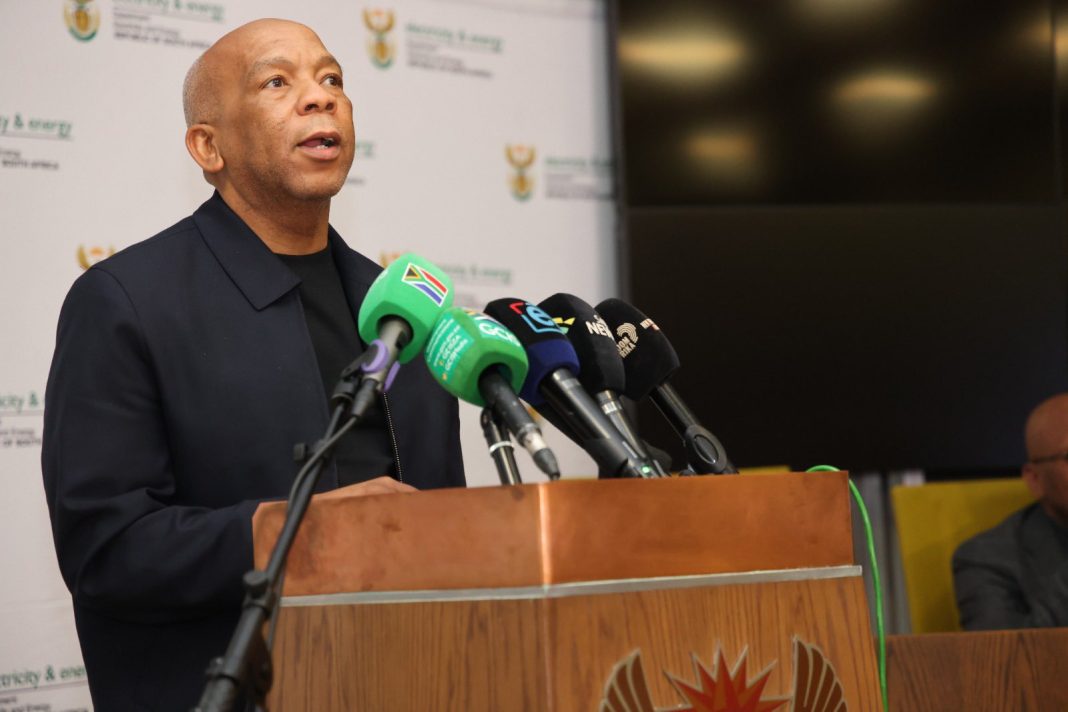
Ramokgopa was addressing the media in Pretoria on Sunday, outlining the department’s version of events at the recent incidents which occurred at Koeberg Nuclear Power Station as well as the current operational status of the facility and the outage.
This comes after there were four separate contamination incidents recently on 30 June, 2 July, 7 July, and most recently on 16 July, which South Africa’s National Nuclear Regulation said on Thursday, 16 July, that they were duly contained inside the station with respect to established safety guidelines.
The regulator also emphasised that workers were screened and that they were recorded to have radioactive contamination below the level a person is exposed to when they have a dental X-ray scan, therefore no cause for concern.
Chief Nuclear Officer, Velaphi Ntuli, said that 245 additional workers had undergone a body count. He attributed the 2 July incident to a faulty Portable Ventilation Unit, which had burnt out, saying that investigations are ongoing.
ALSO READ: Ramaphosa appoints media expert Philly Moilwa as new MDDA board chairperson
Ntuli highlighted that after the workers underwent the screening tests, it was revealed that the highest radioactive dose when factoring all four incidents, was recorded at 20 microsieverts, which was so little compared to the standardised 20,000 per year microsieverts an employee is allowed to have.
“I want us to contrast the 20 microsieverts that this team received, and the 20,000 microsieverts that this team [is allowed]. The issue of issuing potassium iodide tablets they were not necessary for two reasons: the first reason was that those, as you can see, it was very low 20 microsieverts,” Ntuli said.
“But also the reason that potassium iodide tablets were not necessary. Their purpose is to saturate your gland with iodine… that is only important when you have a fuel melting or an incident with your fuel. As I have indicated, the fuel current is not even in the containment building; it safely stored in the fuel building.”
ALSO READ: England, France in 10 goal thriller for World Cup Bronze medal match
Eskom Board Chair, Mteto Nyati, reiterated that the elevated radioactive contamination that was detected at Koeberg was contained at no risk to the environment and the public, adding that it demonstrated the strength of the entity’s safety systems and that of the employees.
He underscored SA’s ambitions to expand its nuclear programme beyond electricity supply, but to also establish reliable energy, sustainable growth, and further nurture the development of critical skills.
“South Africa already supplies about 20% of global medical isotopes. The nuclear build will strengthen this contribution to healthcare, whilst creating meaningful opportunities for universities and related industries through skills development and local participation,” Mteto said.
INSIDE POLITICS





