
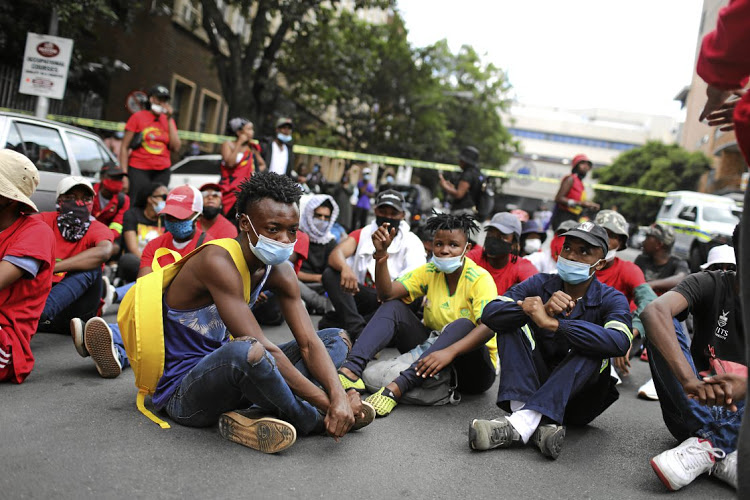
THE SA Communist Party and Congress of South African Trade Unions say the current chaos in higher education in South Africa were a direct result of Finance Minister Tito Mboweni’s budget cuts and austerity measures.
The bilateral meeting took place this week and was attended by the SACP’s General Secretary Blade Nzimande and COSATU’s president Zingiswa Losi.
The bilateral meeting resolved that at the centre of the funding problems affecting colleges and universities was the ‘endemic capitalist crisis and neoliberal policy of austerity’, inclusive of the paradigm of budget cuts over the years dating to previous administrations.
This week, thousands of the country’s 26 universities embarked on a national shutdown against financial exclusion.
The student movement is calling for the debt of R13 billion to be cleared, the allocation of funding from the National Student Financial Aid Scheme, or NSFAS, to new students and for laptops to be provided as universities have moved their academic programmes online.
Mboweni allocated R37.3billion to NSFAS for 2021-22 in last month’s budget that will only increase by 1.7% annually for the next three years, while inflation for post-school education is at 4.7%.
Funding for higher-education institutions was cut by R8bn for the next three years as the National Treasury trimmed the spending allocation for some parts of the government in an attempt to narrow the fiscal deficit and slow debt growth without increasing taxes.
“The budget presented last month to Parliament by the National Treasury continues the cuts to funding support affecting higher education and training institutions throughout the current medium-term expenditure framework up to its outer year, 2023/2024,” both the SACP and COSATU said in a statement.
“This path of neoliberal austerity, often referred to as “fiscal consolidation”, amounts to defunding education and other key economic and broader social development priorities.”
The bilateral said that due to the economic impact of COVID-19, including retrenchments, wage cuts, and increased unemployment and poverty, the number of students eligible for National Student Financial Aid Scheme (NSFAS) funding has increased.
“The meeting reaffirmed education as a right, as elaborated in the Freedom Charter and the Constitution of the Republic,” both organizations said.
“Additionally, our shared resolutions attach great importance to the goal of free education for the poor and working-class, who cannot afford student fees.”
Meanwhile, the SACP and COSATU has welcomed the efforts by the government to reprioritise funds to support the National Student Financial Aid Scheme (NSFAS).
“This will contribute to addressing the problem of funding experienced by students eligible for NSFAS coverage during this academic year. However, the SACP and COSATU wish to stress the importance for the government to go beyond that, to ensure that the NSFAS is adequately funded, going forward, and no deserving student is excluded,” according to the bilateral.
“Furthermore, the government must rollback education defunding and expand the technical, vocational, and higher education and training sector. This will contribute to
the success that South Africa needs, among others to eliminate the phenomenon of young people who are Not in Employment, Education and Training (NEET).”
The bilateral further said that Technical and Vocational Education and Training (TVET) colleges are crucial to developing cutting-edge productive capacity through a skills revolution.
“To admit more students than universities, the TVET colleges should, by far, offer more education and training programmes than they offer now. Funding cuts affecting the TVET sector are a major setback to employment creation and co-operatives and small and medium-sized enterprises development.”
The SACP and COSATU said the government must attend to this question as a matter of priority, bearing in mind that TVET colleges require a massive expansion of qualification types and diversity based on high quality and adequate infrastructure.
The SACP and COSATU said they were strongly of the view that the private sector, as a major consumer of education and skills capacities in the country’s economy, must come to the party and contribute significantly to the funding of higher education not only focusing on universities but also, and with more emphasis, on TVET sector.
The bilateral added: “The government must use its legislative and policy muscle to ensure that this does happen. Education and training cannot be left to the government fiscus alone, especially in a country with such a large and wealthy private capitalist sector and high levels of inequality.”
“The SACP and COSATU, working with the progressive student movement, together committed to embarking on a joint campaign to ensure that this does happen. The SACP and COSATU strongly condemn opportunistic attempts at hijacking student struggles for factionalist interests and agendas inside our movement.”
- Inside Politics





