
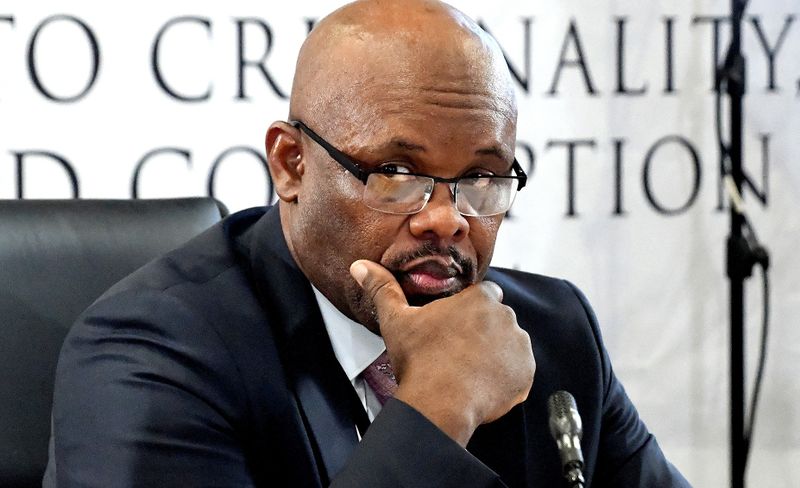


By Charles Molele
Suspended deputy national police commissioner for crime detection, Lieutenant-General Shadrack Sibiya, aimed a dagger blow on Thursday at the national commissioner Fannie Masemola and crime intelligence boss Lieutenant-General Dumisani Khumalo, saying they did not have an objection to the disbandment of the Political Killings Task Team (PKTT) in KwaZulu-Natal.
Sibiya, who testified for the second day at the Madlanga Commission, put all the blame for the PKTT disbandment going ahead on Masemola, who he says should have told then Police Minister Senzo Mchunu he did not agree with his decision and pushed back against it.
Sibiya, a career cop with over 37 years in the police force, also cited the minutes of a November 2024 meeting, which he said recorded discussions about the disbandment with Mchunu and Masemola present.
“If the national commissioner was not in agreement, he ought to have gone back to the minister,” Sibiya, who stands accused of improper and criminal conduct and of being on the payroll of alleged cartel boss Vusimuzi “CAT” Matlala.
He dismissed Masemola’s earlier claim that he had been ‘surprised’ by the move to disband, insisting that they were “together” in planning the winding down of the unit.
“The testimony of the national commissioner that the decision to disband the PKTT came as a surprise is difficult to reconcile with the events preceding the directive. He said the task team was meant to evolve into a unit at a later stage. He could not have been surprised because he participated in those meetings,” said Sibiya.
“I was not surprised by the directive. I didn’t expect that he would disband in December, or that it would happen. What I knew was that it was a subject of discussion.”
He told the commission that police leadership had relied on the Maree report, which recommended that task teams such as the PKTT be integrated into permanent structures — specifically the Murder and Robbery units.
According to Sibiya, several meetings were held where the future of the task team was “ventilated”, including proposals to integrate it into existing murder and robbery units.
While acknowledging that the PKTT had been doing good work, Sibiya argued that capacity constraints in provinces such as the Western Cape and Gauteng — where murder rates remain high — required a more equitable distribution of resources.
“We were focusing a lot of money on one political task team serving the interests of one province,” he said, adding that taxi violence, political killings, and general murder and robbery investigations required broader resourcing.
On whether he had consulted with Khumalo, head of the PKTT, Sibiya said his role was to relay the message following consultative meetings in which Khumalo had participated.
“I was merely relaying a message on disbandment to General Khumalo, as head of the PKTT,” he said.
Sibiya further testified that at a November 2024 management meeting attended by senior leadership, the reconsideration and review of certain capabilities — including the task teams — was discussed and received positively.
He said he questioned the continued allocation of significant funding to the PKTT.
“Politicians don’t die every week or second week, and yet we are spending millions in hotels. Where I am sitting, we could use the budget better,” he said.
But evidence leader Advocate Adila Hassim challenged Sibiya over his earlier support for the team’s budget, saying that in March 2024, the top cop signed off on funding for the PKTT without any objections.
However, Sibiya explained that March 2024 was the first time the budget had been routed through his office following his promotion in July 2023.
He said he could not withhold approval at that stage, as it had to proceed to the national commissioner’s office for signature.
He added that later in 2024, after studying the Maree report in greater detail, he concluded that the PKTT’s mandate overlapped with that of the murder and robbery units nationwide, including in KwaZulu-Natal, resulting in duplication.
“General Khumalo was part of the meeting and was in agreement with the decision to disband the PKTT,” Sibiya said.
Hassim countered that the PKTT’s mandate extended beyond political killings to include the murders of traditional leaders and other targeted killings, making it a national task team addressing several areas of concern.
Sibiya responded by saying that political-related killings accounted for only a portion of the cases investigated, with others linked to drugs, land disputes and ordinary criminality.
“It is not necessarily that when a child of a councillor is killed at a shebeen it is a political killing,” he said, arguing that some cases had been incorrectly classified.
Asked what had changed between his earlier budget approval and his later position, Sibiya said that after several months in office he had gained a clearer understanding of operational pressures and service delivery demands in crime hotspots such as Eldorado Park, Westbury and Hanover Park.
He argued that task teams were meant to be temporary interventions to “extinguish the fire” and should not exist indefinitely.
He also raised concerns about investigators accumulating dockets while deployed externally on task team operations.
Quoting from the Evaluation of the Implementation of Approved Workstudy Investigations for the Establishment and Review of Resources for Specialised Investigation Capacities: Detective Service report, Sibiya said: “Task teams are created without start and end dates or impact analyses that could, over time, indicate their success or failure. Very few provinces could supply any form of written establishment documentation for some of these task teams.”
He added: “It is necessary to assess the status of these Provincial Investigation Unit capacities and make a decision based on implementation, or possibly close them at a provincial level. These two provinces could utilise the few members and posts allocated to Murder and Robbery, Organised Crime, or Commercial Crime to strengthen those existing capacities. This would also alleviate the need to establish a capacity where there is no current need, particularly amid continuous budget cuts, especially for compensation. Closure of the Provincial Investigation Units would relieve the pressure of maintaining an additional unit requiring capacity and resources.”
Concluding day two of his testimony, Sibiya said disbanding the PKTT would not have been difficult, as it was a relatively small team.
The commission adjourned for the day.
The Madlanga Commission, established by Cyril Ramaphosa to investigate serious allegations by KwaZulu-Natal Provincial Police Commissioner Nhlanhla Mkhwanazi that elements within the criminal justice system have been infiltrated by criminal networks, is expected to conclude in March.
It is currently in Phase 2, during which those facing serious allegations are given an opportunity to present their case
INSIDE POLITICS