
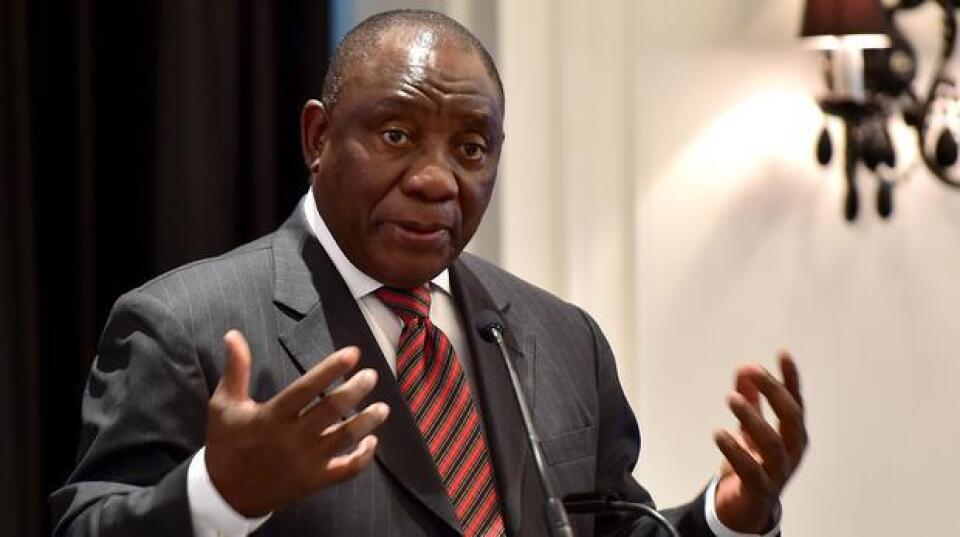
CYRIL Ramaphosa faces his first vote of no confidence since he succeeded his predecessor, former president Jacob Zuma, in 2018.
This follows the authorization of a vote of no-confidence against him in the National Assembly by the Speaker of Parliament Thandi Modise.
The motion, to be held on Thursday, was brought by the African Transformation Movement (ATM).
The party has only two seats in the 400-member National Assembly, meaning the motion has a little chance of succeeding.
The motion of no-confidence by the ATM was also dealt a blow after Modise turned down the party’s request to have the vote in a secret ballot.
Modise said there would be an open ballot as the ATM has not offered any evidence of a highly charged atmosphere of any members in the motivation for their request.
On Friday, Parliamentary spokesperson Moloto Mothapo further confirmed that the motion would be debated and voted on in a hybrid sitting of the House through an open ballot.
The ATM has since written to the Speaker of Parliament to reconsider not acceding to a secret ballot for the #NoConfidence motion against Ramaphosa.
“ATM has throughout the lapsed 9 months since lodging the Notice of No Confidence Motion in President Ramaphosa been asking for updates vial formal correspondence and even on social media,” ATM leader Vuyo Zungula said.
“The ATM is furthermore placing it on record that notwithstanding the COVID-19 considerations, more could have been done to give effect to Section 237 of the Constitution of South Africa. We, therefore, appeal to the Speaker to act with extreme urgency in addressing the ATM request for a secret ballot. Breaching the Constitution s237 any further would be untenable.”
In a motion tabled in February, Zungula said that Ramaphosa had misled the country when he said there would be no load-shedding between December 17, 2019, and January 13.
Zungula had also listed alleged failure by Ramaphosa to act against Public Enterprises Minister Pravin Gordhan and the Eskom board.
Other grounds in Zungula’s motion include the R500 000 in donations made by the late Bosasa chief executive Gavin Watson for his CR17 presidential candidate campaign.
While the motion of no-confidence against Ramaphosa is unlikely to succeed, his detractors within and outside the party are expected to use the opportunity to air his ‘dirty linen’ in public and try to embarrass him.
Supporters of ANC Secretary General Ace Magashule are adamant that Ramaphosa must account for the CR17 campaign funding.
Magashule’s supporters argue that Ramaphosa should lead by example and resign over the CR17 funding saga.
However, the Magashule ‘faction’ is likely to use this political gambit at the party’s National General Council (NGC), expected to be held in May next year.
Magashule is expected to make his biggest power play at the NGC, while Ramaphosa’s supporters are also working hard to consolidate his position and garner enough support before the meeting.
This week, Ramaphosa’s supporters in the North West petitioned the ANC leadership, during their visit to Mahikeng on Monday and requested Magashule to apologize his utterances about former ANC provincial chairperson Supra Mahumapelo in Free State during his court appearance.
The party’s National Working Committee descended on the province to address issues ahead of the Branch, Regional, and Provincial Conference.
Branch member at the Ramotshere Moiloa Municipality, Dinah Pule, read a memorandum received by Magashule.
“We call upon the NEC and NWC to urgently call upon the Secretary-General, comrade Ace Magashule, to retract the statement made in Bloemfontein after his appearance in court while addressing those who went to support him that the ANC in the North West can only function on the basis of the presence of comrade Supra Mahumapelo. His statement is wrong as it implies that an individual is bigger than the ANC. It has the potential to create divisions and can impact negatively on the organisation.”
When receiving the petition, on behalf of the party’s national leadership, Magashule apologised.
“No individual can be above a structure. So, if I said Supra is above, it is a wrong thing which I might have said. The IPC, the regional structures, the branches of those collectives are the most important including the branch members of the African National Congress. So, my apologies for having said anything which elevates an individual more than a collective.”
Party members have also requested the national leadership to reaffirm the full powers of the Interim Provincial Committee appointed in the province.
The CR17 campaign supported Ramaphosa’s candidature for the position of president of the ANC.
At that time, he was the Deputy President of the ANC and of the country.
As to the donation of R500 000.00 by Watson, Ramaphosa told the Public Protector Busisiwe Mkhwebane that it was businessman James Motlatsi who had approached the former CEO of Bosasa for a donation.
The president claimed that he was not made aware of this donation until after he responded to former DA leader Mmusi Maimane’s question on 6 November 2018 in the National Assembly.
He told the Public Protector that he had no relationship with Watson.
He also explained the CR17 campaign incurred a range of expenses, according to his court papers.
The president described these as including office rental and administration, travel and accommodation, salaries, marketing and communication campaigns, media monitoring, research and security.
Besides, the CR17 campaign had to pay the cost of hiring venues for rallies, stipends for organisers, branch meetings, T-shirts and related campaign items.
These expenses were incurred at both the national and provincial level.
In July last year, Mkhwebane found that Ramaphosa misled parliament in his response to a question about the donation from Bosasa for his presidential campaign.
Mkhwebane maintains that Ramaphosa had a duty to disclose the donations raised by the campaign that saw him elected ANC president at the party’s elective conference in December 2017.
This week, Ramaphosa’s legal team told the Constitutional Court that Mkhwebane’s report was ‘irrational and unlawful’ and had no basis in law.
(SOURCE: INSIDE POLITICS)





