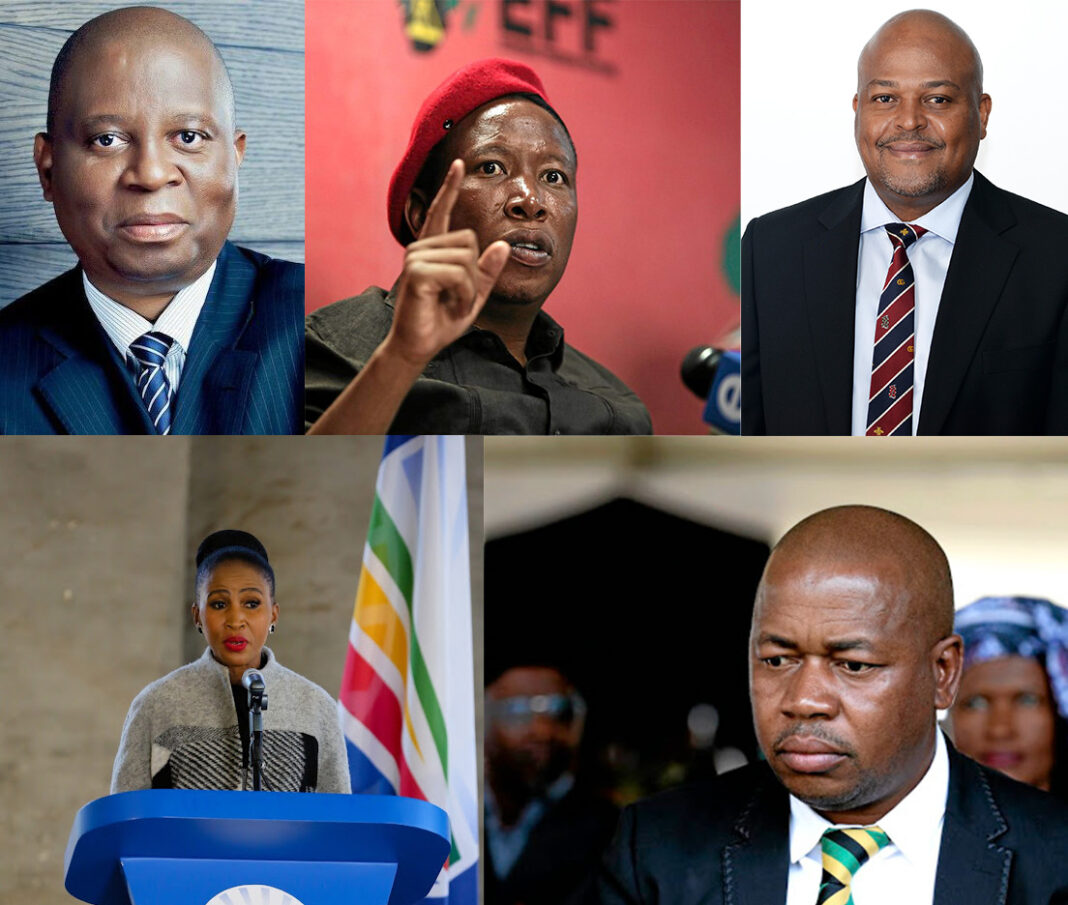
AHEAD of the local government elections on Monday, leading political parties have put forward candidates as their preferred mayors, especially for the country’s major metros such as Joburg, Cape Town, Ekurhuleni and Tshwane.
The ANC has, however, indicated that it will not announce its mayoral candidates until after the elections.
While the Economic Freedom Fighters (EFF) will contest all 257 municipalities in the country, it has also not fielded any candidates for mayoral positions, saying it preferred to allocate PR councillors based on which ward councillor candidate worked the hardest.
City of Ekurhuleni
While the ANC has not yet announced its mayoral candidate for the Ekurhuleni Metropolitan Municipality, it is believed the governing party will retain Mzwandile Masina as the mayor, should it win the local government elections this week.
Masina is credited for leading a stable party and government that also scored a clean audit.
Under Masina’s leadership, the city has invested R283 070 000 to upgrade the network infrastructure in the Germiston area.
The city has also spent R65-million in Wadeville alone on the new 44kV cables installation to strengthen electricity supply and R174 000 000 to upgrade the network infrastructure in the Benoni area.
Other recent developments during Masina’s administration include the BRT, the Aerotropolis and the Radisson Hotel and Conference centre and the Prasa-Gibela train manufacturing facility.
In October 2020, President Cyril Ramaphosa unveiled the R950-million Radisson Hotel, Convention Centre in the City.
The hotel in Bredell, an area that is primed for urban renewal is one of the key projects and catalysts towards the realisation of the City’s 30-year aerotropolis masterplan.
The Democratic Alliance has nominated Refiloe Ntseki as the party’s into mayoral candidate for the City of Ekurhuleni.
ActionSA has announced Letlhogonolo Moseki as it mayoral candidate.
City of Johannesburg
The 2016 local government elections saw the ANC lose its majority in the country’s biggest metro which later saw the then DA member Herman Mashaba became mayor.
The DA managed to make its coalition in the city work, thanks to a voting agreement with the EFF.
Once that fell to pieces, it lost control of the metro.
The DA’s mayoral candidate is Mpho Phalatse, described as one of the most credible leaders in the party to take the City of Joburg into new heights.
The ANC’s Mpho Moerane is currently the man in charge.
Moerane, the current ANC Johannesburg mayoral candidate, is second on the ANC list, behind member of the mayoral committee (MMC) for group corporate and shared services, Loyiso Masuku, who tops the list as the race for leadership of Gauteng’s metros gets under way.
Moerane recently fought with Eskom over electricity supply in Johannesburg. City Power claimed that it had secured private power plant energy to be able to avoid Stage 1 and 2 of load-shedding.
The power problems in the metro could be key in pushing voters away from the ANC.
Moerane was until recently a member of the Mayoral Committee for Environment, Infrastructure, and Services in the City of Johannesburg.
He is also the ANC’s Joburg Regional treasurer and worked as the head of fundraising in the office of the Treasurer-General.
He also had a stint as an electrician, working for national power utility Eskom, until 2006 before venturing into full-time entrepreneurship.
Moerane has also served on the boards of Metro Bus, Alexandra Clinic and currently serves as a Non-Executive Director for Chancellor House Holdings.
He has interest in the hospitality industry and is involved in the restaurant business.
According to the City of Johannesburg’s information, Mpho Moerane was born in Alexandra township, Johannesburg. He later moved to live with his own family in the suburb of Bryanston. Moerane is married to his wife Fikile, who is a professional in the IT and Finance sphere.
Mashaba is ActionSA’s mayoral candidate for Joburg.
The former Johannesburg mayor has pleaded for public support to ensure his return to the mayoral hot seat he vacated in 2019. Mashaba quit the DA in a huff that year and resigned as mayor, citing ideological differences with the official opposition party’s top leadership.
ActionSA has set itself six priorities for fixing local government that include, among others, quality and reliable service delivery, appointing ethical and competent officials, safety and security, as well as addressing illegal immigration.
Mashaba has also promised voters his party will prioritise service delivery, fight corruption and deliver pro-poor governance if elected into power in the upcoming municipal elections.
Mashaba says ActionSA would show South Africans that failing governments can be removed and replaced in these municipalities, and that services can be delivered to all citizens.
“It is from these cities that we will go to every South African across our country. We will ignite the hope that will see the change of government in 2024. It is from these cities that will start the process of fixing South Africa,” he said.
Mashaba was brought up in near-poverty in GaRamotse in Hammanskraal by his sisters while his absent domestic-worker mother worked long hours to provide what little she could.
Mashaba founded the cosmetics group Black Like Me in the teeth of apartheid oppression and has built several successful businesses since then, including Leswikeng Minerals and Energy.
In 2016, the EFF agreed to vote for Mashaba as the Mayor for Johannesburg, despite misgivings. After winning, Mashaba was sworn in as a Johannesburg City Councillor on August 22, 2016.
Later that day, he was sworn in as the Mayor of Johannesburg, becoming the first non-ANC Johannesburg mayor since 1994.
Mashaba was mayor of Johannesburg for three years.
He resigned from the DA in 2019 and later formed ActionSA.
City of Tshwane
The City is Tshwane is one of the battleground metros during these elections.
In 2016, the DA gained a plurality in the metro council. This means that while no one got a 50% +1 majority, the DA secured the largest number of votes.
At the time, the DA took home just 2% more than the ANC. Solly Msimanga was then sworn in as mayor.
The DA’s mayoral candidate in the metro is the current mayor Randall Williams.
In the 2016 municipal elections, the ANC lost control of the City of Tshwane to the Democratic Alliance (DA) due to the issue of preference on those who shall be taking positions in the council.
Deputy president David Mabuza the party would announce its mayoral candidate after the elections in order to avoid internal battles as people fight for positions at the municipal level.
ANC regional president Tshwane, Dr Kgosi Maepa, appears to have lost branch nominations to become the mayoral candidate of the ruling party in the town of Tshwane in the upcoming local elections.
Several ANC members have said that Maepa was not the preferred candidate for the highest post in the capital.
However, Maepa tops the ANC list.
In the Tshwane Metro, there are 42 parties and 36 independents contesting the elections.
Some of the parties contesting polls in the capital city are Arush Economic Coalition, Bolshevik Party of South Africa, Disability and Older Person Political Party, Economic Emancipation Forum, and United Cultural Movement.
ActionSA is also strong in Tshwane and has nominated former DA regional chairperson Abel Tau as its mayoral candidate.
Born and raised in Soshanguve, Tau has a distinguished record of community service serving as the Tshwane MMC of Utility Services, the Acting Mayor of Tshwane and the DA Regional Chairperson.
Prior to entering politics, Tau was a qualified Electrical Diesel Fitter for Transnet, and joined politics after witnessing the dire state of affairs in our State-Owned Entities.
He also holds a Diploma in Operations Management.
“What is clear is that Abel does not seek positions within the party and wants to sign up as an ordinary member, along with the thousands who have joined to date. He brings important skills in coordinating our ground structures in Tshwane which will be invaluable,” said Mashaba.
“This is one of the strengths of our party, our commitment that residents will choose our candidates through primaries, means that any person wishing to stand will have to pass this test if they want to serve as a public representative.”
Nelson Mandela Bay Metro
Nqaba Bhanga is now the DA’s mayoral candidate. In 2016, the DA was just 4 seats short of a majority.
With Nelson Mandela Bay being the best chance for the DA to secure its first metro majority outside of Cape Town, it is still going to be a tough ask.
According to polls from the metro, the ANC and DA are said to be neck and neck.
Bhanga says the DA wants to return NMB to its rightful place as the economic powerhouse of the province.
He says the DA will continue to focus on delivering quality service delivery to the Metro by appointing fit for purpose municipal staff and by clamping down on corruption and maladministration within the municipality.
“We will create an enabling environment for business to thrive and address unemployment. We will make our communities safer to guarantee a better life for all,” says Bhanga.
Bhanga joined the ANC and became Nelson Mandela Bay ANC Youth Leader, an SRC president at the Port Elizabeth Technikon (now Nelson Mandela University) where he graduated with his first qualification in Public Administration and later studied towards a postgraduate qualification in Maritime Studies.
The DA’s provincial leader also served as the national secretary general of the South African Student Congress (SASCO), and then the youth leader of the breakaway Congress of the People (COPE) and its member of Parliament, before switching to the DA in 2014.
The switch followed a conversation with Federal Chairperson, Athol Trollip, where they agreed that the people of Nelson Mandela Bay needed leaders to work together to save first Nelson Mandela Bay and, ultimately, the Eastern Cape and South Africa.
City of Ethekwini
The two front runners to be the next Durban mayor, Mxolisi Kaunda and Thabani Nyawose, have vowed to bring stability to the troubled city.
However, the ANC’s firm majority in the eThekwini Municipality is at risk, not from opposition parties, but due to rising ANC voter despondency and ANC members being at the centre of efforts to de-campaign the governing party.
Dr Makhosi Khoza is ActionSA’s mayoral candidate for the eThekwini municipality for the upcoming local government elections. Khoza is a former ANC MP and member of provincial legislature who has also served at the SA Local Government Association. Her focus would include holding management to account, attending to longstanding inaccurate billing issues, and investing in infrastructure.
“Dr Khoza brings her tried and tested ethical leadership, competence, decades of political experience at national and local spheres of governance, and a deep desire to see eThekwini transformed into a thriving and inclusive city that allows all its residents to lead dignified and productive lives,” Mashaba said in a statement.
Mashaba said Khoza was “no stranger to the people of eThekwini” KwaZulu-Natal and South Africa as a whole.
“She served as a pivotal figure in holding former President Jacob Zuma to account in Parliament at the height of his powers; publicly declaring that she would vote for a motion of no confidence in him.”
City of Cape Town
The DA shadow Finance Minister, Geordin Hill-Lewis is the party’s nomination for mayor of Cape Town, to replace current incumbent, Dan Plato.
The DA has been the party of choice in the city of Cape Town since 2006, although without the majority.
Hill-Lewis says the ongoing electricity blackouts and the prospect of a complete collapse of the electricity grid will never be acceptable as long as the DA governs in Cape Town.
“That is why I am pleased that Cape Town is protecting residents against 2 full stages of load shedding today. While other cities are trapped in 6.5 hours of rolling blackouts today, our investment over the years in the Steenbras hydroelectric system means that we can eliminate 2.5 hours of load shedding,” said Hill-Lewis.
He said Cape Town will procure its own electricity from independent producers and empower residents to generate and trade their own electricity via the city’s grid.
Hill-Lewis introduced the party’s structures at the University of Cape Town (UCT), where he obtained his BCom and an honours degree in politics, philosophy and economics.
In 2009 he worked in the successful campaign that propelled DA federal chair Helen Zille to the position of premier in the Western Cape.
In 2011 he joined the National Assembly at the age of 24. In 2011-2012 he was shadow deputy minister of public service.
In 2012-2014 he became shadow deputy-minister of trade and industry.
- Inside Politics