
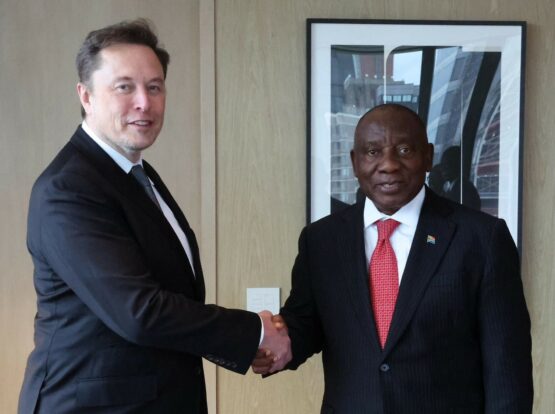


By Marcus Moloko
SpaceX founder and chief executive Elon Musk has renewed his criticism of South Africa’s telecommunications rules, claiming his satellite internet service Starlink is being kept out of the country because he is “not black”.
In a post on X (formerly Twitter), Musk said: “Starlink is not allowed to have an internet provider license in South Africa for the sole reason that I am not black. This is not OK.”
Musk’s comments followed his appearance at the Qatar Economic Forum in 2025, where he condemned laws that give preferential treatment based on race.
Musk, who has the largest stake in SpaceX, said that South Africa’s Broad-Based Black Economic Empowerment (B-BBEE) rules, which require 30% equity ownership by historically disadvantaged groups, have prevented Starlink from launching.
The billionaire said he is “extremely opposed to any anti-black and anti-white laws,” insisting that South Africa now has “more anti-white laws than there were anti-black laws under Apartheid”.
He maintains that Starlink supports equity equivalents, pointing to a R500 million pledge to provide free internet to 5,000 rural schools as part of its commitment to social upliftment.
In December 2025, Communications Minister Solly Malatsi issued a policy directive that formally recognised Equity Equivalent Investment Programmes (EEIPs) as valid alternatives to the rigid 30% direct ownership requirements under South Africa’s Broad-Based Black Economic Empowerment (B-BBEE) framework.
The directive was designed to attract multinational investment in the ICT sector by allowing companies to contribute through large-scale social and infrastructure projects rather than ceding equity.
Malatsi emphasised that EEIPs could accelerate broadband access and digital inclusion, noting that over 90% of public submissions supported the reform.
For Starlink, which has pledged R500 million to provide free internet to 5,000 rural schools, the directive appeared to create a pathway to compliance without restructuring SpaceX’s ownership model.
Despite this policy, the Independent Communications Authority of South Africa (ICASA) has yet to implement the directive, leaving Starlink’s licensing prospects in limbo.
INSIDE POLITICS