

By Johnathan Paoli
Research by the Global Initiative against Transnational Organised Crime (GI-TOC) has revealed that the criminal justice system needs to be fundamentally rebuilt in order to successfully confront organised crime that has become embedded within the state.
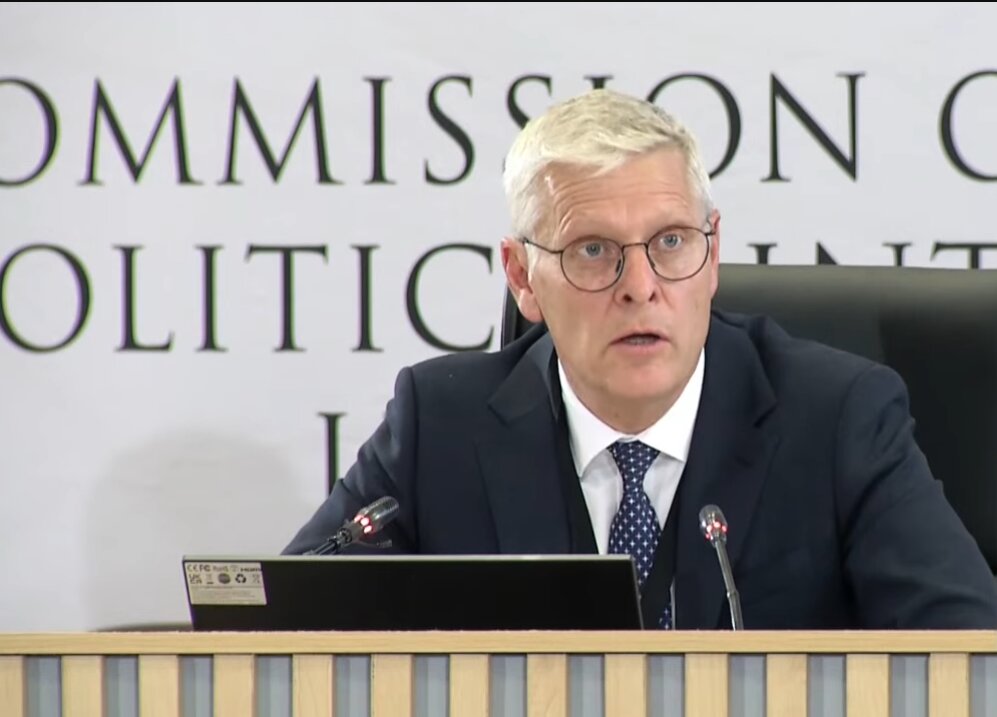
Presenting a report for the Madlanga Commission of Inquiry, GI-TOC director Mark Shaw said the evidence emerging from both its own research and the commission showed organised crime had penetrated parts of the criminal justice system to such an extent that piecemeal reform would no longer be enough.
ALSO READ: Two sentenced to life for killing DA councillor Nhlalayenza Ndlovu
Appearing before the commission on Wednesday, Global Initiative against Transnational Organised Crime (GI-TOC) representative Michael Shaw warned that South Africa’s position on organised crime and corruption had deteriorated from a global perspective.
“It is now beyond serious dispute that legislative and policy interventions are urgently needed to counter the organised criminal networks that have infiltrated state institutions indispensable to the survival of South Africa’s constitutional democracy,” Shaw said.
The commission commissioned a GI-TOC report which found that organised crime groups had developed relationships with officials, politicians, businesses and other actors within the criminal justice system, allowing them to exploit institutional weaknesses and undermine law enforcement efforts.
Shaw said the problem could not be addressed simply through more arrests or the deployment of additional police officers.
He said criminal networks survived by establishing relationships with people inside state institutions, obtaining sensitive information, influencing investigations, exploiting procurement and administrative weaknesses and, in some cases, corrupting or killing officials tasked with investigating them.
A key concern identified in the report was the failure of investigations after criminal groups obtained information from within the state.
Shaw said South Africa’s organised crime problem had evolved over more than three decades, becoming increasingly sophisticated and expanding from traditional criminal markets into legitimate businesses and relationships with state officials.
GI-TOC’s 2025 Global Organised Crime Index ranked South Africa seventh out of 193 countries for criminality, second out of 54 African countries and first in Southern Africa.
ALSO READ: Emfuleni electricity scam ‘mastermind’ arrested
The country received a criminality score of 7.43, placing it among the five percent of countries globally most affected by organised crime.
Shaw said 12 of the 15 criminal markets assessed by GI-TOC scored six or higher, including drug trafficking, extortion, firearms trafficking and non-renewable resource crimes.
He said the threat was not limited to isolated acts of corruption, but included continuing relationships between criminal groups and state officials.
“An official who accepts gratification in exchange for taking an unlawful decision may commit the offence of corruption without entering a continuing relationship with an organised criminal group,” Shaw said.
The report cited examples of corruption involving police and other officials, highlighting the particular vulnerability created when officers responsible for criminal investigations are themselves compromised.
Former national police commissioner Jackie Selebi’s relationship with convicted drug trafficker Glenn Agliotti was cited as an early example of organised crime allegedly gaining protection through a senior state official.
In 2016, former SAPS Colonel Christiaan Prinsloo pleaded guilty to systematically diverting about 2,400 police firearms to criminal groups. A subsequent investigation uncovered further alleged collusion between police officials and criminal networks to manipulate the Central Firearms Registry and supply guns and firearm licences.
Shaw said the number of firearms involved was closer to between 7,000 and 9,000.
The report said organised crime infiltration could become self-reinforcing, with criminal networks using access to the criminal justice system to frustrate investigations and protect their operations.
It said the recurring nature of these relationships and the systematic provision of state resources to criminal groups distinguished such conduct from ordinary corruption.
The report also highlighted alleged links between police and the taxi industry, including findings by the Shongwe Commission that state-issued firearms had been used in taxi violence and that confidential complaints and planned police operations had allegedly been leaked to suspects.
GI-TOC recorded 2,458 assassinations, attempted assassinations and plots between 2000 and 2025, warning that investigations often fail to progress beyond the gunmen to the networks behind the killings.
Against this backdrop, Shaw said South Africa’s existing institutional architecture was not sufficiently independent or coordinated to deal with criminal infiltration.
The Directorate for Priority Crime Investigation, known as the Hawks, remains within SAPS, while the Investigating Directorate Against Corruption (IDAC) is housed within the National Prosecuting Authority and remains severely under-capacitated.
The Independent Police Investigative Directorate (IPID) is institutionally separate from SAPS but depends on other criminal justice institutions to enforce the consequences of its findings.
ALSO READ: MK Party demands non-GNU chair for Ramaphosa impeachment committee
The report also identified fragmentation among intelligence and investigative structures.
Although the Fusion Centre brings together the NPA, Hawks, SAPS, IPID, Special Investigating Unit, SARS and the State Security Agency, GI-TOC said it operates largely through voluntary cooperation and cannot compel agencies to participate or reallocate cases.
Shaw said proposed reforms should begin with a short-term “personnel reset”.
He recommended an independent, time-limited reassessment of officials across SAPS, Crime Intelligence, the Hawks, NPA, IDAC, IPID, intelligence services and Correctional Services.
The first phase would focus on institutional heads, senior management and officials in sensitive positions involving intelligence, evidence, firearms, procurement, appointments and disciplinary powers.
Officials would face more rigorous asset and income disclosures, independent verification of their wealth and scrutiny of disciplinary records and complaints.
They could ultimately be confirmed, transferred, suspended or dismissed, with criminal or disciplinary referrals where warranted.
GI-TOC also recommended periodic integrity assessments for senior officials rather than scrutiny only after allegations emerge.
Shaw cited international examples, including Albania, where a major judicial vetting programme reassessed every serving judge and prosecutor.
By the completion of its appellate process in 2026, 804 final decisions had been recorded: 348 confirmations, 283 dismissals and 173 terminations of the process, including 114 resignations.
Mexico has also introduced periodic integrity certification for police, prosecutors, forensic officials and prison personnel, including checks for unexplained wealth and links to criminal organisations.
Shaw said South Africa should adopt similar mechanisms while introducing a National Organised Crime Strategy and an Organised Crime Council bringing together government, civil society, business, labour, academia and affected communities.
The council would monitor the police and prosecutorial response to organised crime and oversee implementation of the commission’s recommendations.
In the longer term, the report proposes amendments to the Prevention of Organised Crime Act to create a specific offence of criminal infiltration of the criminal justice system.
It also recommends legislation allowing the state to target unexplained wealth, including civil asset recovery where a public official’s property is materially disproportionate to their lawful income.
GI-TOC’s most far-reaching recommendation is the establishment of an independent Anti-Organised Crime Agency as a Chapter 9 institution.
The agency would have constitutionally entrenched structural and operational independence and investigate organised crime and criminal infiltration of state institutions.
It would be able to initiate investigations, take over cases where an institution’s leadership was unwilling or unable to investigate independently, access classified information, trace assets and establish joint investigative teams.
Crucially, Shaw proposed that the agency should also have prosecutorial powers, either independently or jointly with the NPA, which would require an amendment to Section 179 of the Constitution.
Its jurisdiction would cover relationships between organised criminal groups and officials in policing, prosecution, intelligence, corrections, court administration and related oversight institutions.
The agency would also have the power to prescribe or arrange independent integrity assessments and issue binding remedial orders, subject to judicial review.
Shaw warned, however, that no single institutional reform would solve the problem.
He said criminal infiltration exploited mutually reinforcing weaknesses, including compromised personnel, fragmented intelligence, weak oversight, political interference and inadequate protection for witnesses and investigators.
Simply replacing compromised officials without changing the systems that enabled the misconduct, he said, risked reproducing the same problem.
GI-TOC said the scale of South Africa’s response must therefore match the scale of the threat.
Shaw said organised crime had penetrated parts of the criminal justice system deeply enough to pose a threat not only to law enforcement, but to the country’s constitutional democracy itself.