



By Thapelo Molefe
The National Joint Operational and Intelligence Structure (NATJOINTS) has recorded 21 politically motivated murder cases linked to the 2026 Local Government Elections, including the killing of an uMkhonto weSizwe (MK) Party member in KwaZulu-Natal.
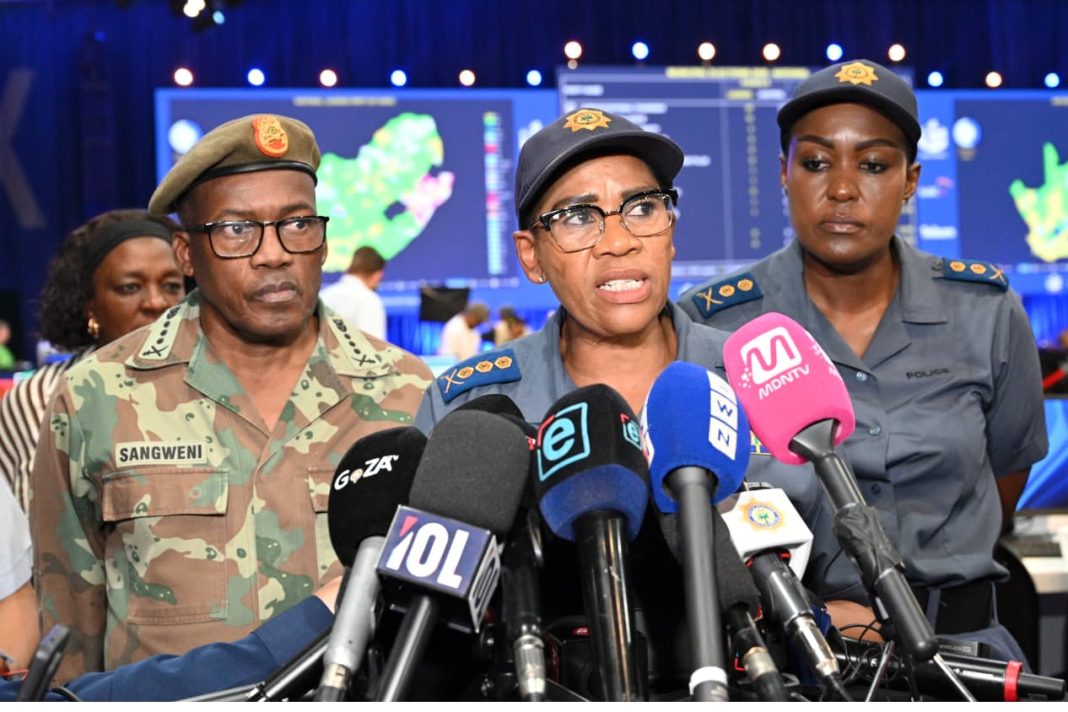
Deputy National Commissioner of the South African Police Service (SAPS) and NATJOINTS co-chairperson Lieutenant General Tebello Mosikili disclosed the figures during a security briefing at the national Results Operations Centre (ROC) in Midrand on Thursday, as the capturing and verification of votes continued across the country.
Mosikili said police were also investigating three other murder incidents reported in Mpumalanga, Limpopo and KwaZulu-Natal.
These included the killing of a 57-year-old man in Bushbuckridge, Mpumalanga, in the early hours of Thursday.
In Limpopo, a 31-year-old man was stabbed to death at a park opposite Florapark Comprehensive School in Polokwane. Police arrested a 35-year-old man in connection with the murder.
Another murder was reported in KwaZulu-Natal, where a man was attacked and killed while walking home on Wednesday, voting day.
Responding to concerns about continued political killings, Mosikili said political intolerance and politically motivated murders were being addressed through the country’s organised crime strategy.
She said the strategy had been presented to Cabinet and would be implemented in phases, with political killings forming part of the broader organised crime concerns being monitored by law enforcement agencies.
“You cannot take the life of the other just because you are differing in ideologies or because of the position,” Mosikili said.
She called on communities to embrace political tolerance and respect the right to life.
The briefing also revealed that 85 incidents were reported across the country on voting day, resulting in 57 criminal case dockets being opened and 27 suspects arrested.
Of the incidents, 32 related to contraventions of the Electoral Act. Other cases included four assaults, two cases of malicious damage to property, two intimidation cases, one theft, two cases of crimen injuria, one case of drunk and disorderly conduct, one public violence case, one business burglary and one fraud case.
KwaZulu-Natal recorded the highest number of cases, with 15, followed by Limpopo with 11 and the Eastern Cape with 10.
Gauteng recorded eight cases, while the Western Cape recorded four. Mpumalanga and North West each recorded three cases, the Free State two and the Northern Cape one.
During the two special voting days on Monday and Tuesday, a further 65 criminal case dockets were registered, with 32 suspects arrested.
Mosikili said the security cluster would maintain its deployment as the country moved into the next phase of the electoral process, particularly amid concerns about possible tensions as election results emerged.
She said security operations would continue until the counting, reconciliation, verification and capturing of results were completed and the elections formally concluded.
“We continue to receive intelligence, we continue to observe the mood in the country, and we will then make that operational decision whether to continue with the staff that we have deployed,” she said.
Mosikili said the security cluster had made provision for roving teams to supplement existing deployments where necessary. Decisions on demobilising personnel would depend on intelligence assessments.
She also confirmed that all 23,000 voting stations had been covered by static law enforcement deployments on voting day.
Asked about the fraud case included in the election-day statistics, Mosikili clarified that it did not involve an IEC official.
She said the case was opened after a voter discovered that her name had already been crossed off the voters’ roll before she could present her documents.
Mosikili said the incident could have resulted from human error but required investigation to establish what had happened.
The security cluster also reported two additional deaths during the election period. These involved an elderly woman who collapsed and later died after arriving at hospital in Shallcross, KwaZulu-Natal, and an IEC official who died following a similar reported incident at Buhrmansdrift in the Ngaka Modiri Molema District, North West, on Monday.
Mosikili said law enforcement agencies had also taken action against an SAPS member in KwaZulu-Natal who arrived at a voting station in a vehicle displaying political party branding.
She said the security cluster remained committed to ensuring accountability and protecting the integrity of the electoral process.
Despite the incidents, Mosikili described the voting process as largely peaceful, saying planned marches and protests across the provinces had not materialised.
She said the coordinated security operation had enabled eligible voters to exercise their democratic rights with minimal disruption.
“The country is safe. We said, South Africans, we are ready, go and cast your vote,” Mosikili said.
She added that voter participation had increased by four million compared with the 2021 and 2024 elections, describing this as an indication that the security arrangements had been effective.
NATJOINTS said security operations would remain in place until the Local Government Elections were formally concluded.
INSIDE POLITICS






