
By Johnathan Paoli
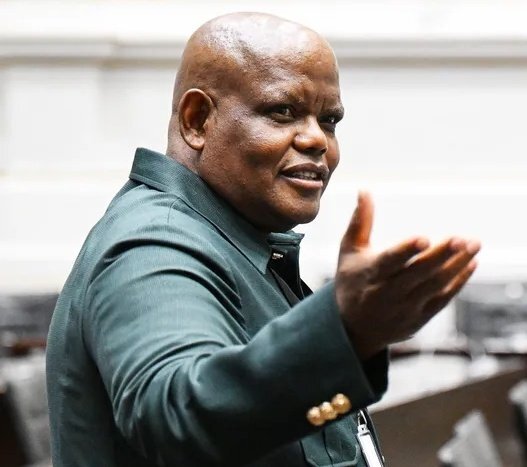
Former acting National Police Commissioner Khomotso Phahlane has repeatedly denied wrongdoing before Parliament’s ad hoc committee, insisting he was innocent of corruption allegations, unlawfully dismissed, and the victim of political interference.
Appearing in Parliament on Thursday afternoon, Phahlane clashed with evidence leader Norman Arendse and several MPs during a tense session that frequently veered into arguments over court cases, criminal charges, forensic reports and claims of factional plots within the SAPS.
“The evidence leader is putting two things together that do not belong together. There is not a single criminal charge against me. What is being said here is wrong information, and I cannot be expected to respond to matters that are being concocted and placed before this committee,” Phahlane said.
The session opened with Arendse indicating he would focus on key issues, including a recent ruling by the Labour Appeal Court dismissing Phahlane’s appeal against his dismissal from SAPS.
But before Arendse could proceed, Phahlane objected, telling the committee he had lodged an appeal to the Constitutional Court and would not answer questions about the Labour Appeal Court judgment or forensic reports.
“The matter is in the Constitutional Court, one. Two! I don’t think it is fair for the SC to go selectively through the judgment. I don’t have the appetite to go too much into that matter,” he said.
Arendse confirmed that the Labour Appeal Court dismissed Phahlane’s appeal on 5 February, although the judges differed on aspects of their reasoning.
Phahlane insisted one judge had found his dismissal unlawful but declined to engage further, arguing it would be inappropriate while the matter was before the apex court.
Tensions escalated when Arendse turned to pending criminal matters in the Specialised Commercial Crimes Court in Gauteng and the High Court in Pretoria.
Arendse read from a charge sheet indicating Phahlane faced 192 charges including fraud, corruption, money laundering and contraventions of the Public Finance Management Act related to procurement in Crime Intelligence, including social media monitoring software during the Fees Must Fall protests.
“General, do you accept that you are facing a myriad of charges?” Arendse asked.
However, despite initially resisting, Phahlane later acknowledged he was “allegedly facing” charges but accused the National Prosecuting Authority (NPA) of having “concocted” them.
He blamed former IPID head Robert McBride and forensic examiner Paul O’Sullivan for instigating the cases.
Arendse eventually placed on record that Phahlane had acknowledged the charges and that prosecutions were anticipated later this year.
On the controversial Ithemba tender, Arendse asked whether Phahlane’s dismissal stemmed from alleged irregularities in that process.
“I’m not going to give a yes or a no. Which irregularities?” Phahlane replied.
He maintained that he was not party to any wrongdoing and that he had merely failed, in the view of investigators, to cancel the contract timeously.
He insisted he had no role in the R31 million settlement paid to Ithemba after the contract was terminated and said former national commissioner General Khehla Sitole took the decision to settle.
Phahlane also addressed the long-running “blue lights” procurement case before the Palm Ridge court, describing it as a decade-long saga driven by propaganda.
He denied allegations of double payments amounting to R3.9 million and claimed the state in fact owed the supplier money.
ANC MP Xola Nqola questioned Phahlane about his Sable Hills property and a R80,000 sound system installed there.
Phahlane said he secured a bond with Nedbank after selling his previous home in Montana and that he personally paid for the sound system, and referred MPs to invoices and bank statements attached to his affidavit.
“There is no service provider who bought me the sound system,” he said.
He acknowledged that an interior designer linked to Crimetech sourced the quotation but denied receiving any benefit from SAPS suppliers.
In one of the day’s contentious moments, Phahlane accused Arendse of representing “the cabal you are party to”, linking him to McBride and O’Sullivan.
Chairperson Soviet Lekganyane intervened, warning Phahlane he may have lost his cool.
Phahlane withdrew the remark unconditionally and apologised to the committee and Arendse.
Late in the evening, disputes arose over WhatsApp messages between McBride and Sarah Jane Trent, formerly associated with O’Sullivan, which Phahlane submitted as evidence of a plot against him.
Arendse questioned how the messages were obtained and suggested they were unlawfully downloaded from a cellphone.
Phahlane refused to answer, stating he was a complainant in the matter and that the phone had been seized during an arrest.
Arendse described his response as “absolutely shocking”, prompting further objections from MPs who accused the evidence leader of hostility.
Phahlane closed by expressing disappointment that he was not allowed to fully traverse his affidavit.
The committee is expected to continue its proceedings next week and seek legal guidance on O’Sullivan’s conduct.
INSIDE POLITICS



