By Johnathan Paoli
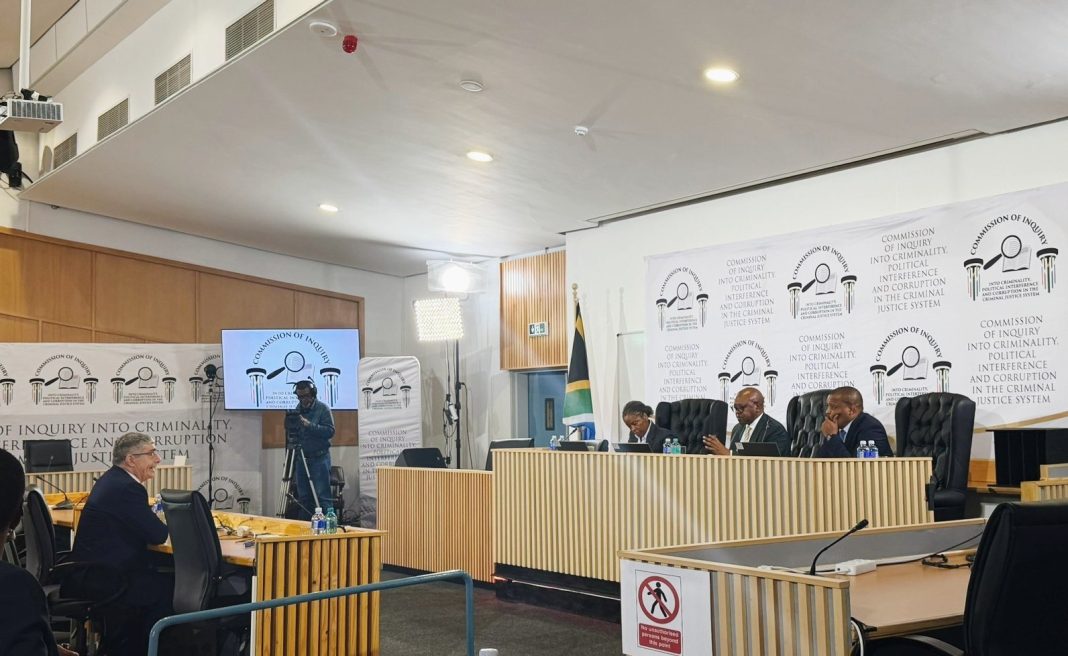
Suspended Organised Crime Investigations head Major-General Richard Shibiri on Thursday denied trying to bribe investigators in the murder case of engineer Armand Swart.
A recorded phone call between Shibiri and a junior officer became a central focus at the Madlanga Commission, which was examining his account of the circumstances surrounding the investigation.
During Thursday’s proceedings, the commission played an audio recording of a 16 December 2024 telephone conversation between Shibiri and an officer who previously testified as Witness A, who had earlier submitted the recording as part of an additional affidavit.
ALSO READ: Ramaphosa defends decision to release Madlanga Commission report after August
In the call, Shibiri can be heard discussing the safety of investigators working on the Swart case and warning about the dangers surrounding the probe.
“We cannot let this thing get to us in a manner which the people who are doing the work become vulnerable,” Shibiri said.
However, Shibiri consistently maintained that he merely alerted them to an attempted bribe to ensure their safety and facilitate an entrapment operation.
“I am very much sure that I cautioned them not to accept the bribe. The plan was to go after entrapment and arrest the person trying to bribe. [If] You are endangering people’s lives, then you will have a dead source,” he said.
The conversation also touched on fears within the investigative team, protection measures and the need for resilience as the probe into Swart’s killing unfolded.
However, the recording also drew scrutiny after Shibiri referenced information flows within the investigation and mentioned senior police figures, including suspended Deputy National Police Commissioner Shadrack Sibiya.
ALSO READ: Chetty tells Parliament about law enforcement abuse of power
When pressed by commissioners to clarify remarks he made in the call about “the other side”, Shibiri initially suggested he was referring to a police faction, but later changed his explanation to say he meant the family of an accused suspect.
Confronted with the contradiction, Shibiri ultimately conceded that he had misled the commission, effectively admitting he had not been truthful in his earlier explanation.
Commissioner Sandile Khumalo expressed frustration with witnesses who provide conflicting testimony under oath, warning that there could be consequences for dishonesty before the commission.
Earlier in the proceedings, during questioning by evidence leader Advocate Lee Segeels-Ncube, Shibiri insisted he had acted to protect investigators after receiving intelligence that money was being mobilised to influence the case.
Shibiri told the commission that he has never revealed the identity of his source, explaining that the information came from an informant connected to individuals linked to the suspects.
According to Shibiri, the source warned him that funds were available to secure bail for suspects arrested in connection with Swart’s murder and that investigators themselves could be approached with bribes.
He said he relayed the information to the detectives so that an entrapment operation could be considered, but also claimed he warned investigators that refusing such offers could expose them to danger.
ALSO READ: Commission tears into Shibiri’s explanation of R70 000 Matlala loan
Seegels-Ncube challenged his version of events, noting that statements from Witness A, Witness B among others, did not record any warning from him advising investigators to refuse the alleged bribe.
Shibiri rejected the suggestion that he had encouraged investigators to accept the money, telling the commission that he recommended a formal threat risk assessment after discussing the situation with senior officers, adding that investigators were eventually placed in a safe house.
At the same time, the commission also scrutinised Shibiri’s conduct outside official meetings.
He was questioned about a social gathering at the luxury Johannesburg venue 12 on Hillel, where Witness A and other investigators later encountered him with businessman Vusi Makhubela.
Shibiri said he was surprised to see the investigators there, insisting the visit was purely social.
He also rejected suggestions that the meeting was intended to test whether investigators were susceptible to bribery.
“It’s not true. I never told Vusi and we never discussed that thing. It’s not true,” he said.
This follows earlier testimony from investigators who described a conversation in which Shibiri allegedly referred to “three envelopes” of money intended to influence the case.
According to Witness A and Witness B, the envelopes were purportedly meant for the investigating officer, the prosecutor and the magistrate to facilitate bail for the suspects.
Shibiri has consistently denied encouraging any illicit payments, maintaining he raised the issue only to alert investigators to a possible corruption attempt and to ensure their safety.
The commission adjourned on Thursday afternoon, with Shibiri expected to return on Friday to continue his testimony.