By Simon Nare
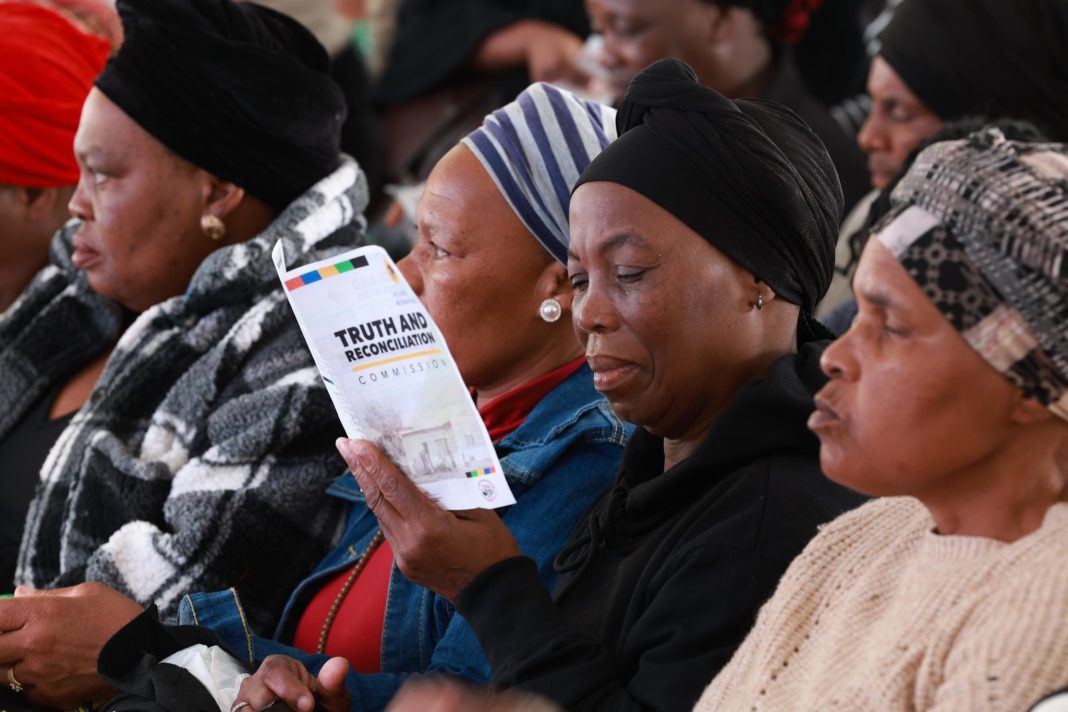
President Cyril Ramaphosa on Tuesday launched housing assistance reparations for victims identified by the Truth and Reconciliation Commission at Sonkombo Sports Field in Ndwedwe, KwaZulu-Natal.
The launch marked the implementation of regulations enabling apartheid-era victims, verified through the TRC process, to receive state-funded housing support.
“We are marking this milestone almost exactly 30 years after the first public hearing of the Truth and Reconciliation Commission was held in East London on April 15, 1996,” Ramaphosa said.
“We remain determined to ensure that the work of the Truth and Reconciliation Commission is completed.”
He said Ndwedwe holds significant historical importance, having been among the areas in KwaZulu-Natal hardest hit by political violence in the late 1980s and early 1990s, with widespread displacement, destruction of property and loss of life.
Ramaphosa said the TRC’s final report recommended measures to restore the dignity of victims, including targeted housing support in areas where violence led to mass displacement.
“The housing assistance regulations that we published in January 2026 flow directly from these recommendations,” he said.
The regulations provide for a once-off housing grant or the construction of a new home for beneficiaries formally identified through the TRC process.
The cost will be covered by the President’s Fund established under the TRC Act.
“Through these regulations we are giving effect to our longstanding commitment to reparations for victims of apartheid and to our constitutional obligation to advance human dignity,” Ramaphosa said.
He said parliament in June 2003 approved a package of reparations, including a once-off grant of 30,000 rand, medical and social support, memorialisation, and community rehabilitation.
Ramaphosa said the once-off grant programme had been completed for all processed applications, with remaining cases limited to those who had yet to apply.
He added that the government had supported 11,783 learners in basic education at a cost of just over 134 million rand, and 1,896 students in higher education at a cost exceeding 129 million rand.
TRC victims and their families are also entitled to free healthcare in public facilities, he said, adding that the Gallows Exhumation Project had been completed.
Ramaphosa further referred to several apartheid-era inquests recommended by the National Director of Public Prosecutions (NDPP), including those into the deaths of activists such as Albert Luthuli, the Craddock Four, Griffiths Mxenge and Steve Biko.
The housing regulations, published on January 16, 2026, provide for assistance of up to 183,257 rand per approved beneficiary, per household, per incident.
As of March 18, 2026, the Department of Justice had received 941 applications, with 220 beneficiaries verified, all opting for the once-off housing grant.
A total of 650 million rand has been ring-fenced for the programme.
In Ndwedwe, 476 approved beneficiaries are expected to receive a combined 87.2 million rand once all applications are verified. To date, 20.9 million rand has been paid to 114 beneficiaries.
“As at March 18, 2026, the total number of approved listed beneficiaries positively verified in Ndwedwe is 220. The estimated total amount to be paid to these beneficiaries is 40.3 million rand,” Ramaphosa said.
INSIDE POLITICS