
By Johnathan Paoli
Parliament’s ad hoc committee investigating allegations of criminality, political interference and institutional failures within the South African Police Service (SAPS) has ordered further revisions to its preliminary report, with MPs calling for stronger and more unequivocal findings before it is released to affected parties.
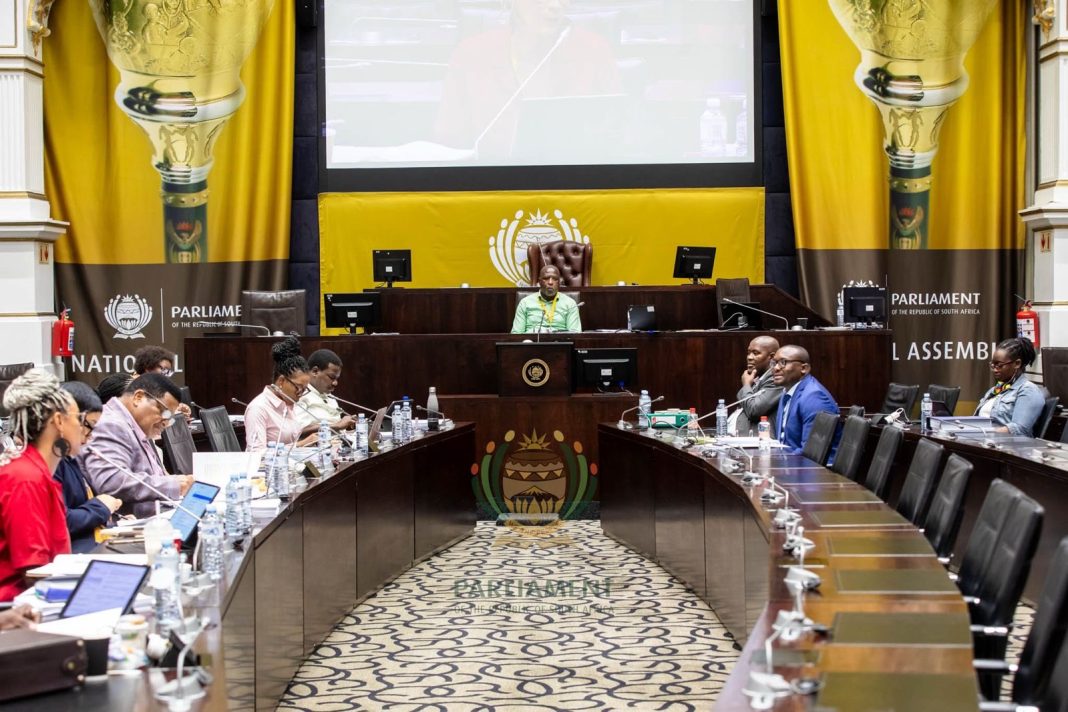
Meeting virtually on Tuesday, the committee deliberated on the second draft of the report following months of public hearings into allegations involving suspended Police Minister Senzo Mchunu, senior SAPS leaders, Crime Intelligence and other law enforcement institutions.
While members broadly endorsed the report’s structure and recommendations, several argued that its findings had been softened and did not adequately reflect the evidence presented during the inquiry.
Committee chairperson Soviet Lekganyane acknowledged that further work was required before the report could be adopted.
“This was the second draft preliminary report. And from the inputs that members have made, it’s very evident that we will still need other drafts before we send it out. Members will guide me whether they still need a meeting or the draft can be circulated,” he said.
Lekganyane said members favoured adopting the final report at an in-person meeting.
“The strongest feeling that I get is that the adoption of the committee report has to be done in a physical meeting. That is what I read from the sentiment from the meeting,” he said.
The committee was briefed by legal expert Nicolette Van Zyl-Gouws, who presented the draft findings and recommendations.
She emphasised that Parliament’s role was one of oversight rather than adjudication.
The draft distinguishes between established governance failures, unresolved allegations, institutional risks and matters requiring referral to competent authorities.
It identifies systemic weaknesses in police governance, shortcomings in the management of specialised task teams, vulnerabilities within Crime Intelligence, procurement irregularities, weaknesses in witness protection, poor coordination between law enforcement agencies and declining public confidence in oversight institutions.
On individual accountability, the report avoids making definitive findings where evidence remained disputed or where implicated individuals did not testify before the committee, instead recommending that several matters be referred to the appropriate investigative or oversight bodies.
However, several MPs argued that the draft had become overly cautious.
ANC MP Khusela Sangoni said some recommendations appeared to have been diluted during the drafting process.
ANC MP Xola Nqola proposed that the committee recommend reforms to the Secret Services Act, describing it as apartheid-era legislation that continues to govern intelligence funding through special accounts.
MK Party MP David Skosana also argued that the report appeared to exonerate many of those implicated during the inquiry and said several proposals submitted by members had not been adequately reflected.
DA MP Ian Cameron, however, described the draft as balanced, saying it fairly reflected the evidence while avoiding conclusions not supported by the record.
Referring to fellow DA MP Dianne Kohler Barnard, Cameron questioned what more she could reasonably have done after receiving sensitive information, given that the Joint Standing Committee on Intelligence was not properly constituted to investigate the matter.
Lekganyane urged members to treat the draft as their own work rather than that of parliamentary support staff.
“The content team has written a report and the appeal I want to make is that members must not engage with the report as if this is not their report,” he said.
He said members wanted Parliament’s oversight role to be reflected more forcefully.
“To some degrees, it may have to be unambiguous, so that whatever statement we make out there, ordinary citizens of this country reading our report must understand that this report comes from an oversight of the state,” he said.
Lekganyane said the committee had moved beyond merely assessing evidence and now had to make clear findings supported by corresponding recommendations.
He said proposals for legislative reform and further investigations should be clearly articulated.
“Whatever referrals are made, they should come out very clear that this matter is being referred for further investigation by law enforcement agencies or by respective bodies,” he said.
The committee also wants stronger parliamentary oversight mechanisms, including regular reporting requirements to monitor implementation of its recommendations.
Van Zyl-Gouws undertook to produce a third draft of the report by Friday, although Lekganyane said a short extension could be granted if necessary to ensure the document was properly refined.
Once the revised draft has been circulated, members will submit any remaining technical amendments before reconvening for what is expected to be the committee’s final deliberations and formal adoption of the report.
INSIDE POLITICS





