
Staff Reporter
Water and sanitation minister Pemmy Majodina said on Monday that the launch of a second tunnel boring machine (TBM) for the Lesotho Highlands Water Project Phase II would help bring Gauteng closer to water security.
Speaking at the launch in Lesotho, Majodina said the milestone was more than an engineering achievement.
Instead, it was a strategic intervention for South Africa’s economic heartland and a regional infrastructure project for both Lesotho and South Africa.
“As TBM [machinery] advances, it brings us closer to the dream of a water secure Gauteng, which is the economic hub of the country,” Majodina said.
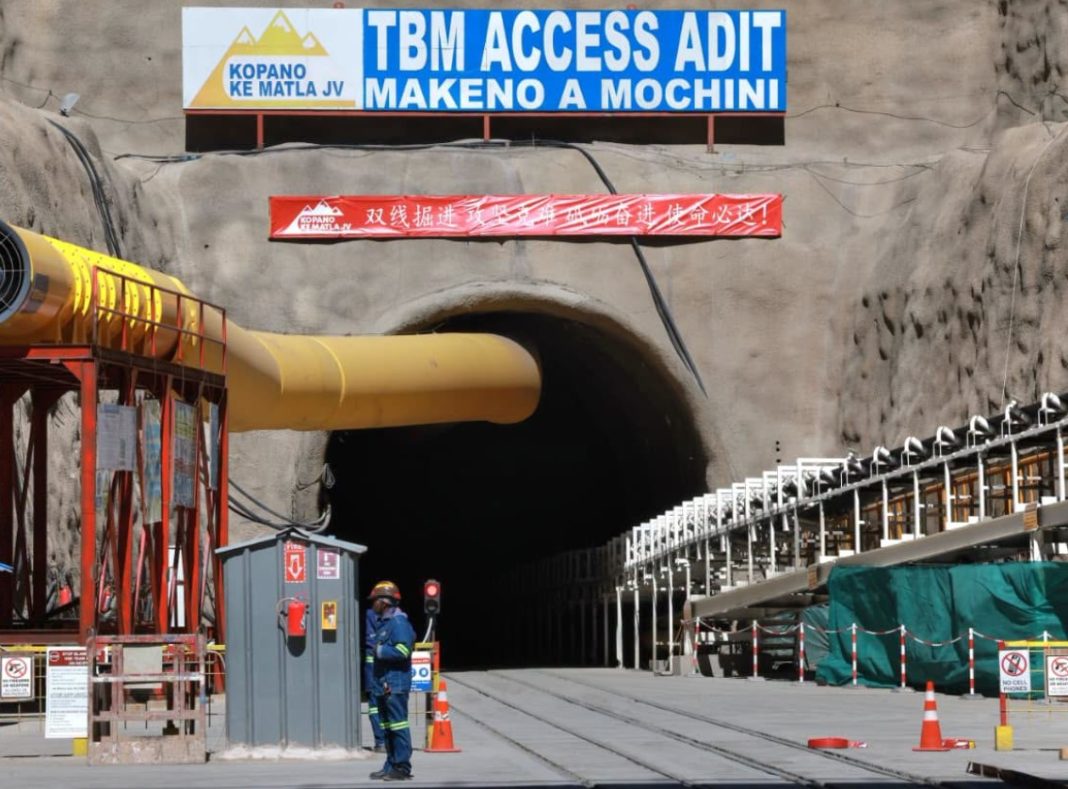
The central focus of the project is a 38.5-km transfer tunnel linking the Polihali and Katse dams into a gravity-driven water system that will move water “without a single pump”.
She said the launch marked a shift “from preparation to full-scale underground progress” after years of preparatory work, including the completion of access adits, construction of assembly chambers and the earlier launch of the first tunnel boring machine at Katse in January 2025.
Majodina said excavation was now advancing from both ends of the tunnel alignment, with “over 600 metres excavated from the Katse side” and “over 380 metres from Polihali”.
She said the project’s significance lay in its direct impact on water and energy security.
“Water security is no longer a distant concern. It is a present necessity,” she said.
“Through this tunnel, water transfer will increase from 780 to 1,270 million cubic metres per annum. At the same time, energy generation at the ‘Muela Hydropower Station will increase by approximately 30 percent.
“This is not incremental change. This is a step-change in regional resilience — for both the Kingdom of Lesotho and the Republic of South Africa.”
The tunnel boring machine is 423 metres long with a 5.38-metre cutterhead. It will operate beneath mountains rising above 3,000 metres, under rock cover exceeding 500 metres, and in some sections, 1,000 metres of overburden.
“This is not just excavation. It is precision engineering under pressure,” she said.
She also used the occasion to highlight the project’s developmental benefitsfor Lesotho, saying it was designed to deliver jobs, skills, and procurement opportunities.
“But beyond engineering, this project is about people. It is about opportunity. It is about empowerment,” Majodina said.
According to her, about 2,400 Basotho are employed on the project, most of them local workers, while more than 1,100 individuals have received skills training, and more than 700 have been certified.
She said local economic participation had already exceeded M600 million, with procurement and enterprise development benefiting Basotho and regional businesses, including black-owned firms.
“This is not incidental. It is intentional. This is how infrastructure builds nations,” she said.
Majodina also delivered a warning on governance, saying large infrastructure schemes had to be matched by accountability and value for money.
“Projects of this magnitude demand more than technical excellence. They demand discipline. They demand accountability. They demand integrity,” she said.
“There will be no tolerance for corruption. No tolerance for inefficiency. Every Maloti invested — in this R9.2 billion project — must deliver value to the people of Lesotho and South Africa.”
INSIDE POLITICS





