
By Johnathan Paoli
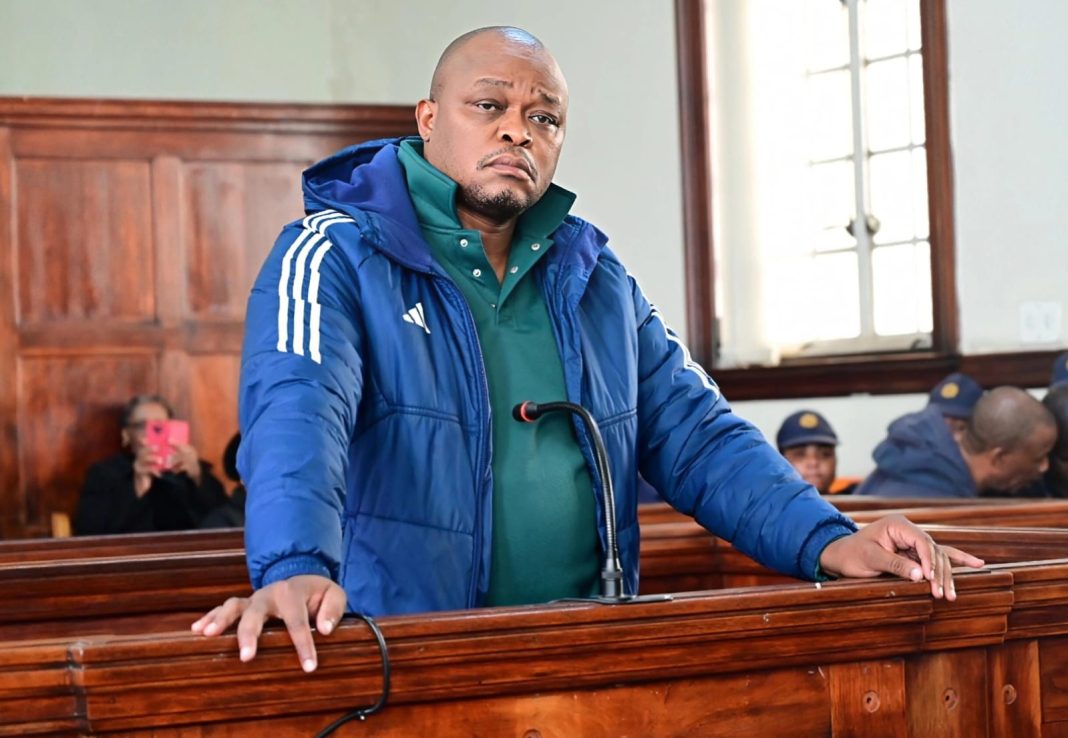
As the bail application of alleged political fixer Brown Mogotsi continues, the State has alleged that eyewitnesses saw him shoot at his own vehicle before falsely claiming he had survived an assassination attempt.
Appearing in the Johannesburg Magistrate’s Court on Thursday, prosecutor advocate Thami Mpekana argued that Mogotsi should remain behind bars because witnesses allegedly saw him stop his Chevrolet in Vosloorus in November last year, get out of the vehicle and fire several shots at it before reporting the incident as an attempt on his life.
“The submission of the state is that there are eyewitnesses who saw the car stop and (Mogotsi) fired a few shots towards the car,” Mpekana said.
The allegations form the basis of charges against Mogotsi, including defeating the ends of justice, perjury, unlawful possession of a firearm and ammunition, and discharging a firearm in a public place.
Mogotsi was arrested earlier in the month in connection with what investigators allege was a staged assassination attempt after his Chevrolet was found riddled with bullets.
Mpekana argued that the circumstances surrounding the alleged shooting raised serious concerns about Mogotsi’s credibility and cooperation with police investigations.
“He gives his statement through an attempt 10 days thereafter. This is the person who is fearing for his life,” Mpekana said.
The prosecutor said that police initially regarded Mogotsi as a victim, but their investigation later shifted after inconsistencies emerged.
“It is at that time when he was contacted by the police that he was aware that the police have now established that he is no longer a witness,” Mpekana said.
CCTV footage from the area allegedly showed no other vehicles near Mogotsi’s car at the time of the shooting.
“At the time, the person was lying on the ground. He was alone in the car, there were no passengers. CCTV also indicated that there wasn’t any other car that had tailed the applicant,” Mpekana said.
The firearm allegedly used in the shooting has not yet been recovered.
Mpekana argued that investigators struggled to trace Mogotsi after the incident, with police allegedly being told at one stage that he had died.
“The investigating officer had gone to Mmabatho and also to his place of business and was told that he is dead,” he said.
Proceeding also focused on disputes over Mogotsi’s residential address, with prosecutors arguing that investigators had still been unable to properly verify where he lived.
The case had previously been postponed to allow police to investigate an address supplied by Mogotsi through his legal team.
Reading from a supplementary affidavit compiled by the investigating officer, Mpekana said police visited a property linked to Mogotsi but found inconsistencies.
“A pin location was supplied as per the applicant’s supplemental statement placed before the court. At the pin location of the left-hand side, I found a residential address. There was no street number displayed at the house,” the affidavit stated.
The investigating officer said he met a woman identified as Dorothy Ledwaba, who allegedly confirmed she had submitted an affidavit supporting Mogotsi’s residential claims.
However, prosecutors said the street number she provided differed from the number appearing in court documents.
“She was requested to point out the personal property of the applicant and she pointed out minimal clothing in the main bedroom. She could not produce any personal documentation or other belongings of the applicant,” the affidavit read.
Mogotsi’s legal team strongly rejected the State’s arguments, insisting that the accused remained presumed innocent and had adequately demonstrated that he could be traced.
Defence advocate Makau Sekgatja argued that Mogotsi was a prominent public figure who could not simply disappear.
“He’s a well-known businessman and he’s a public figure. The applicant has also previously appeared before public institutions. This includes the Madlanga Commission of Inquiry and has engaged with parliamentary processes. The applicant is not a person capable of disappearing into anonymity. His identity, movements and public activities are widely known and readily traceable,” Sekgatja said.
He challenged the State’s claims regarding discrepancies in Mogotsi’s lease agreement and residential documents, arguing that investigators had overlooked supporting evidence, including affidavits, GPS pin locations, WhatsApp communications and municipal records.
Sekgatja dismissed the State’s reliance on the “minimal clothing” allegedly found at the property.
“Is there a formula in terms of the number of items you need to find in a particular house? A person can have three or four items, but it does not mean they do not stay there,” he said.
The defence further submitted that Mogotsi had substantial business and family ties to South Africa and was not a flight risk and told the court Mogotsi could afford bail of R10,000.
Judgement was reserved with proceedings to continue on 4 June, while Mogotsi remains in custody.





