
Staff Reporter
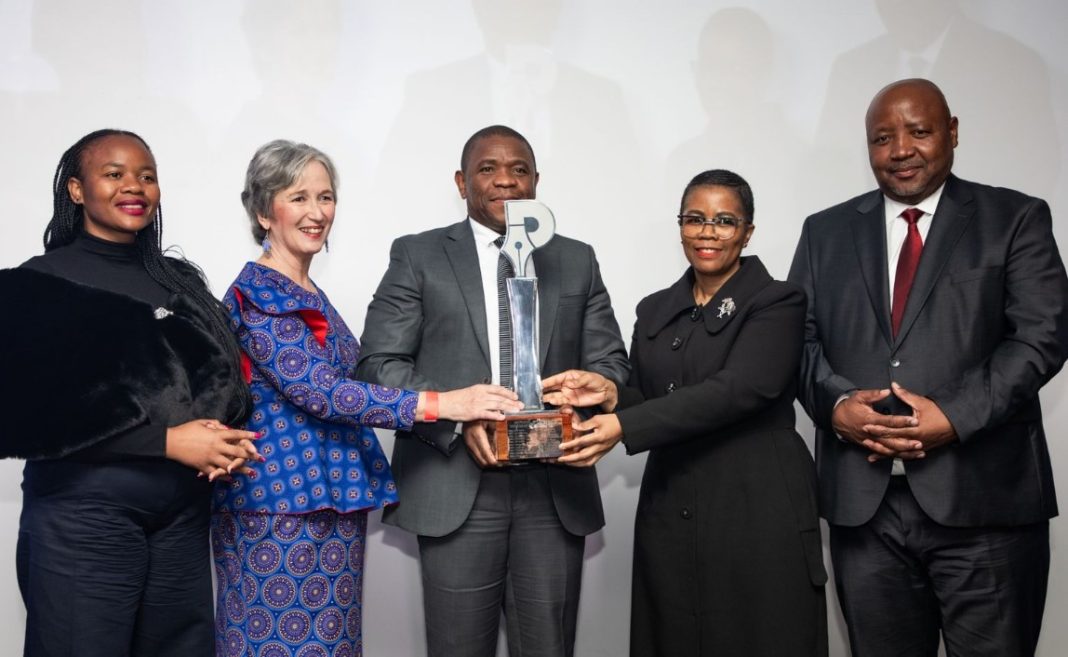
KwaZulu-Natal police commissioner Lieutenant-General Nhlanhla Mkhwanazi warned that South Africa was at a “crossroads” over corruption and compromised institutions, using his acceptance of the National Press Club’s 2025 Newsmaker of the Year award to defend his July 2025 media briefing that triggered the Madlanga Commission.
Speaking at the press club’s gala dinner at the CSIR International Convention Centre in Pretoria on Friday night, Mkhwanazi said his 6 July 2025 briefing was not an attempt to court popularity, but an act of duty.
“The media briefing of 6 July 2025 was not an exercise in popularity. It was not a campaign. It was not an attempt to become a public figure. It was an act of duty,” he said.
His remarks came on the same day the Madlanga Commission submitted its second interim report to President Cyril Ramaphosa, marking a new stage in the inquiry into allegations of criminality, political interference and corruption in South Africa’s criminal justice system.
“When institutions begin to fear the truth more than they fear criminality, society enters dangerous territory,” Mkhwanazi said. “South Africa is standing at such a crossroads.”
He added: “The truth is painful; A capable state cannot coexist with compromised institutions.”
Mkhwanazi was named the newsmaker of the year after his July briefing placed allegations of criminal infiltration of law enforcement and intelligence structures at the centre of South Africa’s political and criminal justice debate.
In that briefing, Mkhwanazi alleged the existence of a sophisticated criminal syndicate that had infiltrated law enforcement and intelligence structures. He also alleged that then-police minister Senzo Mchunu had interfered in sensitive police investigations and colluded with business people to disband the KwaZulu-Natal political killings task team.
Mchunu has denied the allegations. Ramaphosa later placed him on leave and announced the judicial commission of inquiry, chaired by Justice Mbuyiseli Madlanga, to investigate the claims.
Said Mkhwanazi during his speech: “We cannot continue to normalise corruption. We cannot continue to protect incompetence. We cannot continue to romanticise criminality while honest citizens live behind burglar bars, businesses collapse under extortion, communities are terrorised by organised crime and public trust in institutions continues to erode.”
He said the “spring cleaning” confronting the criminal justice system should not be selective and must extend across government departments, municipalities, law enforcement agencies, the private sector and the media.
“If South Africa is serious about a national reset, then that reset must include all of us; political leadership, law enforcement, the judiciary, business, civil society and the media,” he said. “No institution can place itself above scrutiny while demanding accountability from others.”
Mkhwanazi said accepting the award should not be read as a sign that “all is well” in the country.
“It is precisely because all is not well that every one of us must recommit ourselves to making it well,” he said.
He accepted the award on behalf of police officers, detectives and members who, he said, continued to serve despite intimidation, limited resources and criticism.
“There are many honest and committed police officers in this country. Men and women who refuse to surrender this organisation to corruption, criminal infiltration or institutional decay,” he said.
“History will not judge us by the titles we held, the awards we collected or the speeches we delivered. History will judge us by whether we defended the truth when it mattered.”
INSIDE POLITICS





