

By Johnathan Paoli
Congress of South African Trade Unions (COSATU) President Zingiswa Losi has appealed to the National Education, Health and Allied Workers’ Union (NEHAWU) to remain a pillar of the federation, while the union’s own leadership used its national congress to sharply criticise what it described as COSATU’s recent ideological “flip-flopping” and drift from its revolutionary traditions.
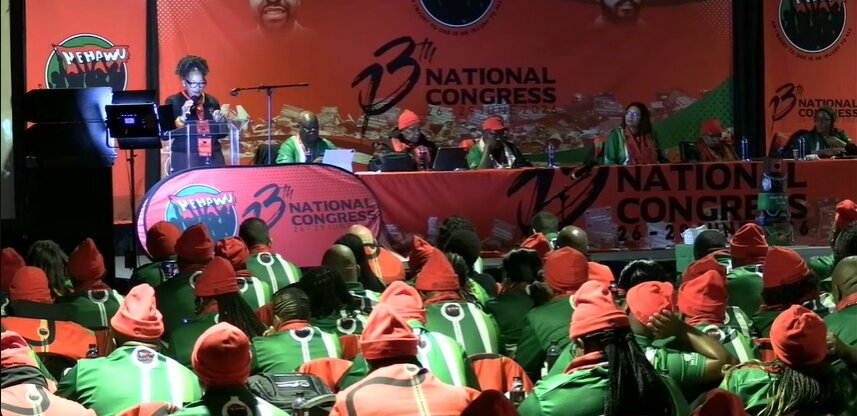
The contrasting messages emerged on the second day of NEHAWU’s 13th National Congress in Boksburg, where Losi stressed that COSATU’s strength depended on its largest affiliates, while General Secretary Zola Saphetha’s political report accused elements within the federation of diluting its Marxist-Leninist orientation and succumbing to political patronage.
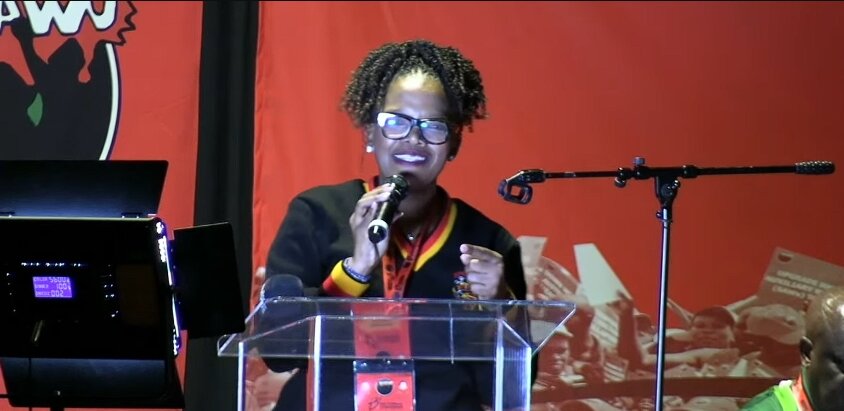
Addressing delegates, Losi described NEHAWU as indispensable to the federation’s future.
“We are now heading to our COSATU National Congress in September. We need NEHAWU to continue to be a source of revolutionary ideas and a defender of COSATU and workers’ unity,” she said.
“COSATU can only be as strong as our affiliates. We are confident NEHAWU will continue to be a defender and an engine of the federation. We need to see a fighting, a militant, a coherent, and a united NEHAWU emerge,” Losi added.
Losi reminded delegates that the relationship between COSATU and NEHAWU had been forged over decades of struggle.
“We are indeed, as this federation, humbled that throughout the journey of toil and sacrifice, COSATU and NEHAWU have stood as one. This is a unity of the working class that is grounded in ideological consciousness, in pursuit of the principles of scientific socialism, and whose unity, comrades, must always be jealously guarded. We dare not take our affiliates, our federation, our alliance for granted,” she said.
She argued that South Africa’s economic crisis required labour movement unity rather than division, saying workers faced high unemployment, poverty and the effects of austerity measures.
“The working class is under siege,” Losi said, warning that that the country “cannot continue naively upon a path of neoliberal and reckless austerity budget cuts,” she said.
Losi defended COSATU’s strategy of engaging government through the National Economic Development and Labour Council (Nedlac), rejecting calls for organised labour to abandon social dialogue.
“Some comrades chose to run away from engaging at NEDLAC. But as this federation, we stayed and persevered and succeeded, securing agreements to double severance pay, to expand maternity and paternity leave, to extend labour protection to vulnerable workers, to protect the minimum wage from deductions, and most critically, to defend our hard-won rights,” she said.
Losi further reaffirmed COSATU’s commitment to the Tripartite Alliance.
“Our alliance with the African National Congress, the leader of the Liberation Movement and the South African Communist Party is not a fair-weather friendship. It is the most effective and the only vehicle we have to ensure the total emancipation of the working class,” she said.
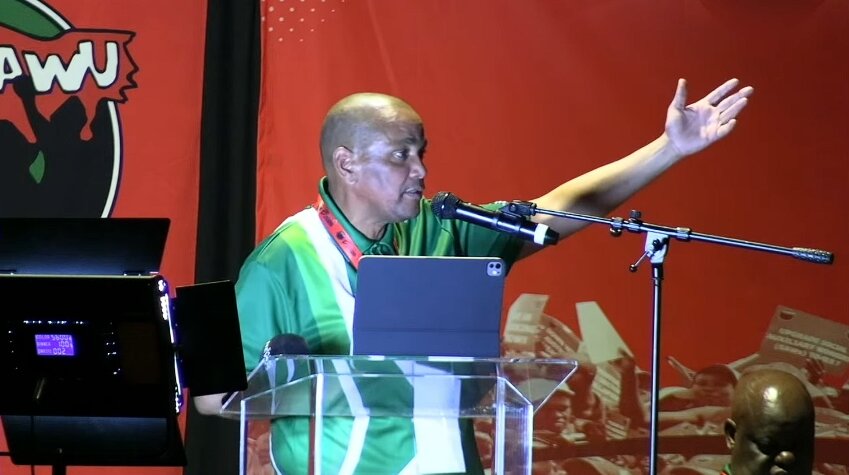
However, while welcoming COSATU’s leadership to congress, Saphetha’s Secretariat Overview Report painted a markedly different picture of the federation’s recent ideological direction.
The report praised NEHAWU’s revolutionary roots while accusing sections of COSATU of abandoning those traditions.
“As NEHAWU, we are a trade union that is proudly born out of the traditions of Marxism-Leninism, class-orientation and shop-floor militancy. We are proud to unwaveringly uphold and respect our revolutionary roots which are also consistent with the founding ideological and political principles of our federation, COSATU,” Saphetha said.
But the report immediately contrasted that history with what it described as the federation’s current trajectory.
“Unfortunately, the revolutionary traditions and identity of our federation have recently been challenged. In fact, we can even say that the revolutionary traditions and identity of our federation have already been corrupted by expedient moves to dilute the ideological outlook of the federation by a right-wing opportunist tendency, whose reformism has put it under the pressure of political patronage from a dominant faction within the ANC),” Saphetha read.
The report went further, accusing parts of the ANC of creating divisions within organised labour, adding that the party had encouraged sections of COSATU to undermine congress decisions in favour of factional interests.
Saphetha also criticised what he characterised as COSATU’s inconsistent ideological positioning on the international stage, saying NEHAWU had helped push the federation towards closer relations with the World Federation of Trade Unions.
“Our federation, COSATU, has had to begrudgingly accept WFTU affiliation, at last implementing several congress resolutions that directed it to do so,” the report stated.
The report argued that ideological tensions had also surfaced during recent public sector wage disputes.
“Unfortunately, during this time some of the long suppressed ideological cracks surfaced within the ranks of the COSATU public service unions, as one craft union exposed its true and inherent ideological colours in finding a common course with other similar unions outside the ranks of the federation.” the union was not named but apart from Nehawu, Cosatu has six public service unions incuding the South African Democratic Teacher Union (SADTU) and Democratic Nurses of South Africa (DENOSA).
While Losi urged affiliates to strengthen COSATU ahead of its September congress, Saphetha’s report signalled that debates over the federation’s ideological direction, alliance politics and organisational strategy are likely to feature prominently as NEHAWU delegates deliberate over the next four days.
Despite the contrasting tone, both leaders agreed that organised labour faces mounting economic and political challenges requiring a stronger, more militant workers’ movement capable of defending collective bargaining, resisting austerity and advancing the interests of South Africa’s working class.
The congress adjourned for lunch, with the rest of the day divided into commissions discussing the General Secretary’s report and will close on Monday.