
By Charmaine Ndlela, Johnathan Paoli and Lebone Rhoda Mosima
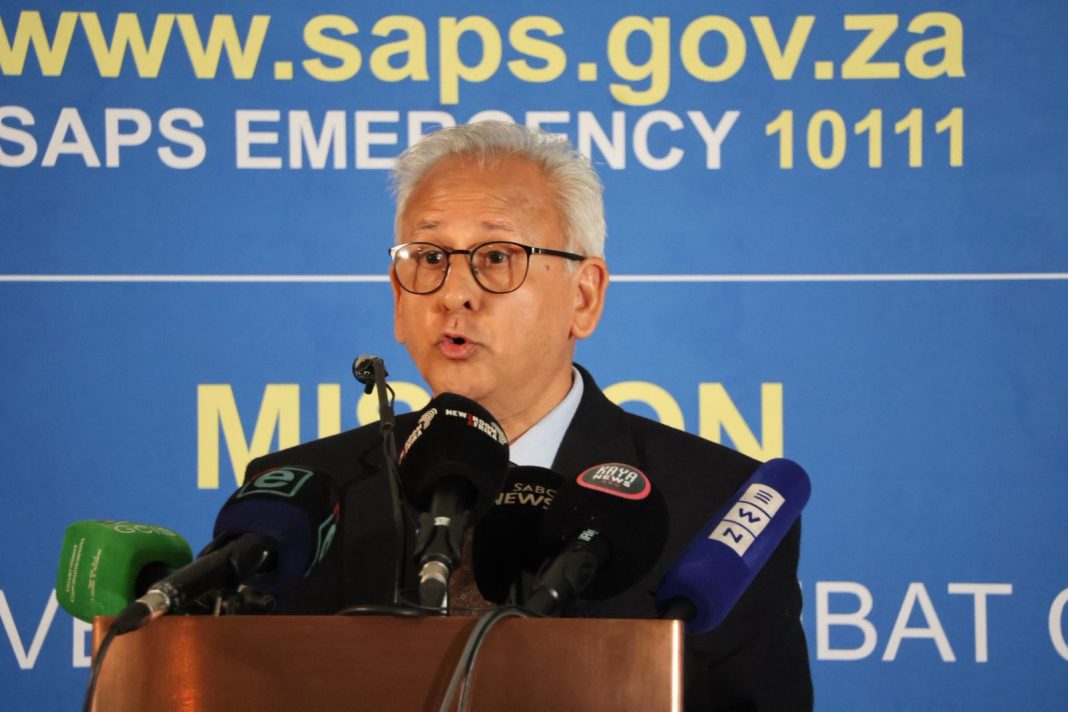
Acting police minister Firoz Cachalia on Tuesday warned that South Africa’s nationwide anti-illegal immigration protests appeared to be evolving into a political campaign ahead of next year’s local government elections, as isolated outbreaks of violence in Germiston contrasted with largely peaceful demonstrations across much of the country.
Addressing a post-protest media briefing in Pretoria, Cachalia said government recognised that South Africans had legitimate concerns about illegal immigration, crime, border management and unemployment, but the announcement by organisers that demonstrations would continue every Thursday until the local government elections suggested a broader political agenda.
“These marches will continue each Thursday until the next local government election. That suggests to me there are some involvement in mobilising sentiment around genuine grievances that are genuine, but that there is also a political dimension. That they is political dimension that this may be part of a project to mobilise politically as a lead-up to the local government election,” he said.
“So it’s a genuine grievance, but there also appears to be a political agenda.”
Cachalia said government remained committed to addressing illegal immigration through democratic institutions while maintaining national unity.
“We have emphasised the unity of our people and that we must address the genuine grievances around illegal immigration through a conversation between government and our people. Under the leadership of Minister Kubayi and the Inter-Ministerial Committee, we remain committed to addressing these important issues,” he said.
He warned that although peaceful protest is protected by the Constitution, police would act decisively against criminal conduct linked to the demonstrations, including alleged incitement and other offences.
“We have been consistent in our message that we’re going to enforce the law, the laws relating to immigration and irregular migration. We are going to enforce the law against criminal conduct. And I think you can expect to see, after June the 30th, action being taken by the police to ensure that those who are guilty of incitement and other forms of criminality, um, will be arrested and prosecuted,” Cachalia said.
Responding to widespread claims that government had spent R600 million policing Monday’s protests, Cachalia said the figure had been misunderstood.
“There is no additional budget for these costs and certainly not R600 million spent on one day or one operation. But I think our people have to understand that when there are periods of instability and threats of shutdowns and so forth, the right thing to do by the police is to take preventative action, and to be prepared to make the recall resources available for maintaining peace and security in the country,” he said.
While violence flared in parts of Gauteng, demonstrations across Mpumalanga remained largely peaceful despite attracting thousands of participants.
Police spokesperson Brigadier Donald Mdluli said an estimated 5,000 people joined the main anti-illegal immigration march in Mbombela.
The procession started in the Nelspruit CBD before moving through the city to the Mbombela Civic Centre, where protesters handed over a memorandum to executive mayor Sibongile Makhushe, who accepted the document and addressed demonstrators before they dispersed peacefully.
Smaller demonstrations were also held in Piet Retief, Mayflower, Volksrust, Kinross and Trichardt.
Meanwhile, about 150 protesters gathered outside the Sabie Magistrate’s Court during the appearance of an Eswatini national accused of fatally stabbing a South African man.
Police said the accused appeared on a murder charge and the case was postponed to 14 July to allow consultation with legal representatives.
No incidents were reported in Sabie.
In Lydenburg, residents participating in anti-illegal immigration protests apprehended two suspected drug dealers believed to be foreign nationals before handing them over to police, according to authorities.
Mdluli said Public Order Policing units monitored demonstrations across the province and, apart from Trichardt, where protesters remained on the streets into the afternoon, gatherings dispersed peacefully.
The calm in Mpumalanga contrasted sharply with events in Germiston, where anti-illegal immigration protests descended into sporadic violence after breakaway groups allegedly forced their way into homes in Delville and the Germiston CBD, demanded identity documents, assaulted residents and looted property before police fired rubber bullets to restore order.
The unrest marked a dramatic escalation from an earlier peaceful march, with members of the South African Police Service (SAPS), the Ekurhuleni Metropolitan Police Department (EMPD) and private security companies responding to multiple flashpoints across Germiston, Delville and Primrose.
Several people were detained following incidents of looting and vandalism, while police recovered stolen property, including cellphones and a Bluetooth speaker allegedly taken from foreign nationals.
Police also handed several individuals over to immigration authorities after residents detained people they suspected of being undocumented foreign nationals.
Witnesses described protesters moving from house to house in Delville, forcing residents outside for identity checks regardless of whether they were documented, children or elderly.
One Tsonga-speaking family was allegedly harassed before their home was looted.
Two people were reportedly injured during clashes, with one later transported to hospital by ambulance.
Earlier, protesters gathered outside a building on President Street in the Germiston CBD, claiming undocumented foreign nationals were living there and that drugs were being sold from the premises.
Organisers later told demonstrators no undocumented foreign nationals had been found inside, but violence erupted shortly afterwards.
A breakaway group later gathered outside a building in Primrose, alleging it was linked to drug trafficking, although police prevented demonstrators from entering the property.
Meanwhile, hundreds of Zimbabwean nationals queued outside the Zimbabwean Consulate in Bedfordview as buses continued transporting people to the Beitbridge border post.
Officials processed passengers in groups before their departure.
Cachalia praised law enforcement agencies for their handling of Monday’s nationwide demonstrations, saying most had remained peaceful and that police had exercised restraint.
He also dismissed claims circulating on social media that government had spent R600 million policing the protests, saying the figure had been taken out of context and reflected broader operational costs associated with maintaining public order rather than expenditure on a single day’s operation.
Minister in the Presidency Khumbudzo Ntshavheni said government was not concerned by organisers’ announcement that demonstrations would continue every Thursday, noting that protests had been taking place throughout June and that authorities remained focused on maintaining public safety while advancing the National Dialogue process initiated by President Cyril Ramaphosa.
Justice and Constitutional Development Minister Mmamoloko Kubayi said government would continue implementing Ramaphosa’s migration management strategy and insisted efforts to tackle illegal immigration had begun well before the June protests.
She said government had recently repatriated 4,286 foreign nationals and deported a further 419 undocumented immigrants as part of ongoing enforcement operations. Police also arrested 361 undocumented foreign nationals, made 291 common-law arrests and recorded four drug-related arrests during Monday’s nationwide operations.
Kubayi condemned isolated incidents of looting and vigilantism, warning that those responsible would face the full might of the law.
She also appealed to South Africans to reject xenophobia and report corruption involving Home Affairs officials rather than taking the law into their own hands.
ANC first deputy Secretary-General Nomvula Mokonyane said the violence in Germiston risked undermining the broader concerns that had drawn thousands of South Africans onto the streets.
She called for intelligence-led policing to dismantle criminal syndicates involved in drug trafficking and human trafficking while urging residents to work through community policing structures instead of resorting to vigilantism.
“A family cannot now be traumatised. Don’t take the law into your own hands. Do it within the confines of the law,” Mokonyane said.
INSIDE POLITICS





